Skip to content

Southern Italian Surnames: Meanings, Regions, and Girl Name Ideas
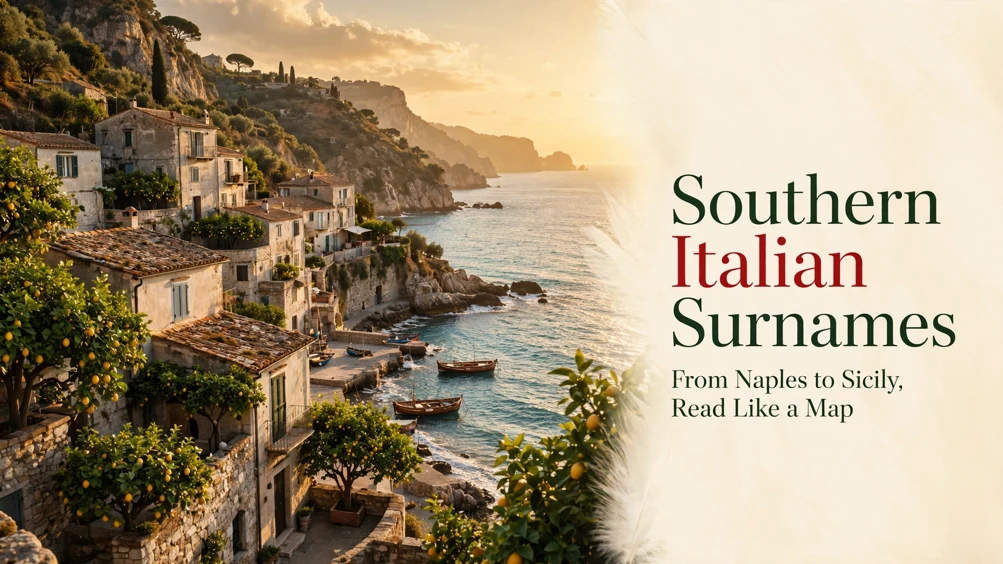
Southern Italian surnames are read like a map, not like a list, because a single ending, prefix, or article can point to Campania, Calabria, Puglia, Basilicata, or Sicily. This guide defines the south up front, gives a 30-second reading key, then walks region by region through verified names, with girl framing and honest uncertainty labels throughout.
It links early to the Italian girl names pillar, so you can pair a southern surname with a first name from the same tradition.
What Southern Italian Means Here
The core south, the Mezzogiorno, means Campania, Calabria, Puglia, Basilicata, Molise, and Sicily in the definition used here, with Abruzzo as a border case. Some narrower definitions count Abruzzo and Molise as central Italy, so this article puts them in a short border box rather than silently including or excluding them. Sardinia is treated separately, not as mainland south, because it is a western Mediterranean island with its own language and surname system.
One warning runs through the whole guide: a surname is a clue, not proof. A southern surname can record a northern origin, as Lombardo does, or a move away from a town, as Napolitano does, and only records, town first, then parish and civil records, can prove one family’s story. No competitor page in this research owned the exact keyword with a region-by-region southern guide, which is the gap this article fills.
How to Read a Southern Surname in 30 Seconds
Four clues place most southern surnames at a glance. Endings come first: singular -o forms cluster in the south, as in Russo and Esposito, while plural -i forms cluster in the north and centre, as in Rossi and Bianchi, but this is a tendency, not a law. Greek -o and -a endings, as in Tripodi, Macrì, and Laganà, point to Calabria, Puglia, and Sicily, while southern occupational -aro, as in Ferraro, contrasts with northern -aio, and southern diminutives -ello and -illo contrast with northern -otto and -etto.
Prefixes come second: De, Di, and D are southern patronymic workhorses, as in De Luca, Di Stefano, and D’Angelo, where De and Di mean of or son of and D is the elided form before a vowel. Article forms come third: Lo, La, and Li fused forms, as in Lo Russo, La Rosa, and Li Causi, are a southern and Sicilian habit, rare in the north.
Layers come fourth: Greek, Latin, Arabic, Norman, Spanish, and Arbëreshë layers each leave markers, and the layers section below shows how to spot them without overstating any single layer.
The Names Every Southern Family Recognizes
A pan-southern core list anchors the whole guide, since these names appear across the south rather than in one region only. Russo is the single most important correction in the article, since it means red, from Late Latin russus, the southern form of northern Rossi, and it does not mean Russian. Esposito is the foundling name, from Latin expositus, exposed, centred on Naples, where the first Esposito was registered on 1 January 1623, but a surname alone does not prove a particular ancestor was a foundling, since records decide that.
| Surname | Meaning | Origin | Pronunciation |
|---|---|---|---|
| Russo | Red, red haired, southern form of Rossi, not Russian | Campania, Sicily, Puglia, Calabria | ROO-soh |
| Esposito | Exposed, foundling name, Naples centre, variants Esposto and Sposito | Campania, Naples | eh-SPOH-zee-toh |
| Greco | Greek, Greek descent or Byzantine rite | Puglia, Calabria, Sicily, wider south | GREH-koh |
| Grieco | Greek, southern variant of Greco | Basilicata, Calabria, Campania | GREE-eh-koh |
| Romano | From Rome, or from the Latin personal name Romanus, ambiguous | Italy-wide | roh-MAH-noh |
| Marino | Of the sea, or from the personal name Marinus, ambiguous | Calabria, Sicily, coastal Campania and Puglia | mah-REE-noh |
| Ferraro | Blacksmith, ironworker, southern -aro form | Campania, Calabria, Puglia, Basilicata | fer-RAH-roh |
| Rizzo | Curly, southern form of Ricci, not Arabic | Sicily, Calabria, Campania | REET-tsoh |
| Caruso | Sicilian boy or young apprentice, Campania shorn hair, regional variants, see Campania section | Sicily and Campania | kah-ROO-zoh |
| De Luca | Son of, or house of, Luca, Luke | Campania, Sicily, wider south | deh LOO-kah |
| De Santis | Of the saints, devotional, or near a church, American spelling DeSantis | Puglia, Campania, Abruzzo, Molise | deh SAHN-tees |
| Santoro | Holy or saintly, traditionally linked to All Saints Day, not proven for every family | Campania and Puglia | sahn-TOH-roh |
| Lombardo | The Lombard, a northern settler or migrant, proving a southern name can record a northern origin | Sicily and wider south | lom-BAR-doh |
| Calabrese | From Calabria, given after a family moved away | South and diaspora | kah-lah-BREH-zeh |
| Pugliese | From Puglia, mainland form, with Puglisi as the Sicilian and Neapolitan -isi form | Puglia and Sicily | poo-LYEH-zeh |
Campania: Naples and the Foundling Name
Campania is the Naples story, and Esposito is its anchor, but the region is far more than one name. Russo clusters in Naples and Campania, Giordano is linked in popular guides to the Jordan name and Norman settlement, with the crusader detail kept hedged here since it is not independently verified, and a run of toponymics, Sorrentino from Sorrento, Amalfitano from Amalfi, Salernitano from Salerno, and Napolitano from Naples, all follow the same pattern: the name was usually given after a family moved away from the town.
Trade names complete the Campania picture, with Marinaro for a sailor, Pastore for a shepherd, and Sarto for a tailor, plus Ferraro and Ferrara for ironworking families. Caruso needs both regional glosses, since Sicilian carusu means boy or young apprentice, while old Neapolitan caruso meant shorn, closely cropped hair, and neither gloss cancels the other.
Tenor Enrico Caruso, born in Naples in 1873, is a Campania bearer note, not a girl example, and the sulphur mine carusi history for Sicily is handled sensitively in the Sicily section, not as a fun fact.
Calabria: The Greek Toe
Calabria is the Greek toe, where Magna Graecia colonies and later Byzantine Greek speakers left -o and -a endings that have no northern equivalent. Tripodi, Macrì, and Laganà are Greek-origin names in this group, with Tripodi possibly from Tripodion, small tripod, and Laganà carrying a herb seller tradition, both kept hedged here since the sources hedge them. Foti, from Greek Photios, light, is verified for Calabria and Sicily, while Arcuri, from archegos, leader, is kept as probable, not certain.
Calabria also gives the strongest mainland Arabic example, Morabito, from Arabic murabit, holy man or hermit, verified across sources for Calabria and Sicily, and the noble name Ruffo, red haired, whose verified female bearer is Paola Ruffo di Calabria, Queen Paola of Belgium. Toponymics anchor the chapter too, with Calabro from Calabria, Cosentino from Cosenza, Reggio from Reggio Calabria, Rossanese from Rossano, Catanzariti from Catanzaro, and Scigliano from the town of Scigliano.
A noble group, Spinelli, Pignatelli, De Nobili, and others, is presented as a group only, without individual glosses that the sources did not verify.
Puglia: The Heel and the Adriatic
Puglia is the heel and the Adriatic, where article forms and eastern Mediterranean links dominate. De Santis clusters in Bari, Taranto, and Brindisi, Lorusso means the red, Lo plus Russo, in Bari and nearby areas, Loiacono means the deacon, and Loiodice means the judge, all teaching the Lo article pattern in one place. Santoro, Leone, and Greco cluster in Puglia as well, reflecting the region’s eastern Mediterranean connections.
Semeraro is a Puglian occupational name, for someone who led pack animals or a trade caravan, more common in Apulia than elsewhere, while Elmo, possibly Germanic for helmet, is usable through Cloe Elmo, soprano of Lecce, with the hedge intact. A Puglia frequency group, Fanelli, Nardelli, Laricchia, Di Palma, Convertini, Triggiani, and Tanzarella, is listed as a frequency group only, since individual glosses were not verified in the research pass and are not invented here.
Colucci is marked uncertain, since a rival table’s gloss for it is not usable, and Martino’s warrior gloss is marked uncertain for the same reason.
Basilicata: The Quiet Heart of the South
Basilicata, the quiet heart of the south, is Lucania in older usage, and its names reward patience, since several are high-frequency markers with unverified glosses. Grieco leads the region in dataset counts, with Pace for peace, Palumbo for dove, Ferrara for ironworking, Lauria from the town of Lauria, and Stigliano from the town of Stigliano as verified or probable anchors. Dataset counts are not a census, so no headcount is published as a current population fact here.
The marker-only group, Santarsiero, Cifarelli, and Paolicelli, is listed as Basilicata markers without invented meanings, since no verified gloss was opened for them, and the same rule holds for Mecca and Sabia, which are listed only as frequency names, not with guessed meanings. That restraint is deliberate: a guide that invents a meaning for a Basilicata name to fill a table is less useful than a guide that says plainly which names still need a dictionary check.
Sicily in Brief, and Why It Gets Its Own Page
Sicily gets only a brief section here, because the site already has a full Sicilian surnames page, and repeating it would duplicate that work. Only the Sicily names that teach a south-wide point appear below, with the full Sicily guide linked for readers who want the island in depth.
The Arabic examples are Vadalà, from Abd Allah, servant of God, Sciortino, from Sicilian sciurta, city watchman, from Arabic shurtiyy, policeman, and Favara, from fawwara, spring or fountain, while Giuffrida, from Norman Germanic Goffredo, Geoffrey, and Catalano, the Catalan, teach the Norman and Spanish layers. The Puglisi and Pugliese pair teaches regional spelling, since the same Puglia origin takes a mainland form and a Sicilian and Neapolitan -isi form.
Bella, the feminine form of Bello, beautiful, is the clearest feminine form example in the Sicily material, and it belongs in the girl section below. Arbëreshë names Schirò and Matranga, clustered in Piana degli Albanesi near Palermo, settled in 1488, teach the Italo-Albanian layer, with the caution that they are research leads, not proof of an individual’s ancestry.
The Layers Under the Names
Layers are a reading key, not a copy of the Sicily page, which organizes by layer for one island, while this article organizes by region first and layer second. Greek and Byzantine markers are Greco, Grieco, Foti, Tripodi, Macrì, and Laganà, plus -eo, -iti, and -oti toponymics. Latin and Roman markers are the deepest layer under everything, with Russo, Marino, Vitale, Pace, Palumbo, Amato, Ferraro, and Pastore, plus the De and Di patronymic system itself.
Arabic markers are strongest in Sicily, from 831 to 1091, and real but thinner on the mainland, where Morabito is the strongest example, so the Arabic layer must not be inflated on the mainland. Norman and Swabian markers are Giuffrida and Giordano, hedged, Spanish and Aragonese markers are Catalano and the Spanish-inflected saints names, and Arbëreshë markers are Schirò, Matranga, Mandala, Albanese, and Schipa.
Bourbon and Kingdom of Naples names, Ruffo, Spinelli, and Pignatelli, belong in the political frame that held the mainland south together, not in a generic old family bucket.
North Versus South: The Endings and Prefixes That Give It Away
Five pairs teach the north versus south contrast in one glance. Rossi and Russo split the same red root into a northern and central plural and a southern singular, Ricci and Rizzo split curly the same way, Mancini and Mancuso split left handed, Bianchi and Bianco split white, and Ferrari and Ferraro split ironworking, with Ferraro as the southern -aro form.
Northern patronymics more often use bare plurals, as in Mariani and Bernardi, or -i forms without a prefix, while southern patronymics use De, Di, and D, as in De Luca and D’Angelo.
Sardinia breaks the mainland rules entirely, which is why it gets a contrast box, not a mainland row. Sardinian names such as Sanna, Piras, Pinna, Melis, and Manca come from the Sardinian language, with endings -u, as in Porcu, -as, as in Piras, and -is, as in Melis, distinct from mainland -o and -i patterns. Folding Sardinia into the mainland south, as thin competitor surveys do, hides the one system that explains why Sardinian names look different.
Southern Surnames in America and Beyond
From 1880 to 1924, more than four million southern arrivals reached the United States, with further migration to Argentina, Brazil, Canada, and Australia, and Americanization followed clear patterns: final vowels dropped, spaces dropped, as in De Santis to DeSantis and Di Palma to Palma, plus phonetic respelling and, rarely, translation.
The Ellis Island myth, that inspectors invented new names at Ellis Island, is debunked by stronger guides with National Park Service sources, since inspectors checked manifests prepared at departure and did not invent names. Changes came from personal choice, clerical spelling, translation, or later legal action.
For readers tracing a southern name, the order is town first, then parish and civil records, then the Antenati portal, since a surname alone, even a rare one, does not prove a town or a layer. A name such as Calabrese proves only that a family was once identified with Calabria after moving, and a name such as Lombardo proves only a northern link in the family’s past, not a current northern home.
For a Girl: Keeping, Honoring, and Choosing a Southern Surname
Italian surnames do not change by gender in modern use, so a girl keeps Russo, Esposito, or Greco exactly as her family spells it, and readers searching for girl names often expect a feminine form that does not exist for surnames.
The honest exceptions are Bella as the feminine form of Bello, La Rosa, La Barbera, and La Mantia as La article forms that read as feminine, and Di Maria as a matronymic route through a female name. These are exceptions, not a general rule, and no feminine version should be invented for a surname that has none.
A southern surname works as a girl’s middle name, as a double barrel family name, or as heritage inspiration, with worked examples from verified names only: Greco as a middle name keeps the Greek layer visible, Ruffo as a middle name carries a Calabrian noble line, and La Rosa as a double name keeps the article form.
For more first-name ideas, browse the Sicilian girl names, the rare Italian girl names, and the broader Italian last names guide. Verified female bearers are Paola Ruffo di Calabria, Donatella Versace as a bearer only with no gloss verified, Dalida as Iolanda Cristina Gigliotti as a bearer only, and Cloe Elmo of Lecce, with her Germanic helmet origin kept hedged.
Esposito and the Sicilian Caruso mine history are handled with care, not as cute meanings, since foundling and child labour histories are real family histories.
Frequently Asked Questions
Does Russo mean Russian?
No, Russo does not mean Russian. Russo means red, from Late Latin russus, and it is the southern form of northern Rossi, dominant in Campania, Sicily, and Puglia. The Russian reading is a common competitor error, corrected explicitly by stronger guides.
What does Esposito mean, and why is it sensitive?
Esposito means exposed, from Latin expositus, and it is a foundling name centred on Naples, where the first Esposito was registered on 1 January 1623. It should be read with care, as part of a real family history, and a surname alone does not prove a particular ancestor was a foundling, since records decide that.
How can you tell a southern surname from a northern one?
Endings, prefixes, and articles give the first clues: singular -o forms, De, Di, and D prefixes, and Lo, La, and Li article forms all lean south, while plural -i forms lean north and centre. Greek -o and -a endings point to Calabria, Puglia, and Sicily, and Sardinian -u, -as, and -is endings break the mainland rules entirely. All of these are tendencies, not laws.
Does a southern surname change for a girl?
No, Italian surnames do not change by gender in modern use, so a girl keeps Russo, Esposito, or Greco exactly as her family spells it. The honest exceptions are Bella as the feminine form of Bello, La article forms such as La Rosa, and Di Maria as a matronymic route, and no feminine version should be invented for a surname that has none.
Did Ellis Island officials change southern Italian surnames?
No, inspectors at Ellis Island checked manifests prepared at departure and did not invent names. Changes came from personal choice, clerical spelling, translation, or later legal action, with common patterns including dropped final vowels and dropped spaces, as in De Santis to DeSantis.
Conclusion
Southern surnames stop looking like a list once you read them as a map, with region, layer, ending, and prefix each adding one clue.
By the end of this guide, you can look at a southern surname and say which region it leans toward, which historical layer it probably comes from, what its ending and prefix are telling you, and how it works as a girl’s middle or family name, without pretending the surname alone proves ancestry. For the fullest background on Italian surnames generally, see the Behind the Name Italian surnames index.