Skip to content

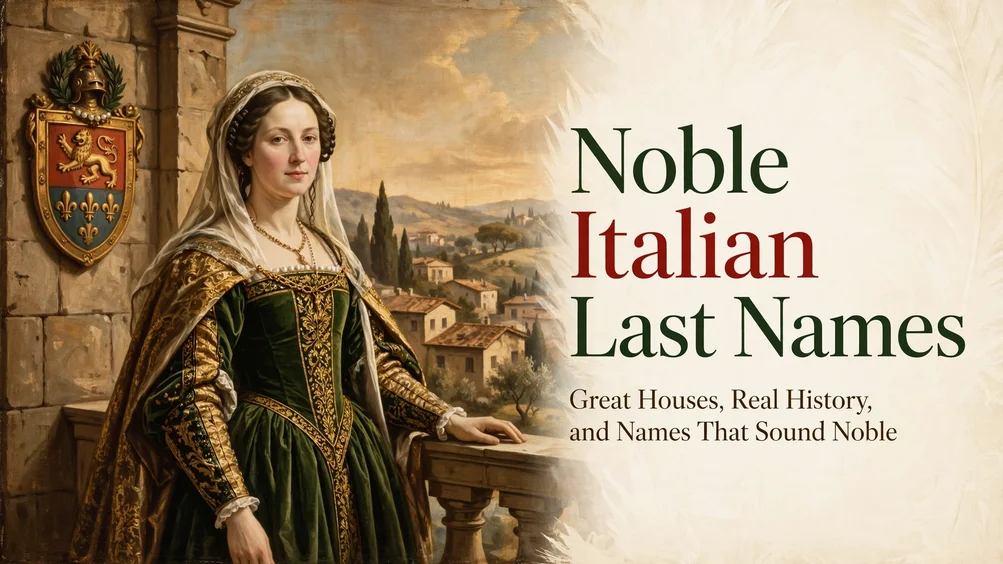
Noble Italian Last Names: Real Houses, Sound-Alike Names, and the Girl Lens
Noble Italian last names belong to families that held documented rank in Italy’s pre-unification states, from the dukes of Milan to the princes of Rome and the patricians of Venice and Genoa. The strongest names are tied to real houses with recorded titles, land, or city office, not simply to a grand sound.
Many surnames that look aristocratic, such as Conte or Barone, usually marked service to a count or baron rather than descent from one. Below are the documented houses by region, the sound-alike names explained plainly, a reality check for researchers, and a girl lens with famous female bearers. It sits beside our wider Italian girl names collection.
What Noble Actually Meant in Italy
In Italy, noble meant recognized rank within one state, not membership in a single national aristocracy. Before unification in 1861, the peninsula held kingdoms, duchies, republics, and the Papal States, each with its own titles. A family powerful in Florence could be unknown in Venice, so every claim needs a place and a date.
Titled houses held ranks such as principe, duca, marchese, conte, visconte, and barone, usually tied to land, a city office, or service to a ruler. Below them sat the patrizio families of the republics and the untitled nobili, cadet branches carrying noble status without a title. Rank described a legal position, not a pleasant sound.
Papal nobility worked differently. A family could rise when a relative became pope or cardinal, gaining principalities, palaces, and marriages into older houses. The Borghese, Barberini, and Farnese families all followed this route, which is why Rome has so many princely names with recent roots. Their nobility was real but granted, not ancient, and rested on the Church as much as on land.
Republican patricians form the third pattern. In Venice and Genoa, rank came from council membership and trade, not from a king’s patent. In Florence, merchant families such as the Medici and Strozzi became patricians through wealth, banking, and city office, only later gaining ducal titles. A name from one of these cities needs its city’s system explained, not a generic label.
There was never a single Italian register of nobility, and there is none today. The legal status of nobility ended with the Italian Constitution of 1948, and the Libro d’Oro is a private genealogical record, not a state roll. Titles survive socially and in compound surnames such as Lanza di Trabia, where the territorial tag, or predicato, joined the legal surname. So a surname alone can never settle the question.
The Authenticity Test: Four Questions Before You Trust a Noble List
A list earns trust only when it names a real house, a place, and a date. If a page gives you a grand meaning and no history, treat it as decoration, not evidence. Four quick questions separate documented houses from invented prestige: who held the title, where did they rule, when did they live, and what record proves it.
First, ask who held the title and where they ruled. Medici means doctors, yet the family ruled Florence and later became Grand Dukes of Tuscany, documented in centuries of banking and civic records. Sforza means force, yet Francesco Sforza became Duke of Milan in 1450 through marriage to Bianca Maria Visconti and military command. Meaning alone tells you nothing; the record of office does.
Second, check the meanings, because popular lists get them wrong. One rival list claims Savoy means know-how, Este means east, and Gonzaga means battle ready. In fact, Savoia comes from the Alpine region of Savoy, Este from the town of Este in the Veneto, and Gonzaga from the town of Gonzaga in Lombardy. A list inventing three meanings in one section cannot be trusted on harder claims.
Third, watch for padding and duplication. One generator page covers all of Europe yet gives Italy only four names, listing Medici and de Medici as if they were two separate houses. Another page presents title words such as Conte, Marchese, and Principe as though carrying the word proved descent, even while admitting that service, nicknames, and aspiration produced the same names. Padding is a warning sign, not extra value.
Fourth, ask how many unrelated families share the name. A surname carried by thousands of families across Italy cannot belong to one house, and tenants and servants often took the name of the local lord. Real proof looks like parish records, notarial acts, or a published family history naming individuals, not a coat of arms from a surname database. Coats of arms were often assumed or sold, so they prove little alone.
Great Houses of the North: Milan, Mantua, Ferrara, and Venice
Northern Italy produced dukes, marquesses, and republican patricians rather than one royal court. Milan and Mantua were ruled by ducal houses, Ferrara and Modena by the Este family, and Venice and Genoa by closed councils of merchant patricians. The table below gives the documented houses and the meaning of each name.
| Surname | Base | Meaning and documented note |
|---|---|---|
| Visconti | Milan | From vicecomes, a deputy count; lords then dukes of Milan. |
| Sforza | Milan | From sforzare, to force; dukes of Milan from 1450. |
| Este | Ferrara and Modena | From the town of Este; dukes of Ferrara and Modena. |
| Gonzaga | Mantua | From the town of Gonzaga; rulers of Mantua. |
| Doria | Genoa | Genoese patrician admirals; early etymology uncertain. |
| Grimaldi | Genoa and Monaco | Genoese patricians; the ruling house of Monaco. |
| Contarini, Cornaro, Mocenigo | Venice | Patrician council families; rank came from trade and office. |
| Borromeo | Lombardy | Counts of Arona; Lombard noble house. |
| Savoia | Savoy and Piedmont | From the Alpine Savoy region; kings of Italy after unification. |
Two northern women show why the girl lens matters here. Isabella d’Este, Marchioness of Mantua, ran a court famous across Europe for art and diplomacy, and her letters record a woman exercising real political power. Beatrice Borromeo, daughter of a Count of Arona, works as a journalist and film maker and married into Monaco’s princely family. Several houses here also appear in our guide to wealthy Italian surnames.
Great Houses of Rome and the Papal States
Rome’s nobility grew around the papacy, land, and ancient baronial families. The oldest Roman houses held castles and feuds around Latium for centuries, while newer princely families rose when a relative became pope. Both kinds are documented, but they differ in age, which matters when a list calls every Roman name ancient.
| Surname | Base | Meaning and documented note |
|---|---|---|
| Colonna | Rome | Linked in tradition to a Latium town and the Latin word for column. |
| Orsini | Rome | From a diminutive suggesting a little bear; linked to several popes. |
| Borghese | Siena, then Rome | Pope Paul V’s family; became princes. |
| Barberini | Florence, then Rome | Pope Urban VIII’s family; seventeenth century patrons. |
| Farnese | Lazio | From the town of Farnese; Pope Paul III’s family, dukes of Parma. |
| Della Rovere | Liguria | Of the oak tree; popes Sixtus IV and Julius II. |
| Chigi | Siena, then Rome | Pope Alexander VII’s family; banking roots, Roman rank. |
| Aldobrandini | Florence, then Rome | Roman nobles tied to cardinals and Pope Clement VIII. |
Clarice Orsini shows the marriage politics of these houses. She married Lorenzo de’ Medici, called Lorenzo the Magnificent, which tied Rome’s old baronial blood to Florence’s banking power in a single alliance. Vittoria Colonna, Marchioness of Pescara, became one of the most admired poets of the Renaissance and a friend of Michelangelo. These women carried their houses into courts, letters, and art.
One caution belongs in every Roman list. Borgia is often filed among Italian noble houses, but the family came from Valencia in Spain and rose in Rome during the Renaissance, so its most famous chapter played out in Italy while its origin stayed Spanish. Lucrezia Borgia, daughter of Pope Alexander VI, married into Ferrara’s Este court, showing how a Spanish papal family joined the Italian system.
The South and the Islands: Norman, Spanish, and Feudal Houses
Southern nobility came from Norman conquest, Spanish rule, and feudal landholding rather than from merchant republics. Naples and Sicily had titled barons, counts, and princes whose rank passed with fiefs. Southern records need extra care because feudal titles were widely granted and widely claimed.
| Surname | Base | Meaning and documented note |
|---|---|---|
| Sanseverino | Naples and the south | One of the great Neapolitan baronial families. |
| Caracciolo | Naples | Neapolitan noble family; branch Caracciolo di Torchiarolo. |
| Ruffo di Calabria | Calabria | Calabrian noble house; territorial tag marks the fief. |
| Pignatelli | Naples and the south | Southern aristocrats, some became Spanish grandees. |
| Tomasi di Lampedusa | Sicily | Sicilian princely family; territorial tag marks Lampedusa. |
| Lanza di Trabia | Sicily | Sicilian princes of Trabia; predicato survives in the surname. |
| Carafa | Naples | Neapolitan noble family with cardinals and princes. |
| d’Aragona | Naples and Sicily | Linked to the Aragonese dynasty of Naples. |
Southern compound names deserve a special note, because they look grand and often are. A double name such as Tomasi di Lampedusa or Lanza di Trabia records a marriage, an inheritance, or a fief, and the second half is the territorial tag marking the family’s land. That structure is a genuine noble pattern, but not proof alone: the tag must match a recorded fief and family.
Surnames That Sound Noble but Usually Are Not
Most title surnames in Italy marked service, not rank. A family called Conti usually worked for a count, lived on a count’s land, or behaved in a lordly way, and the same logic covers Barone, Marchese, Duca, and Principe. These names hold real histories, but usually of servants, tenants, and nicknames, not of titled lords.
| Surname | Literal sense | Usual real origin |
|---|---|---|
| Barone | Baron | Servant or tenant of a baron, or a lordly nickname. |
| Conte, Conti | Count | Worked for a count or behaved like one. |
| Marchese | Marquis | Service to a marquis or a nickname. |
| Duca | Duke | Service to a duke or a nickname. |
| Principe | Prince | Servant in a prince’s household, or a nickname. |
| Re, Regina | King, queen | Court service, or a nickname for regal bearing. |
| Nobile, Nobili | Noble | Nickname or aspirational adoption, not rank. |
| Gentile | Kind, gentle | Described manners, not birth. |
| Cavaliere, Cavalieri | Knight, horseman | Knight service, a horseman’s trade, or a nickname. |
The Conti case deserves precision, because it is the most common trap. Behind the Name records Conti as coming from the noble title conte, meaning count, and notes it denoted a person who worked for a count or behaved like one. That single sentence undoes dozens of listicles: the title inside the name points to a job, not to a bloodline. If your family name is Conti, the honest starting point is a household, not a castle.
Prefixes mislead just as often. The particles di, de, del, della, and da usually mean of or from, marking descent from a father or origin in a town far more often than nobility. De Luca means son of Luca, and Del Corso means dweller near the highway, not heir to a highway. The plurals dei and degli work the same way: they mean of the, not higher rank.
Our own guide to Italian last names states the same warning plainly: Conti looks noble, but it almost always meant service to a count rather than being one. That sentence belongs in any honest treatment, because it stops the costliest researcher mistake: chasing a castle that belonged to an employer. Start from the job, then look for the record.
My Surname Is Noble, Am I Noble? The Reality Check
No, a noble surname alone does not make you noble, and in Italy it carries no legal rank at all. The Constitution of 1948 ended the legal status of nobility, so titles survive only as social courtesies and in genealogical records. What a surname can do is point you toward a research question, not hand you an answer.
Three mechanisms explain almost every false match. Tenants and servants took the name of the local lord, so one village could hold dozens of unrelated Conti or Barone families. Spelling drift and migration scrambled prefixes, so a humble di Stefano could look grand after a century abroad. After 1948, with no state authority checking claims, sellers of coats of arms filled the gap with flattering inventions.
Real evidence looks boring, which is how you know it is real. Parish and civil registers sometimes mark a person as nobile or use honorifics such as don, illustrissimo, or magnifico across several generations of one line. Notarial acts, wills, and published family histories naming individuals and dates carry weight. A surname match, a printed coat of arms, or a DNA test does none of this work: DNA can suggest a region, never a title.
If you find a genuine link, enjoy it for what it is: a documented family story, not a rank you can use. Descendants of titled families still use historical titles socially, and predicato compounds remain part of the legal surname. That social survival is real, but it confers no privilege, no office, and no legal status in the Italian Republic today.
Choosing a Noble Surname Feel for a Girl
Choose the association, not the title, and test the full name aloud. A girl’s name pairs best with a noble surname feel when the first name is shorter than the surname, easy to pronounce, and linked to a real woman bearer. The goal is a name that sounds elegant daily, not one needing a history lecture.
Start from famous female bearers: each gives you a first name with a story. Caterina recalls Caterina de’ Medici, Queen of France; Isabella recalls Isabella d’Este, Marchioness of Mantua; Clarice recalls Clarice Orsini, wife of Lorenzo the Magnificent; Vittoria recalls Vittoria Colonna, poet and Marchioness of Pescara; Beatrice recalls Beatrice Borromeo, the modern journalist. Each name stands alone, so the child never carries a house as a first name.
If you want the surname feel itself, use it carefully. Medici, Borghese, Visconti, and Este read as surnames in Italy, not as given names, so a girl called Medici will spend her life explaining a family name. A softer route is a middle name, a character name in fiction, or a first name linked to the house, such as Caterina for the Medici. Fiction can borrow a house freely; a birth certificate should borrow lightly.
Sound test every combination before you commit. Say the first name with the family surname three times, and listen for clashing rhythms, repeated endings, and awkward initials. A long compound surname such as Tomasi di Lampedusa pairs best with a short first name, while a short house name such as Este can carry a longer classic. For more classic first names to test, browse our traditional Italian girl names collection.
Frequently Asked Questions
Does Conte mean my family were counts?
Almost certainly not. Conti usually meant a family that worked for a count, lived on a count's land, or behaved in a lordly way. Behind the Name gives exactly that definition, and the same service logic covers Barone, Marchese, Duca, and Principe.
Do di, de, del, or della prefixes prove nobility?
No. These particles usually mean of or from, and they mark descent from a father or origin in a town far more often than rank. De Luca means son of Luca, and Del Corso means dweller near the highway, not heir to a highway.
What are the most famous noble Italian surnames?
The best documented houses include Medici and Strozzi of Florence, Visconti and Sforza of Milan, Este of Ferrara, Gonzaga of Mantua, Colonna and Orsini of Rome, Doria and Grimaldi of Genoa, and Savoia, the royal house of Italy. Each is tied to recorded titles, land, or city office.
Is Borgia an Italian noble name?
It is a noble house famous in Italian history, but it is Spanish in origin. The family came from Valencia, produced two popes in Rome, and joined the Italian system through papal politics and marriage, including Lucrezia Borgia's marriage into the Este court of Ferrara.
Can I use a noble surname as a girl's first name?
You can, but in Italy names such as Medici, Visconti, and Este read as surnames, not given names, so a child would spend her life explaining the choice. A softer route is a first name linked to a famous woman bearer, such as Caterina for the Medici, Isabella for the Este court, or Beatrice for the Borromeo family.
Conclusion
Noble Italian last names reward patience and punish wishful thinking. The documented houses of Milan, Rome, Venice, Genoa, Naples, and Sicily offer real stories and famous women, while the title surnames offer an equally real story of service and village life. Choose the story your evidence supports, say the full name aloud, and let genuine history do the work a grand sound pretends to do.