 Skip to content

What Does Chiara Mean?
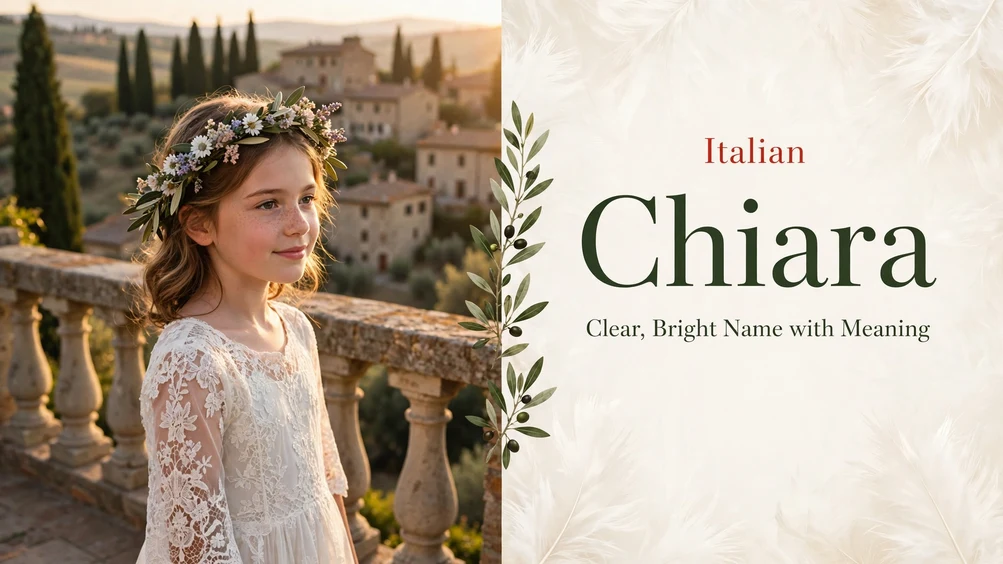
Chiara means clear, bright, and famous. It is the Italian form of Clara, from the Latin word clarus, and it carries the same sense of light that made it a saint’s name in Assisi. Among Italian girl names, Chiara stands out because it kept its Italian spelling and sound while its cousins spread across Europe.
Parents usually meet Chiara in one of two places. They hear it in Italy, or they meet a Chiara abroad and wonder how a name that looks like it should start with a soft sound begins with a hard K. This guide answers the meaning first, then traces the name from Latin to modern Italy, sorts out the lookalikes, and ends with practical help for choosing it.
What Chiara Means, Word by Word
Chiara means clear and bright, with famous as a third shade of the same Latin root. The root word is clarus, a Latin adjective used for light that can be seen plainly, a sound that carries, and a person whose name is known. That is why English sources gloss Chiara as clear, bright, or famous.
The light sense: what Italians hear inside Chiara
The light sense dominates in everyday use. Italian speakers hear chiarezza, clarity, inside Chiara, and the name has long been given to girls in families who wanted a name that sounded open and plain rather than ornate. It never needed a second meaning to justify itself, and that plainness is part of its staying power in Italy.
One warning: Chiara is not the Irish Ciaran
One warning belongs here. Some web pages tie Chiara to the Irish name Ciaran and its meaning of dark haired. That link is wrong. The Irish name is Ciara, a separate name with a separate history, and its meaning points in the opposite direction. Chiara comes from Latin clarus, and every reliable name source consulted for this article agrees on the bright reading.
From Latin Clarus to Italian Chiara
Chiara reached Italian through Clara, the feminine form of the Latin name Clarus. Clarus meant clear, bright, and famous, and the feminine form carried that meaning into the languages that grew out of Latin. Italian shaped Clara into Chiara, keeping the meaning intact while giving the name its own spelling and sound.
Saint Clare did what no dictionary could
The saint did more than any dictionary to fix the name in Italy. Chiara Offreduccio of Assisi, known in English as Saint Clare, was born in 1194 and became one of the first followers of Saint Francis. She left a wealthy family, founded the Order of Poor Ladies, later called the Poor Clares, and wrote a Rule of life for her sisters that received approval two days before her death in 1253.
1255: canonization puts the name on every calendar
Her canonization in 1255 put the name on church calendars across Catholic Europe. From there it travelled the way saint names travel, carried by devotion, by families naming daughters after a local patron, and by religious orders. It stayed most at home in Italy, where it still reads as a classic rather than a revival.
Cognates: Clara, Claire, and the rest of the family
Cognates show how far the same root travelled. Clara serves in Latin, Spanish, and Portuguese use, Claire and Clare in French and English, and Klara in German and Scandinavian use. Each version kept the bright meaning. Chiara is the Italian member of that family, and it is the only one spelled with CH pronounced as a hard K.
How to Say Chiara Without the English Trap
Chiara is pronounced kee-AH-rah in Italian, with the IPA written as /kja:ra/. The first syllable is short, the stress falls on AH, and the final A is open and unhurried. English speakers who say chee-AH-rah are reading the CH as they would in chair, and that is the single most common mistake with this name.
The rule behind the sound: CH is a hard K
The rule behind the sound is simple. In Italian, CH before A is always a hard K sound, the same K heard in Chianti or chiaroscuro. Once a reader learns that one rule, Chiara stops looking tricky. The spelling suddenly makes sense, and the name becomes easy to say correctly every time.
For a full breakdown with syllable practice and the mistakes to avoid, see our guide to how to pronounce Chiara. It covers the same ground in more depth, including how the name sounds when English speakers shorten the middle vowel. If you only remember one thing from this section, remember the hard K.
Saint Chiara and the August 11 Onomastico
A girl named Chiara celebrates her onomastico, or name day, on August 11, the feast of Saint Clare of Assisi. In Italy the onomastico is a real celebration, often marked with greetings, small gifts, and a mention at Mass, and for Chiara the date is fixed by the saint who made the name famous.
Why the feast nearly landed on August 12
The date has a small wrinkle worth knowing. Clare died on August 11, 1253, and her feast was first placed on August 12 because August 11 already belonged to two earlier martyrs. A calendar revision in 1969 removed those feasts and moved Clare to August 11, the anniversary of her death. Modern Italian calendars therefore list Chiara on August 11.
Patron of television since 1958
Clare is also remembered as patron of television, a title given by Pope Pius XII in 1958, and as patron of embroiderers and of those with eye disease. Those patronages come from stories about her life, including a legend that she saw Mass projected on a wall when illness kept her from church. Parents who like a name with a story attached will find plenty here.
How families keep the name day
Families who observe the onomastico often pair the name day with a birthday celebration, or keep it as a smaller, separate occasion. Either way, August 11 gives a Chiara a second date of her own each year, tied to a woman who chose poverty over a noble marriage and led a community for four decades.
Chiarina, Chiaretta, and the Names That Look Related
Chiara has a small set of Italian diminutives and a larger set of lookalikes that are not related. Chiarina and Chiaretta are the affectionate Italian forms, used in families and among close friends rather than on official documents. They soften the name without changing its meaning, and they are the forms an Italian grandmother is most likely to use.
The lookalikes that are not related
The lookalikes need more care, because two of them are common enough to cause real confusion. Kiara is a modern international spelling shaped by English pronunciation, and it is listed by Behind the Name as a related English form rather than an Italian one. Ciara is Irish, pronounced KEER-a, and means dark haired, which is the opposite of what Chiara means. Treating them as interchangeable spellings erases the history of both names.
Every form, and where it belongs
| Form | Where it belongs | Relation to Chiara |
|---|---|---|
| Chiarina | Italian, affectionate | Diminutive of Chiara |
| Chiaretta | Italian, affectionate | Diminutive of Chiara |
| Clara | Latin, Spanish, Portuguese | Parent form of Chiara |
| Claire, Clare | French, English | Cognates from the same root |
| Klara | German, Scandinavian | Cognate from the same root |
| Kiara | Modern international | English shaped variant, not Italian |
| Ciara | Irish | Unrelated, means dark haired |
Spelling it out outside Italy
Spelling matters most on documents and in classrooms outside Italy. A Chiara who moves abroad will spell her name out often, and teachers will default to chee-AH-rah unless corrected. That is a small burden, and most bearers treat it as a conversation starter rather than a problem, but parents should expect it.
Women Called Chiara
Chiara has been carried by saints, founders, singers, and actors, and the list below favors bearers whose connection to the name is documented rather than decorative. Saint Clare of Assisi comes first because she is the reason the name spread, and the modern bearers show how the name works in adult life across several fields.
The documented bearers
- Saint Clare of Assisi (Chiara Offreduccio, 1194 to 1253), founder of the Poor Clares and the name’s defining bearer.
- Chiara Lubich (1920 to 2008), Italian Catholic activist who founded the Focolare Movement for spiritual renewal.
- Chiara Ferragni (born 1987), Italian fashion blogger and entrepreneur known for The Blonde Salad.
- Chiara Mastroianni (born 1972), French Italian actress and daughter of Catherine Deneuve and Marcello Mastroianni.
- Chiara Galiazzo (born 1987), Italian singer who won the sixth season of Amici di Maria De Filippi.
- Chiara Siracusa, Maltese pop singer who performs under the single name Chiara.
Two patterns in that list
Two patterns stand out in that list. The name stays recognizably Italian even when the bearer works in France, Malta, or international fashion, and it suits adult professional life without sounding childish or dated. That matters for a name chosen at birth, since the child will carry it into rooms no parent can preview.
Chiara in the United States
In the United States the name remains uncommon. Nameberry’s Social Security data puts Chiara at rank 1066 for girls in 2025 births, with 228 girls given the name that year, against a peak rank of 1054 in 2002. That profile suits parents who want a name people recognize without hearing it in every classroom.
Is Chiara the Right Name for Your Daughter?
Chiara suits parents who want a classic Italian name with a clear meaning, a saint’s day, and a sound that works in several languages. It suits them less well if they want a name no one will ever mispronounce, because the CH spelling will need correcting outside Italy. Weigh those two facts together and the choice usually makes itself.
Pairing Chiara with middle names and surnames
Pairing is straightforward. Chiara works with short middle names that let the stressed middle syllable breathe, and with Italian surnames of any length, since the name itself is compact. It also sits well beside other Italian names in a sibling set, and readers choosing a full set can browse Italian girl names with meanings for options that share its clarity theme. For C names specifically, see Italian baby girl names with C.
The say-it-aloud test
One last practical test helps. Say the full name aloud with your surname, then say it the way an English speaking teacher would on first reading. If you like both versions well enough, and you are happy to correct the second one a few times a year, Chiara will serve a daughter from childhood to adulthood. The meaning will not need explaining, and the saint’s day gives her a story to own.
For the meaning behind the name itself, Behind the Name’s Chiara entry lists it as the Italian form of Clara, with Saint Chiara noted as a follower of Saint Francis of Assisi. Its related names list also shows the cognates discussed above, from Clara and Claire to Klara and Kiara, which makes it a useful cross check.
Frequently Asked Questions
What is the origin of Chiara?
Chiara is Italian in origin, through Clara from Latin Clarus. Saint Clare of Assisi, born Chiara Offreduccio, spread the name across Catholic Europe after her canonization in 1255.
How do you pronounce Chiara?
Chiara is pronounced kee-AH-rah in Italian, IPA /kja:ra/, with stress on AH. The CH is a hard K sound, so chee-AH-rah is the common English mistake to avoid.
Is Chiara the same as Kiara or Ciara?
No. Kiara is a modern international spelling shaped by English pronunciation, while Ciara is Irish and means dark haired. Chiara means clear and bright, so the three names have different histories despite looking alike.
When is Chiara's name day?
Chiara's onomastico falls on August 11, the feast of Saint Clare of Assisi. The date marks the anniversary of Clare's death in 1253, after a 1969 calendar revision moved her feast from August 12.
Is Chiara a popular name?
Chiara is recognizable but uncommon in the United States. Nameberry's Social Security data puts it at rank 1066 for girls in 2025 births, with 228 girls given the name, against a peak rank of 1054 in 2002.
Conclusion
Chiara means clear, bright, and famous, and it earned that meaning through a straight line from Latin clarus through Clara to the Italian form used today. Saint Clare gave it history, the August 11 onomastico gives it a yearly celebration, and the hard K pronunciation gives it a sound that sets it apart from every lookalike. Choose it for the meaning, and keep the spelling, because the spelling is what makes it Italian.


