Skip to content

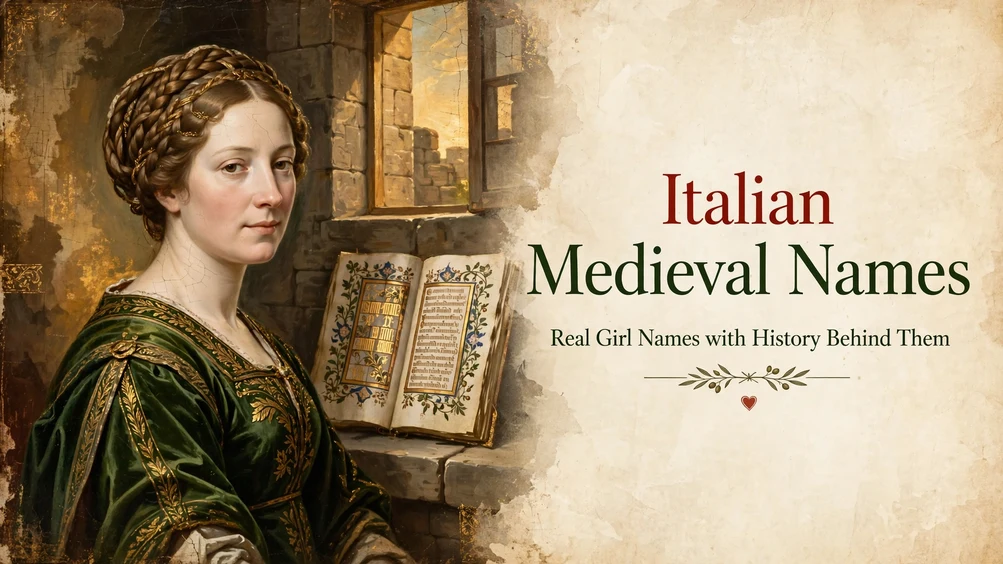
Italian Medieval Names for Girls with Real History Behind Them
Italian medieval names for girls are the names actually recorded in Italy between roughly 500 and 1500, from Florence parish lists to the pages of Dante and Boccaccio. The real ones sound nothing like the invented lists that dominate search results. Names such as Alagia, Belcolore, Bettisia, and Fiammetta belonged to documented women, and each one carries a meaning you can check.
This guide collects only names with real medieval evidence. Each entry gives the meaning and a pronunciation you can say out loud. Start with the full set of Italian girl names if you want the modern picture too, then come back here for the older layer.
What counts as an Italian medieval name?
A name counts as Italian medieval when records show it in use in Italy during the Middle Ages, roughly 500 to 1500. The strongest proof is a dated record: a Florence convent list or parish register, or a named woman in Dante or Boccaccio. A pretty Italian word is not enough on its own.
The three families medieval names came from
Medieval Italian girl names fall into three rough groups. Some came from Latin or Germanic roots and took an Italian shape, like Matilde from Germanic words for might and battle. Others were virtue or wish names, given in hope, like Onesta for honesty or Bonora for a long-awaited birth. A third group came from books, since Dante and Boccaccio fixed names like Fiammetta and Belcolore in the language.
Why one girl can appear under three spellings
Spelling was fluid. The Florence records list the same girl as Caterina or Catherina, and Alessandra next to Lessandra, because scribes wrote what they heard. That matters when you judge a list: a name with three spellings is usually a real name, while a name with one perfect modern spelling and no record behind it deserves a second look.
Rare medieval names with real women behind them
These nineteen names all appear in medieval Italian records with a named woman attached, so they are the safest picks on this page. Each one comes from Behind the Name’s medieval Italian index or the late-period Florence name lists, and each meaning below is the one those sources give.
Why most of them never came back
Most of these names never made it into modern use, which is exactly their charm. A few, like Vannozza and Bettisia, belonged to women famous enough that their stories survive in full. Others, like Altapasqua and Soave, survive only as a single record and a meaning, which makes them rarer still.
The nineteen names and the women who carried them
| Name | Meaning | Origin | Pronunciation |
|---|---|---|---|
| Alagia | Contracted form of Adelagia; the Genoese noblewoman Alagia dei Fieschi, praised by Dante in Purgatorio | Medieval Italian, archaic | ah-LAH-jah |
| Altapasqua | “High Easter”, from alta “high” and pasqua “Easter” | Medieval Italian | ahl-tah-PAHS-kwah |
| Belcolore | “Beautiful color”, from bel and colore; used by Boccaccio in the Decameron | Medieval Italian, literary | bel-koh-LOH-reh |
| Benvenuta | Feminine of Benvenuto, “welcome”; Benvenuta Bojani (1254-1292) | Medieval Italian | ben-veh-NOO-tah |
| Bettisia | Possibly a diminutive of Elisabetta; Bettisia Gozzadini (1209-1261) taught at the University of Bologna | Medieval Italian | bet-TEE-zee-ah |
| Bonora | “Good hour” or “finally”, for a long-awaited birth | Italian, Medieval Italian | boh-NOH-rah |
| Castora | Feminine form of Castor; Blessed Castora Gabrielli (d. 1391) | Medieval Italian | KAHS-toh-rah |
| Contessina | Diminutive of Contessa, “little countess”; Contessina de’ Medici (1478-1515) | Medieval Italian | kon-tes-SEE-nah |
| Ermellina | Uncertain; possibly a variant of Ermelinda or from ermellino, “ermine” | Medieval Italian | er-mel-LEE-nah |
| Fiammetta | “Little flame”, from fiamma with the -etta diminutive; Boccaccio’s Decameron narrator | Italian, medieval literary | fyahm-MET-tah |
| Ghisolabella | Meaning uncertain; sister of Venedico Caccianemico, named in Dante’s Inferno | Medieval Italian | gee-zoh-lah-BEL-lah |
| Lella | Diminutive of names ending in -ella, also of Elena | Medieval Italian | LEL-lah |
| Mercuriade | Meaning uncertain; Mercuriade of Salerno, early 12th-century physician | Medieval Italian | mer-koo-REE-ah-deh |
| Onesta | From onesta, “honesty” | Medieval Italian | oh-NES-tah |
| Pieta | From Old Italian pieta, “piety; compassion” | Medieval Italian | PYEH-tah |
| Soave | Debated; possibly from soave, “sweet, gentle”, or from the Suebi tribe | Medieval Italian | soh-AH-veh |
| Trotula | Trota of Salerno, early 12th-century physician, author of De curis mulierum | Medieval Italian | TROH-too-lah |
| Ubaldesca | Feminine of Ubaldo; Saint Ubaldesca Taccini (1136-1205) | Medieval Italian | oo-bahl-DES-kah |
| Vannozza | Diminutive of Giovanna; Vannozza dei Cattanei, mother of Cesare and Lucrezia Borgia | Medieval Italian | vahn-NOHT-tsah |
Two patterns hidden in the list
Two patterns run through the list. Parents chose wish names that said something about the birth itself, like Bonora for a child born after a long wait, or Confortata for a child born after a loss. And they loved diminutives: endings like -ella and -etta turn a plain name into something tender, which is why Lella and Vannozza both end the way they do.
Familiar names that were already medieval
Not every medieval Italian girl name sounds strange. Eight names that still top Italian charts today were already in daily use in medieval Florence, spelled much as they are now. If you want history without a spelling lesson, start here.
The eight names still given today
| Name | Meaning | Origin | Pronunciation |
|---|---|---|---|
| Beatrice | “She who brings happiness”, from Latin beatrix; Dante’s muse, Beatrice Portinari | Latin, medieval Italian | beh-ah-TREE-cheh |
| Bianca | “White”; Bianca Maria Visconti, Duchess of Milan | Italian | BYAHN-kah |
| Caterina | “Pure”, from Greek; Saint Catherine of Siena (1347-1380) | Greek, via Latin | kah-teh-REE-nah |
| Costanza | “Constant, steadfast”, from Latin; Constance of Sicily, Holy Roman Empress | Latin | koh-STAHN-tsah |
| Ginevra | Italian form of Guinevere; Florentine aristocracy | Italian, via Welsh | jee-NEH-vrah |
| Giovanna | “God is gracious”, from Hebrew; Joan I of Naples | Hebrew, via Latin | joh-VAHN-nah |
| Lucrezia | Latin, meaning uncertain; Lucrezia Borgia, Duchess of Ferrara | Latin | loo-KREH-tsee-ah |
| Matilde | “Mighty in battle”, from Germanic; Matilda of Tuscany | Germanic | mah-TEEL-deh |
Why these eight survived
Several of these names bridge the medieval world and the present, which is why they also appear in our guide to old Italian names. The ones that stayed in steady use, like Caterina and Giovanna, also sit comfortably among traditional Italian girl names, and the line between medieval and traditional is thinner than most lists admit.
How medieval Italian families actually chose a girl’s name
Medieval Italian parents named a daughter for a saint or a grandmother, or for a wish about the child, and the choice followed the family, not fashion. Firstborn girls commonly took a grandmother’s name. Saints’ names covered most of the calendar, and wish names marked the circumstances of the birth itself.
Saints first: a feast day could decide the name
Saints did the heavy lifting. A girl born near a feast day often took that saint’s name, and the onomastico, the saint’s name day, stayed part of her identity for life. Caterina points to Saint Catherine of Siena and Chiara to Saint Clare of Assisi, and both feast days still appear on Italian calendars.
Then family: grandmothers before fashion
Family came first after the saints. The custom was to name the first daughter after her paternal grandmother and the second after her maternal grandmother, with later children named for aunts or godparents, or a relative who had died young. That is why the same five or six names repeat across a whole Florentine family tree, and why a rare name like Bettisia stands out so sharply when it appears.
The authenticity test: five errors to spot in other medieval name lists
Most medieval name lists online mix real names with invented ones, and the errors follow a pattern. Check every meaning against a named source, watch for meanings stated with more confidence than the evidence allows, and distrust any list that never names a single real bearer.
The five errors, one by one
- Cecily, “blind to one’s own beauty.” One popular princess list gives Cecily this meaning. Cecilia comes from the Latin word for blind, and the extra phrase about beauty is invented. A meaning that sounds poetic is not the same as a meaning with a source.
- Leonor, “compassion.” A large medieval girl names list defines Leonor this way. The origin of Eleanor and its forms is debated, and no solid source gives “compassion” as the meaning. When a list is certain about a name scholars call uncertain, that certainty is the warning sign.
- Avelina with two meanings on one site. The same publisher calls Avelina “desired” on its princess page and “little bird” or “hazelnut” on its meanings page. A name cannot carry two unrelated meanings, and the contradiction shows neither page checked a source.
- Veronica, “true image,” listed as Greek fact. Veronica’s popular meaning comes from a medieval folk story that split the name into Latin vera and Greek icon. The real origin is more likely the Greek name Berenice. Presenting the folk story as fact is a common list error.
- Zita, “little girl,” stated as certain. One list gives Zita this flat meaning. The name probably comes from a Tuscan word for girl, but its origin is listed as uncertain by name scholars. Honest lists say “uncertain” where the evidence runs out.
Run the one-minute test on any list
The test is simple enough to run on any list in a minute. Pick three names at random and look each one up. Count how many meanings survive. On this page, every meaning above comes from the medieval Italian index at Behind the Name or the Florence name lists, and the uncertain ones are labeled uncertain instead of dressed up.
How to choose one today
Choose a medieval name the way medieval parents did: say it with your surname and check the meaning holds up before you commit to the spelling. A name that looks lovely on a list can turn awkward at a school roll call, so the sound test matters more than the history.
Say it with your surname first
Start with the tables above and read each candidate aloud with your last name. Short surnames take longer first names well, while long Italian surnames pair better with two-syllable names like Lella or Onesta. If the name has a hard sound, like the double consonants in Bettisia or the zz in Vannozza, practice it once before you commit.
Weigh the meaning like a promise
Then weigh the meaning the way you would any name. A virtue name like Onesta makes a promise a child will hear for life, while a literary name like Fiammetta carries a story you will retell. If a medieval name feels too stark on its own, the softer names of the following century may fit better, and our guide to Italian Renaissance names picks up where this one leaves off.
How to pronounce medieval Italian girl names
Italian pronunciation follows a few steady rules, and medieval spellings obey them too. Stress usually falls on the second-to-last syllable and every vowel is sounded. Double consonants are held a beat longer than single ones, so Bettisia is bet-TEE-zee-ah and Vannozza is vahn-NOHT-tsah.
The letter pairs that trip up English speakers
Three letter pairs trip up English speakers. GN sounds like the ny in canyon, so Ginevra starts with a soft jee-NEH sound. SCI before a vowel sounds like sh, which is why Lucrezia is loo-KREH-tsee-ah. And CH is always hard, like the k in cat, so Chiara is kee-AH-rah.
Diminutive endings change how a name feels
Diminutive endings are worth learning because they shape how a name feels. The ending -ella softens a name and -etta makes it smaller and dearer, while -ina adds affection, so Contessina reads as a tender form of Contessa and Fiammetta as a small flame rather than a fire. Say the full name, then the short form. Keep the one that sounds like your daughter.
Frequently Asked Questions
What is the most beautiful Italian medieval girl name?
Beauty is personal, but the names readers return to most are Fiammetta, meaning little flame, and Belcolore, meaning beautiful color. If you want a familiar sound instead, Bianca and Caterina carry the same history with an easier spelling.
Were names like Sofia and Giulia used in medieval Italy?
Giulia appears in the late-period Florence name lists, so it was in use. Sofia is harder to place: it is a Greek name with a long Italian history, but it does not show up in the Florence records we checked, so treat it as traditional rather than documented medieval.
What does Fiammetta mean?
Fiammetta means little flame. It comes from the Italian word fiamma, meaning flame, with the diminutive ending -etta. Boccaccio used it for one of the narrators in the Decameron and for the heroine of his Elegia di Madonna Fiammetta, written around 1343.
What is the rarest Italian medieval girl name?
Ermellina and Soave are among the rarest on this page, and both carry uncertain meanings, which is part of their appeal. Engoldisa, a Venetian name from the 1300s, is rarer still, and its meaning is unknown. Rare here means few records, not invented.
Can I use a medieval Italian name for a baby today?
You can. Names like Bianca and Caterina never left use, so they need no explanation. Rarer picks like Alagia or Onesta work well too, as long as you are comfortable spelling them for people and saying them aloud first.
Conclusion
Medieval Italy gave girls names with real stories attached, and the best of them are still usable today. Alagia and Bettisia survived because someone wrote them down with the woman attached, and that record is what separates them from the invented names on most lists. Pick the one whose story you want to retell, check its spelling against the table above, and say it aloud with your surname before you decide.