Skip to content

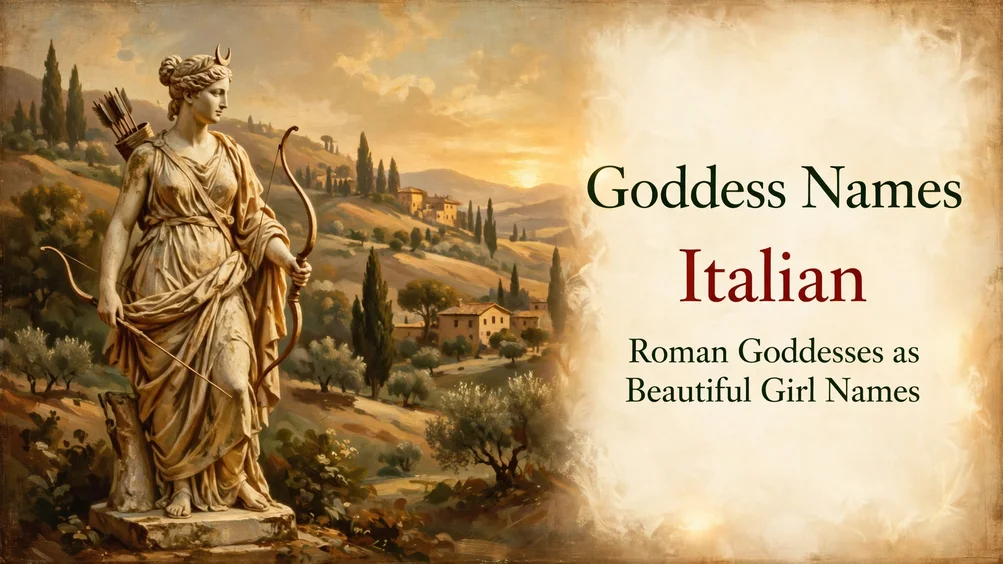
Italian Goddess Names: Roman Goddesses as Beautiful Girl Names
Italian goddess names are girl names taken from the goddesses of ancient Rome: Diana, Minerva, Flora, and Luna lead the list, followed by Aurora, Venus, Juno, Vesta, Ceres, Fortuna, Pomona, and Victoria. Each one carries a real Latin meaning and a goddess with a clear role. If you want the picture first, start with our list of beautiful Italian girl names, then come back here for the goddess names alone.
This guide keeps the list Roman and honest. Every name below carries a label for real Italian usage, so you can tell at a glance which names Italian parents actually use and which ones only look Italian in other lists. Greek goddesses are left out, and so are names that mean death or night.
What Counts as an Italian Goddess Name?
An Italian goddess name is a girl name that belonged to a Roman goddess and is usable as a given name in Italy today. The goddess must be Roman, not Greek, and the name must have a real Latin meaning or a history as a given name. Names that fail that test stay out below, with the reason given.
Roman first, Greek second
Most goddess lists mix every pantheon together, so Athena sits next to Diana and Persephone next to Flora. That mix hides the Italian names. Athena and Artemis are Greek, and their Roman counterparts are Minerva and Diana. If a list calls Athena an Italian goddess name, it is borrowing from the wrong mythology. Our Roman girl names guide covers the Roman era, while this page stays with the goddesses themselves.
A goddess name is not the same as a myth name
Not every female figure in Roman myth makes a good girl name. Lavinia and Hersilia were mortal women, Dido was a queen of Carthage, and Lara was a talkative nymph. They appear in other Roman lists, but none of them is a goddess. The names below all belonged to goddesses, and each section says what the goddess stood for.
The Four Names Every List Starts With
Diana, Minerva, Flora, and Luna are the four names that open nearly every goddess list, and for good reason. All four are real Roman goddesses, all four have clear Latin meanings, and all four work as girl names today. They differ in one important way, though: Italian parents use Diana, Flora, and Luna, while Minerva is rare there.
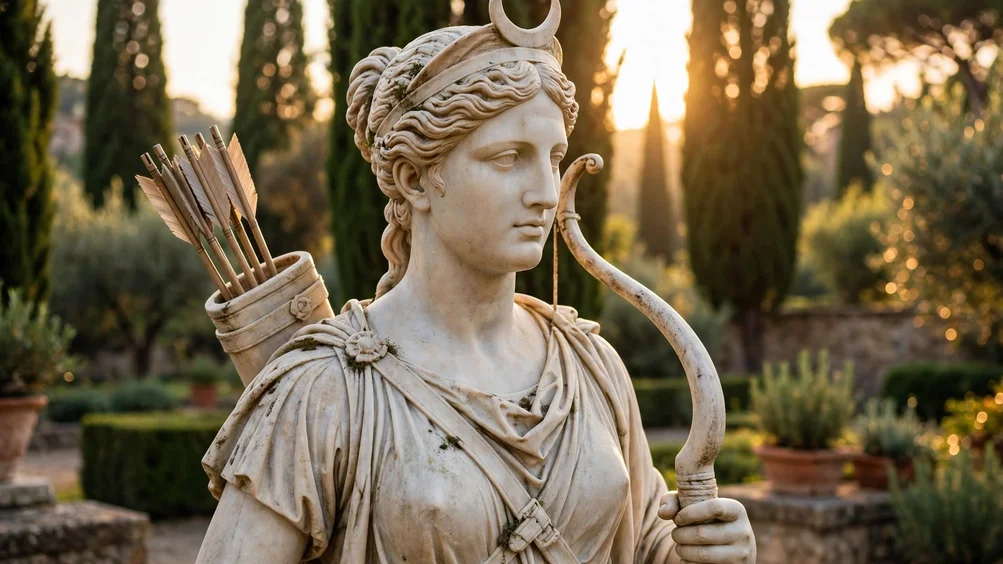
Diana, goddess of the moon and the hunt
Diana means divine or goddesslike, from Latin dia and diva. She was the Roman goddess of the moon, hunting, forests, and childbirth, and her cult centred on the woods and lakes of Italy long before Greek influence arrived. Parents have used the name as a given name since the Renaissance, and it is the most established of the four in Italy. Say it dee-AH-nah.
Minerva, goddess of wisdom and war
Minerva was the Roman goddess of wisdom and war, the counterpart of Greek Athena. Her meaning is uncertain: Behind the Name notes a possible link to Latin mens, meaning intellect, or an Etruscan origin. She is the boldest choice of the four and the least Italian in use. Behind the Name lists it for English and Spanish use, not Italian, so it reads as a classical import. Say it mee-NER-vah.
Flora, goddess of flowers and spring
Flora comes from Latin flos, meaning flower, and she was the Roman goddess of flowers and spring. She was an Italic goddess from early times, and her festival filled Rome with flowers. Parents have given the name to girls since the Renaissance, and it is used in Italy today. It is also the softest sounding of the four. Say it FLOH-rah.
Luna, goddess of the moon
Luna means the moon in Latin, and the word is the same in modern Italian. She was the Roman goddess of the moon, often shown driving a white chariot across the sky. Diana was linked to the moon too, but Luna was a separate divinity, not just another name for Diana. Luna is now the most popular name on this page by far. Say it LOO-nah.
Goddesses of the Sky: Moon, Dawn, and Light
The sky goddesses give the shortest and brightest names on this list. Aurora brings the dawn, Luna carries the moon, and Lucina, strictly speaking, is a title rather than a name. Parents who like celestial names will find the strongest options here.
Aurora, goddess of the dawn
Aurora means dawn in Latin, and she was the Roman goddess of the morning. Parents have used the name as a given name since the Renaissance, and it is now one of the most common Italian girl names of all, far more everyday than the other goddess names here. It suits parents who want the myth link without an unusual name. Say it ow-ROH-rah.
Luna, the moon, and why she leads the lists
Luna was the 13th most popular girl name in the United States in 2024. It has ranked in the top 20 every year since 2019, according to the Social Security Administration. The sound helps: two syllables, open vowels, and a clear image. In Italy the name is used, and it fits with Italian surnames. Its only drawback is familiarity, since a Luna in class will rarely be the only one.
Lucina, an epithet, not a first name
Lucina appears in some goddess lists as a girl name, but it was a title, not a goddess. It comes from Latin lucus, meaning grove, and was later linked to lux, meaning light. Romans used it for Juno and Diana in their role as goddesses of childbirth. It is a pretty sound, but it was never a given name in Roman use, so it sits outside the main list below.
Goddesses of Love, Home, and Marriage
Venus, Juno, and Vesta governed the parts of life closest to home: love, marriage, and the hearth. Their names carry weight, and two of the three are rare as given names in Italy. That rarity is part of their appeal for parents who want something unmistakable.
Venus, goddess of love
Venus means love or desire in Latin, and she was the Roman goddess of love and sex, later matched to Greek Aphrodite. As the mother of Aeneas she counted as an ancestor of the Roman people, which gave her a standing no other love goddess held. As a given name she is bold and rare in Italy, and the planet keeps the name familiar everywhere. Say it VEH-noos.
Juno, queen of the heavens
Juno was the wife of Jupiter and the queen of the heavens, and she watched over marriage and women. Her meaning is unknown, possibly tied to a root meaning young, or possibly Etruscan in origin. The name feels fresh and strong today, helped by the 2007 film Juno, but it is rarely given in Italy. Say it YOO-noh.
Vesta, goddess of the hearth
Vesta was the Roman goddess of the hearth, and the Vestal Virgins kept a continuous fire burning in her temple in Rome. Her name has no literal meaning recorded; it is probably a Roman cognate of Greek Hestia. Vesta is short, clear, and dignified, but it is rarely used as a given name in Italy. Say it VES-tah.
Goddesses of the Land: Harvest, Flowers, and Fortune
The land goddesses give names that feel grounded and old. Ceres fed Rome, Pomona tended the orchards, and Fortuna decided who prospered. Flora belongs in this group too, but she already has her profile above. These three are uncommon as given names, which makes them distinctive.
Ceres, goddess of agriculture
Ceres was the Roman goddess of agriculture, the counterpart of Greek Demeter. Her name comes from an Indo-European root meaning to grow or increase, which fits a harvest goddess exactly. Ceres is a serious, unusual choice, and it is rarely given to girls in Italy. It works best for parents who value the meaning over familiarity. Say it CHEH-res.
Pomona, goddess of fruit trees
Pomona comes from Latin pomus, meaning fruit tree, and she was the Roman goddess of fruit trees, gardens, and orchards. She is one of the most clearly Italian goddesses, with no Greek counterpart of note, yet Italian parents hardly ever use her name. Pomona is a gentle, uncommon pick with a clear meaning. Say it poh-MOH-nah.
Fortuna, goddess of luck
Fortuna means luck in Latin, and she was the Roman personification of luck, bringing good and bad outcomes alike. She was an old Italic goddess, and people across Lazio and Etruria worshipped her as a protector of fertility and childbirth as well as fortune. As a given name she is very rare, and the meaning cuts both ways. Say it for-TOO-nah.
Goddesses of Strength and Victory
Minerva leads the strength group, and Bellona and Victoria complete it. These are names with a martial edge, and they suit parents who want a name that sounds determined. Victoria is the most wearable of the three, and it has a ready Italian form.
Bellona, goddess of war
Bellona comes from Latin bello, meaning to fight, and she was the Roman goddess of war and a companion of Mars. She is a strong, uncommon name with an unmistakable meaning, and Italian parents rarely choose her for a daughter. Bellona suits parents who want a war goddess name without borrowing the Greek Athena. Say it bel-LOH-nah.
Victoria, goddess of victory
Victoria means victory in Latin, and she was the Roman goddess of victory. A 4th-century saint and martyr from North Africa bore the name. In Italy the usual form is Vittoria, so parents choosing the name for an Italian daughter should use Vittoria, pronounced veet-TOH-ree-ah. Victoria itself is the English and Spanish form. Say it veek-TOH-ree-ah.
The Full List at a Glance
These eighteen names are the list: twelve core goddess names and six rarer ones, each with its meaning, its goddess role, and its Italian pronunciation. Behind the Name keeps a full index of feminine Roman mythology names for readers who want to check any entry. For meanings across all our lists, see our guide to Italian girl names with meanings.
| Name | Meaning | Goddess | Pronunciation |
|---|---|---|---|
| Diana | Divine, goddesslike | Moon, hunting, forests, childbirth | dee-AH-nah |
| Minerva | Intellect (uncertain) | Wisdom and war | mee-NER-vah |
| Flora | Flower | Flowers and spring | FLOH-rah |
| Luna | The moon | Moon | LOO-nah |
| Aurora | Dawn | Morning, dawn | ow-ROH-rah |
| Venus | Love, desire | Love and beauty | VEH-noos |
| Juno | Unknown, possibly young | Marriage, women, queen of the heavens | YOO-noh |
| Vesta | No literal meaning recorded | Hearth and home | VES-tah |
| Ceres | To grow, increase | Agriculture and harvest | CHEH-res |
| Fortuna | Luck | Luck and fortune | for-TOO-nah |
| Pomona | Fruit tree | Fruit trees and orchards | poh-MOH-nah |
| Victoria | Victory | Victory | veek-TOH-ree-ah |
| Bellona | To fight | War | bel-LOH-nah |
| Carmenta | Song, poem, enchantment | Prophecy and childbirth | kar-MEN-tah |
| Maia | Greater (probably) | Spring | MAH-yah |
| Concordia | Harmony | Harmony and peace | kon-KOR-dee-ah |
| Felicitas | Good luck, fortune | Good luck | feh-LEE-chee-tahs |
| Pax | Peace | Peace | pahks |
Rare Goddess Names Worth a Second Look
Six names sit below the main list because they are rare, not because they are weak. Carmenta, Maia, Concordia, Felicitas, Pax, and Fauna each belonged to a real Roman goddess, and each one is almost never given in Italy. They reward parents who are willing to explain the name once or twice.
The gentle virtues: Concordia, Felicitas, and Pax
Concordia means harmony and was the goddess of harmony and peace. Felicitas means good luck or fortune and was the personification of good luck; the Italian form is Felicita. Pax means peace and was the goddess of peace. All three are virtue names, closer in spirit to Grace or Hope than to Diana or Luna. They are dignified, but they will sound unfamiliar to most Italians.
The old Italic names: Carmenta, Maia, and Fauna
Carmenta comes from carmen, meaning song or enchantment, and she was a goddess of prophecy and childbirth who was also said to have invented the Latin alphabet. Maia probably comes from maior, meaning greater, and she was a spring goddess and a companion of Vulcan. Fauna was a goddess of fertility, women, and healing. Their cults reach back to the Italic tribes, so these three feel older than the rest.
Names That Look Italian and Goddess-Like but Are Not
Other goddess lists pad their numbers with names that do not belong on an Italian list. Some are Greek, some mean things no parent would choose, and one is a plain error. This section names them so you can spot them elsewhere.
Greek goddesses in Italian lists
Athena, Artemis, Persephone, Aphrodite, Hera, Demeter, and Hestia are Greek goddesses, not Roman ones. Their Roman counterparts are Minerva, Diana, Proserpina, Venus, Juno, Ceres, and Vesta. Gaia and Iris are also Greek in origin, even though both are used as names in Italy today. A Greek name can still be a fine choice, but it is not an Italian goddess name.
Names no parent should borrow
Morta was a goddess of death, Nox was the goddess of night, Discordia was the goddess of discord, Invidia was the goddess of envy, and Libitina was the goddess of funerals and death. All five appear as girl names in at least one big list online. Their meanings are real and documented, and none of them belongs on a baby name shortlist.
Tea is not a goddess name
One large Italian name list glosses Tea as meaning goddess. That is wrong. Tea is a short form of Dorotea and similar names, and it has no link to any goddess. Short forms make fine names, but they should not be sold as goddess names. The same caution applies to Carmen, which some lists present as a goddess name when the goddess in question is Carmenta.
How to Say Them the Italian Way
Italian pronunciation of these names is regular once you know two rules: stress usually falls on the second-to-last syllable, and every vowel is sounded. English speakers tend to swallow the middle of Minerva and flatten the double consonants, so the names below deserve one slow read.
The stress rule that covers most of them
Diana, Flora, Luna, Aurora, Juno, Vesta, Ceres, and Fortuna all stress the second-to-last syllable in Italian, which is the natural pattern for words of this shape. Say them slowly once, dee-AH-nah, FLOH-rah, LOO-nah, and the rhythm settles. The rule breaks only where Latin kept an older stress, which is why the tricky names below are worth learning separately.
The tricky ones
Minerva is mee-NER-vah, with the stress on the middle syllable and a clear v. Pomona is poh-MOH-nah, not poh-MOH-na with a swallowed ending. Carmenta is kar-MEN-tah, Bellona is bel-LOH-nah with a doubled l, and Felicitas is feh-LEE-chee-tahs with a hard c before i. Victoria in Italian is Vittoria, veet-TOH-ree-ah, with a doubled t that English speakers often drop.
Diminutives and Everyday Forms
Italian parents shorten names constantly, and goddess names are no exception. The honest picture is uneven: two names on this list have lovely Italian diminutives, one has a separate Italian form, and the rest have no common short form at all.
Two real Italian diminutives: Fiorella and Lunetta
Fiorella means little flower and is the natural diminutive of Flora, built on fiore, the Italian word for flower. Lunetta is the diminutive of Luna, a small moon. Both are real Italian names in their own right, not inventions, and both work as given names without any reference to the goddess. Diana and Minerva have no common Italian diminutive, so parents should expect the full name to be used.
Vittoria, the Italian form of Victoria
Victoria is the English and Spanish form of the name, while Vittoria is the Italian form. The two are not interchangeable in Italy: Vittoria is what an Italian birth certificate would carry, and it is the form Italian speakers will expect. The same pattern applies to Felicitas, whose Italian form is Felicita. When a goddess name has an Italian form, use it.
Name Days: What to Do When There Is No Saint
Most goddess names have no saint and therefore no name day, which matters in Italy, where families still celebrate the onomastico. Flora is the exception with a fixed date, and Victoria has a saint bearer. For the rest, Italian families use All Saints’ Day.
Flora, the one with a date
Flora of Cordoba died a martyr on November 24, 851, and her feast day is November 24. She is the only name on this list with a firm, dated saint behind it. A girl named Flora can celebrate her onomastico on that day without any awkwardness. Victoria also has a saint bearer, a 4th-century martyr from North Africa, though no feast date was verified for this article.
Everyone else: All Saints’ Day
Diana, Luna, Minerva, Aurora, Venus, Juno, Vesta, Ceres, Fortuna, and Pomona have no saint of the same name in the Roman calendar. Italian families in that situation traditionally celebrate the onomastico on All Saints’ Day, November 1, which covers names without a saint. It is a practical answer, and it keeps the naming tradition intact without inventing a feast day.
How to Choose a Goddess Name That Fits Real Life
A goddess name has to work on a school register and a job application, not just in a myth. Three checks settle most choices: say it with the surname, weigh the meaning, and check how common the name is. A name that passes all three is a name you can stop worrying about.
Say it with the surname
Short goddess names pair well with long Italian surnames, while longer ones need a short surname to breathe. Luna Rossi and Flora Bianchi flow easily, while Fortuna Fortunato trips over itself. Say the full name out loud, including any middle name, and listen for repeated sounds. If you stumble twice, the combination is wrong.
Weigh the meaning
Some meanings on this list are gifts: Flora means flower, Aurora means dawn, Victoria means victory. Others carry weight: Fortuna means luck, good and bad, and Bellona means war. A meaning is not a destiny, but a child will hear the story of her name many times. If you love the sound but not the meaning, say so to yourself before you commit.
Check how common it is
Luna is a top 20 name, and Aurora is common in Italy, so neither will feel unusual. Minerva, Bellona, Pomona, and Carmenta are rare enough that people will ask about them. Neither end is wrong, but they feel different in daily life. If the goddess list feels too bold, the traditional Italian girl names guide offers classic choices, and the old Italian names guide covers the era behind these goddesses.
Frequently Asked Questions
Are Athena and Artemis Italian goddess names?
No. Athena and Artemis are Greek goddesses. Their Roman counterparts are Minerva and Diana, and those are the Italian goddess names. A Greek name can still be a good choice, but it is not an Italian goddess name, and lists that present Athena as Italian are mixing two mythologies.
Is Luna an Italian name?
Yes. Luna means the moon in Latin, and the word is the same in modern Italian. Behind the Name lists Italian among the languages that use Luna, and Luna was the Roman goddess of the moon. It is used as a girl name in Italy as well as in the United States.
How do you pronounce Minerva in Italian?
Minerva is pronounced mee-NER-vah in Italian, with the stress on the middle syllable and every vowel sounded. English speakers often rush the middle of the name, so say it slowly once: mee, NER, vah.
What Italian goddess name means victory?
Victoria means victory in Latin, and she was the Roman goddess of victory. In Italy the usual form is Vittoria, pronounced veet-TOH-ree-ah. Parents choosing the name for an Italian daughter should use Vittoria, since that is the form Italian speakers expect.
Do Italian goddess names have a name day?
Most of them do not, because there is no saint of the same name. Flora is the exception: Saint Flora of Cordoba was martyred on November 24, 851, and her feast day is November 24. For the rest, Italian families traditionally celebrate the onomastico on All Saints' Day, November 1.
Conclusion
Italian goddess names work best when the goddess and the name are both real. Diana, Flora, Luna, and Aurora are the safest choices, because they are used in Italy and their meanings are clear. Venus, Juno, and Vesta are bolder, and they repay a parent who likes explaining a name. Pick the goddess whose story you want to tell, check the pronunciation, and say the full name out loud first.