Skip to content

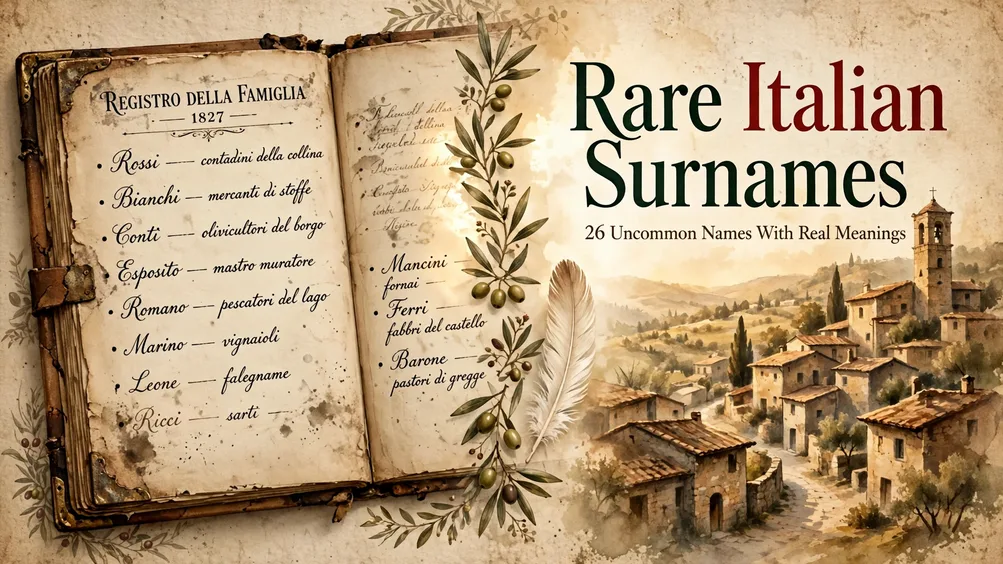
Rare Italian surnames are family names held by very few families, often in one town or valley, and Italy has more of them than any other European country. One database counts about 368,000 distinct Italian surnames, with an average of only around 165 people sharing each name.
Famous names like Rossi and Ferrari sit at one end, while hundreds of names survive in a handful of households at the other. The 26 names in this guide are the second kind, each checked against live sources.
If you are choosing a name for a daughter, a rare surname can shape the whole combination, so it pays to pair it with a first name that carries well. Our guide to Italian girl names lists first names by letter and theme, and it is the best place to test a pairing before you settle on one.
What Makes an Italian Surname Rare?
A surname counts as rare when very few living people carry it, usually because it never spread beyond the town where it began. Italy counts roughly 350,000 distinct surnames, the highest variety in Europe, and the average name is shared by only about 165 people. Rarity is a headcount, not a feeling.
A small number of bearers, not a strange sound
Sound misleads people. Zappacosta sounds unusual to an English ear, yet it survives in several families across Abruzzo and the diaspora, while a plain name like Abatedaga is recorded as practically unique in Piedmont. Ask how many people hold a name today, not how odd it looks on paper. Distribution maps on Cognomix show the count by region, and a name clustered in one province is usually the real thing.
One town, one valley, one family
Most rare surnames never traveled. They formed between the 12th and 16th centuries, when a nickname, a trade, or a place stuck to one household and then stayed put. Dialects split Italy into small language pockets, so the same idea produced different names a valley apart. A surname found in one town and nowhere else is often a single family’s story, written into the parish register and passed down unchanged.
How to Tell a Rare Surname from a Padded List
A trustworthy rare-surname list names the region, explains the meaning, and admits what is uncertain. A padded list does the opposite. It piles up names with one-line meanings, calls common surnames rare, and never says where a name is found. Before you trust a list, check three things: a region, a reason for the meaning, and a source to check.
Three questions to ask first
First, where does the name live? A rare surname clusters in one region, and distribution maps confirm it in seconds. Second, does the meaning come from the words themselves, or from a guess? Bonadonna breaks into bona and donna, good woman, while Buttacavoli has no settled origin, and an honest guide says so. Third, is the name rare? Lombardi and Negroni appear on rare lists, yet both are common surnames.
When a meaning looks doubtful, check it against Behind the Name’s index of Italian surnames, which marks rare entries and gives the derivation where one is recorded. A name the index does not list is not proof of fakery, since many one-town names never made it into print, but a meaning that contradicts the index needs a better source behind it.
The padding to watch for
The worst lists hide padding in plain sight. One 90-name funny-surnames list gives each name a single jokey line and no region at all. A 290-name collection labels its rare section well, then fills nearby sections with Bianchi, Ferrari, and Russo, names every Italian knows. Another list calls Lombardi rare while praising Vince Lombardi in the same breath. Treat any list that never admits uncertainty as a warning sign.
Rare Surnames That Began as Nicknames
Most rare Italian surnames began as nicknames, descriptions of a person’s body, habits, or luck that stuck and then passed to their children. Medieval Italy had no surnames office handing out names. Neighbors supplied them, and the vivid ones survived. The six names below come from bodies and appetites, and the six after them come from wishes and warnings.
Bodies, appetites, and habits
Medieval nicknames were blunt. A big head, a fine leg, or a love of bread could fix a family’s name for six hundred years, and the joke usually softened while the name stayed. These six survived because the families did, not because anyone chose them for charm. Read them as village gossip that hardened into record, and the meanings make immediate sense.
| Surname | Meaning | Origin | Pronunciation |
|---|---|---|---|
| Bellagamba | Beautiful leg, a nickname for graceful legs | Tuscany and Emilia-Romagna | bel-lah-GAHM-bah |
| Testagrossa | Big head, likely a nickname for a large head or a strong mind | Italy | tes-tah-GROHS-sah |
| Chiappa | From Latin clapare, to seize or capture, likely a hunter or trapper name | Italy | KYAH-pah |
| Piscione | Big fish, from pesce plus the -one suffix, likely a fisherman name | Italy | pee-SHOH-neh |
| Buttacavoli | Throw cabbages, origin uncertain | Italy | boot-tah-KAH-voh-lee |
| Gustapane | Enjoy bread, likely a baker or a bread lover | Italy | goo-stah-PAH-neh |
Wishes and warnings in a name
Some names were spoken like spells. Parents gave a child a surname that wished for long life or warned off harm, and the name outlived the belief behind it. Ingannamorte means cheat death, and Ammazzalamorte means kill death, both recorded as wishes that the bearer would outwit death itself. Cantacessi is gentler, tied by tradition to singers of mourning songs.
| Surname | Meaning | Origin | Pronunciation |
|---|---|---|---|
| Ingannamorte | Cheat death, a wish name for a child to outwit death | Italy | een-gahn-nah-MOHR-teh |
| Nonfarmale | Do no harm, from non far male | Italy | nohn-fahr-MAH-leh |
| Ammazzalamorte | Kill death, a wish that the bearer be stronger than death | Near Cerveteri, Lazio | ahm-maht-tsah-lah-MOHR-teh |
| Cantacessi | Believed to come from canta decessi, singers of mourning songs | Italy | kahn-tah-CHES-see |
| Passacantando | Pass singing, likely a nickname for a singing worker | Italy | pahs-sah-kahn-TAHN-doh |
| Cantarutti | Little singer, from cantare with the Friulian -utti diminutive | Friuli, near Udine | kahn-tah-ROO-tee |
Rare Surnames from Land, Work, and the Law
Land and work supplied the second great source of rare surnames. A family took its name from the field it farmed, the tool it used, or the office it held, and the name stayed local because the work did. The six names below span land, work, and the law.
Fields, tools, and trades
A farmer’s name often reads like a field note. Zappacosta joins zappa, a hoe, with costa, a coast, for coastal farmers in Abruzzo. Mezzasalma is subtler: a salma was a Sicilian unit of land, so the name likely marked a family holding half a measure. Mangiaterra looks like earth eater, but it is likely a corruption of Magnaterra, landholder, which changes the whole story.
| Surname | Meaning | Origin | Pronunciation |
|---|---|---|---|
| Zappacosta | Hoe the coast, a farmer name | Abruzzo | tsahp-pah-KOH-stah |
| Mezzasalma | Half a salma, a Sicilian land measure, likely a small landholder | Sicily | met-tsah-SAHL-mah |
| Mangiaterra | Likely a corruption of Magnaterra, landholder | Southern Italy | mahn-jah-TEHR-rah |
Law books and parish registers
Some rare names come from paper, not fields. Legista comes from the Latin for lawyer or jurist, and it is recorded in Caltagirone, Sicily. Diotallevi means may God raise you, and Proietti means projected or thrown forth, and both were given to foundlings in central Italy. Two more foundling names from the same practice are Incognito, meaning unknown, and Abbandonato, meaning abandoned.
| Surname | Meaning | Origin | Pronunciation |
|---|---|---|---|
| Legista | Lawyer or jurist, from Latin | Caltagirone, Sicily | leh-JEE-stah |
| Diotallevi | May God raise you, a foundling name | Central Italy | dee-oh-tahl-LEH-vee |
| Proietti | Projected or thrown forth, a foundling name | Umbria and Lazio | proh-YET-tee |
Rare Surnames Tied to a Place or a Family
A surname can be rare because it never left home, or because it belonged to one family that never grew large. The first kind points at a map, and the second points at a bloodline. Both kinds reward a reader who checks the town before trusting the tale. For the other side of the age question, our guide to old Italian surnames dates names like Bevilacqua to 1037 and groups 25 of them by era. The eight names below split evenly between the two kinds.
Names that stayed in one region
Regional names are the easiest rare surnames to verify, because the map does half the work. Aguglione is an ancient Florentine name, recorded in office-holder lists from 1298 onward, and it comes from aguglia, a needle or fish spear. Bacigalupo means wolf hunter in Genoese dialect, and it still sits in Liguria.
Prencipe comes from principe, prince, in Campania and Calabria. Scaramuccia comes from the swaggering soldier of Neapolitan theatre, and Sicily holds its own stock of rare names, covered in our guide to Sicilian surnames. Both names stayed close to home, which is why their regions are easy to pin down.
| Surname | Meaning | Origin | Pronunciation |
|---|---|---|---|
| Aguglione | From aguglia, needle or fish spear | Florence, Tuscany | ah-goo-LYOH-neh |
| Bacigalupo | Wolf hunter, from Genoese bacigare and lupo | Liguria | bah-chee-gah-LOO-poh |
| Prencipe | Prince, likely a nickname for noble bearing | Campania and Calabria | PREHN-chee-peh |
| Scaramuccia | Little skirmish, from the Neapolitan theatre character | Naples, Campania | skah-rah-MOO-chah |
Names a famous family made rare
A famous bearer can make a rare name known worldwide without making it common. Medici simply means doctors, the plural of medico, yet outside the Florentine dynasty it is uncommon. Buonaparte means good part, or good family, and it stayed rare beyond Napoleon’s own line.
Vespasiani traces by family tradition to the Roman emperor Vespasian. Mastronzo is likely a blend of Mastr’Oronzo, master Oronzo, a craftsman’s title. Scantamburlo, a Veneto name likely built from words for avoiding a joke, shows the same pattern without any famous bearer at all.
| Surname | Meaning | Origin | Pronunciation |
|---|---|---|---|
| Medici | Doctors, plural of medico | Florence, Tuscany | MEH-dee-chee |
| Buonaparte | Good part, or good family | Tuscany and Corsica | bwah-nah-PAHR-teh |
| Vespasiani | From the Roman emperor Vespasian, by family tradition | Lazio | ves-pah-SYAH-nee |
| Mastronzo | From Mastr’Oronzo or Mastr’Alfonzo, master craftsman plus a given name | Southern Italy | mah-STROHN-tsoh |
Pairing a Rare Surname with a Girl’s First Name
A rare surname works best with a first name that is easy to say beside it. Long surnames pair well with short first names, and a surname with a strong meaning leaves room for a gentle first name. Test the name out loud, then write it down. Our guides to Italian surnames and Italian last names help with that test.
Sound first, meaning second
Say the pair aloud three times. If the surname starts with a vowel, a first name ending in a vowel can blur the join, while a first name ending in a consonant keeps them apart. Giulia Zappacosta flows because the stress falls in different places, while a long first name beside a long surname tires the ear. Sound decides first, and meaning breaks the tie between two good sounds.
Check the spelling your family will actually use
Rare surnames change spelling at borders. Prencipe and Principe are the same name in different records, and an American branch may have dropped a letter a century ago. Before you commit, check how your own family spells the name on birth records, not how a website lists it. A name your relatives cannot spell is a name your daughter will spell for strangers for life.
Frequently Asked Questions
How many Italian surnames are there?
Italy has roughly 350,000 distinct surnames, the highest variety in Europe. One database counts about 368,000 names with an average of only around 165 people sharing each one. That average is the reason so many Italian surnames feel rare: most names never spread beyond the region where they formed.
Why do so many rare Italian surnames sound like full sentences?
Many formed as nicknames built from ordinary words, so they read like short phrases. Ingannamorte means cheat death, Nonfarmale means do no harm, and Passacantando means pass singing. Medieval neighbors described a person in plain words, and the description stuck as the family name.
Are rare Italian surnames real, or were they invented for baby-name lists?
The names in this guide are real, each verified against live sources with a stated region and meaning. But padded lists are common: some call Lombardi and Negroni rare, and some give each name a one-line joke meaning with no region. Check the region, the word-by-word meaning, and a source you can open before trusting any list.
Can I use a rare Italian surname as a first name for my daughter?
You can, but test it first. Short first names pair best with long surnames, and a first name ending in a consonant usually keeps the join clean when the surname starts with a vowel. Say the full name aloud several times, then check how your family spells the surname on birth records, since rare names change spelling at borders.
How do I trace a rare Italian surname in my family tree?
Start with the town, not the name. Rare surnames cluster in one region, so find the ancestral town on a distribution map such as Cognomix, then search that town's civil records and parish registers. Italian archives are organized locally, so the town name unlocks the records, and a rare surname makes each hit easier to place.
Conclusion
Rare Italian surnames reward a slow look. Each one is a small record of a place, a trade, or a wish. Start with the region, check the meaning against a source you can open, and say the name aloud beside the first name you love. The right surname will still sound right on the tenth hearing, and that is the only test that matters.