 Skip to content

What Does Cristina Mean in Italian?
Cristina means follower of Christ in Italian. It is the Italian form of Christina, which comes from the Latin Christianus, built on the Greek Christos, meaning anointed. Italians say it kree-STEE-nah, with the stress on the middle syllable, and the name belongs to Saint Christina of Bolsena, whose feast falls on July 24. Among Italian girl names, few carry a faith, a saint, and a feast day in one short word.
The name traveled from Greek to Latin to Italian with its meaning intact, and the spelling without the H is what marks it as Italian. English speakers usually write Christina, while Italians, Spaniards, and Portuguese write Cristina, and the two forms share one history. The rest of this guide follows that history, from the anointing in the Greek root to the July feast on Lake Bolsena.
This guide covers the meaning broken down word by word, the Italian pronunciation with its traps, the story of Saint Christina and her July 24 feast, the famous women who carried the name, and the popularity figures on both sides of the Atlantic, plus a short test for parents weighing Cristina for a July baby. For the wider picture, see our guide to Italian girl names with meanings.
What Cristina Means: Follower of Christ, from Latin Christianus
Cristina means follower of Christ. The meaning comes from the Latin Christianus, a follower of Christ, which comes from the Greek Christos, meaning anointed. Cristina is the Italian form of Christina, the Latin feminine form of Christian, so the name carries its faith in its spelling.
From Christos to Christianus to Cristina
The chain starts with the Greek verb chrio, to anoint, which gives Christos, the anointed one. Latin took Christos into Christianus, a follower of Christ, and the feminine form Christiana followed from it. Italian then shaped Christiana into Cristina, dropping the H and the second syllable, and the same form took hold in Spanish, Portuguese, Catalan, and Romanian.
Behind the Name lists Cristina as the Italian, Spanish, Portuguese, Catalan, and Romanian form of Christina, and it traces Christina to Christiana, the Latin feminine form of Christian. The chain is short and well documented. Parents who choose Cristina for the meaning get exactly what the name promises, with no guesswork in between.
“Anointed” is the root, not the meaning
Some name sites give Cristina’s meaning as anointed, but that reads the root as the meaning. Anointed describes Christos, the Greek word behind the name, while Cristina itself means a follower of Christ, a person defined by that faith. The distinction is small on paper and large in practice, because one describes a title and the other describes the person who carries the name.
MomJunction calls Cristina a Greek name meaning to anoint, which skips the Latin middle of the chain and hands the Greek root straight to the Italian name. The fuller picture runs Greek to Latin to Italian, and each step changes the sense a little. Keeping the steps straight is what keeps the meaning honest.
Cristina, Christina, and Cristiana: the family of forms
Cristina sits inside a family of forms, and the spelling tells you where each one comes from. Christina is the English and Scandinavian form, Christine is French and German, Kristina is the Slavic and Nordic form, and Cristiana is the longer Italian form that keeps the Latin ending. Each one means the same thing, so the choice between them is a choice of language and spelling, not of sense.
| Name | Meaning | Origin | Pronunciation |
|---|---|---|---|
| Cristina | Follower of Christ | Italian form of Christina | kree-STEE-nah |
| Christina | Follower of Christ | English form, from Latin Christiana | kris-TEE-nah |
| Cristiana | Follower of Christ | Longer Italian form | kree-STEE-ah-nah |
| Christine | Follower of Christ | French and German form | kris-TEEN |
| Kristina | Follower of Christ | Slavic and Nordic form | kris-TEE-nah |
| Cristiano | Follower of Christ | Italian masculine form | kree-STEE-ah-no |
Cristiano is the Italian masculine form, and Cristian is its Romanian and Spanish match. Tina is the Italian diminutive listed by Behind the Name, and it is the short form most Italian families actually use. Cris and Stina travel across languages, while Chrissy and Christy belong mostly to English speakers.
How Italians Say Cristina: kree-STEE-nah
In Italian, Cristina is pronounced kree-STEE-nah, with the stress on the middle syllable and a long ee sound in the center. The Italian vowels stay pure, so the first syllable is kree, not kriss, and the middle is stee, not stih. Say it slowly as kree, stee, nah, and the rhythm falls into place.
The three pronunciations, and the Italian one
Three pronunciations of Cristina circulate in English-speaking countries, and only one is Italian. Kree-STEE-nah is the Italian reading, kris-TEE-nah is the English and Spanish reading, and kris-TEE-nuh is the softened American version that swallows the last vowel. All three are understood, but only the first matches how the name sounds in Italy.
Nameberry gives the pronunciation as kris-TEE-nuh, which is the American reading, and Oh Baby! Names gives kree-STEE-nah, which is the Italian one. Both are correct in their own place, and the difference is a matter of which language is speaking. If the name is meant to sound Italian, kree-STEE-nah is the version to teach.
The Christina trap: why the missing H changes the sound
English speakers who see Cristina often read it as Christina with a letter missing, and they say kris-TEE-nah by habit. The Italian spelling has no H because Italian never had one there, and the first vowel is a long ee, not a short i. Reading the name as written, with Italian vowels, gets the sound right, and it takes one correction to learn.
Nicknames Italians actually use
Tina is the nickname Italians reach for first, and it is the only diminutive Behind the Name lists for the Italian form. Cris works in every language the name travels in, and Stina is the short form that comes from the Nordic spellings. Parents who want a nickname should pick one early, since strangers will default to Tina whether the family likes it or not.
July 24: Saint Christina of Bolsena and the Lake
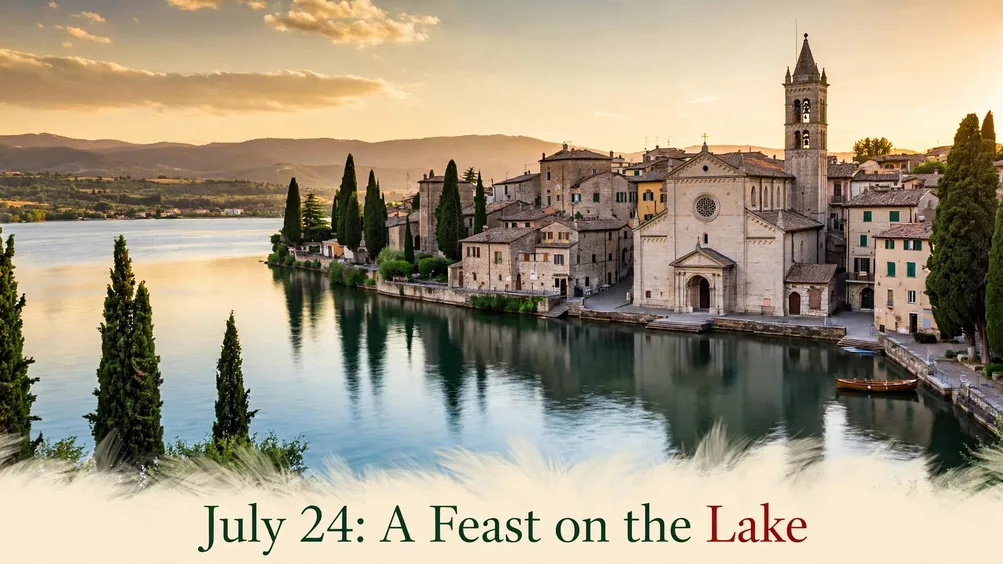
July 24 is Cristina’s name day in Italy, the feast of Saint Christina of Bolsena, a third-century martyr. She was a young woman from Bolsena, a town on a lake in northern Lazio, who was killed for her Christian faith during the Roman persecutions. Her story gives every Cristina a saint, a town, and a summer feast day.
The third-century martyr
Christina of Bolsena lived in the third century, when Christianity was still persecuted in the Roman Empire. The old accounts say she was the daughter of Urban, a rich magistrate of Bolsena, who locked her in a tower when she refused to worship the Roman gods. She was martyred around 300, probably under the emperor Diocletian, and her cult spread from Bolsena across Italy.
The lake, the arrows, and the legend
The legend says Christina was thrown into Lake Bolsena with a heavy stone tied to her neck, and an angel saved her from drowning. Arrows followed, and when those failed, she was killed with a sword, or so the medieval lives of the saints tell it. The details come from legend rather than contemporary records, so the story reads best as devotion wrapped around a real martyr.
Bolsena today: the basilica and the Corpus Christi miracle
Bolsena still keeps Christina as its patroness, and the basilica that bears her name stands over her tomb on the northern shore of the lake. The same basilica was the scene of the Eucharistic miracle of 1263, when a consecrated host was said to bleed during Mass, and that miracle gave rise to the feast of Corpus Christi. A Cristina who visits Bolsena on July 24 finds a town celebrating its own saint.

Famous Cristinas: A President, a Singer, and a Revolutionary
The most famous Cristinas span politics, music, and revolution. Cristina Fernandez de Kirchner led Argentina as president, Cristina Scabbia fronts the Italian metal band Lacuna Coil, and Cristina Trivulzio di Belgiojoso fought for Italian unification in the nineteenth century. Each of them carried the name into a different kind of public life.
Cristina Trivulzio di Belgiojoso, the Risorgimento princess
Cristina Trivulzio di Belgiojoso was born in Milan in 1808 and died near Milan in 1871, and she spent her life and her fortune on the cause of Italian unification. She ran a salon in Paris, funded newspapers, and organized volunteers for the revolutions of 1848, and she later served as a senator in the Kingdom of Italy. Some name sites give her dates as 1819 to 1891, which are wrong on both ends, and the real dates make her story longer and stranger.
Cristina Scabbia and Cristina D’Avena
Cristina Scabbia, born in Milan in 1972, is the singer of Lacuna Coil, the Italian gothic metal band that took Italian music onto world stages. Cristina D’Avena, born in Bologna in 1964, sang the theme songs of a generation of Italian cartoon shows and became a fixture of Italian television. The two singers show the name at opposite ends of Italian pop culture, one in metal clubs and one in children’s television.
Cristina on screen: Cristina Yang and Vicky Cristina Barcelona
Television gave the name its sharpest modern image in Cristina Yang, the brilliant and fiercely competitive surgeon played by Sandra Oh on Grey’s Anatomy. Film gave it another in Vicky Cristina Barcelona, the 2008 Woody Allen film where Penelope Cruz plays the passionate Cristina. Both characters are intense and stubborn, and both made the name familiar to viewers who had never met a Cristina in real life.
How Popular Is Cristina Today?
Cristina peaked in the United States in 1986, when it ranked 163rd among girls’ names, and it has faded steadily since. In 2025 it ranked 1,622nd, with 128 girls given the name, which makes it rare for newborns and common among adults. In Italy the name stays familiar, though no official ISTAT count could be verified for this article.
The American rise and fall: peak 163 in 1986
Cristina first appeared on the American girls’ charts in 1948, and it climbed through the 1970s as the Hispanic-American population grew and Italian culture spread through American film and music. The peak came in 1986 at 163rd, and the fall since the mid-1990s has been steady. Nameberry’s table of Social Security Administration figures shows 128 girls named Cristina in 2025, against 256 in 2014, so the name lost about half its newborns in eleven years.
MomJunction gives a different 2025 rank, 1,293rd, against Nameberry’s 1,622nd, and the two cannot both be right. Nameberry publishes the full year-by-year table with birth counts, so this article follows its figures, and the gap between the two sites is a reminder to check the table rather than the headline rank. Either way, Cristina is now a rare choice for an American newborn.
Cristina in Italy: a living classic, no verified ISTAT count
In Italy, Cristina is a living classic, and it turns up across generations instead of clustering in one decade. One name database estimates about 290,000 people named Cristina in Italy, which would put it among the more common Italian forenames, but that figure is a model estimate rather than an official count. No verified ISTAT ranking of Cristina among newborns could be found for this article, so no Italian number is given here as fact.
An American Cristina is usually an adult, often with Italian or Hispanic roots, while an Italian Cristina can be any age, and the name needs no explanation at home. For parents outside Italy, that gap is useful: the name reads as Italian heritage abroad and as an ordinary classic inside Italy.
Would Cristina Suit a July Baby? A Saint Christina Test
Cristina suits a July baby well, because the name day falls on July 24 and the saint behind it is one of the oldest in the Italian calendar. A July Cristina gets a feast day inside her birth month, which gives the name an anchor most names lack. Weigh that gift against the two habits that trip the name up.
Pick Cristina if the July 24 name day speaks to you
Pick Cristina if you like a name with a feast day you can actually celebrate, because July 24 lands in high summer and Bolsena keeps the saint with processions and lake-side festivities. Pick it too if the meaning matters more than the fashion, since follower of Christ is a statement of faith that will not date the way a fashionable name does.
The name also travels well, since the same spelling works in Italian, Spanish, and Portuguese, which helps a child with family on more than one shore. If you want a second opinion from the same family of names, see what Elisa means in Italian, another meaning explainer in the same series.
Think twice if the Christina spelling will follow you
Think twice if you dislike correcting people, because English speakers will write Christina with an H and say kris-TEE-nah unless you stop them. Think twice too if a rare name matters to you in the United States, since Cristina now ranks outside the top 1,600 for newborn girls and will feel uncommon in a classroom. Neither habit is a reason to drop the name, but both are worth knowing before the birth certificate is signed.
Frequently Asked Questions
How do you pronounce Cristina in Italian?
In Italian, Cristina is pronounced kree-STEE-nah, with the stress on the middle syllable and a long ee in the first syllable. English speakers often say kris-TEE-nah, which is the English reading, not the Italian one.
Is Cristina an Italian name?
Yes. Cristina is the Italian form of Christina, and the same spelling is also used in Spanish, Portuguese, Catalan, and Romanian. The form without the H is what marks it as Italian.
When is Cristina's name day?
July 24, the feast of Saint Christina of Bolsena, a third-century martyr from a town on Lake Bolsena in northern Lazio. Italy celebrates the onomastico on that date.
How popular is Cristina?
In the United States it peaked at 163rd in 1986 and ranked 1,622nd in 2025, with 128 girls given the name. In Italy it is far more common, though no official ISTAT count could be verified for this article.
What are nicknames for Cristina?
Tina is the Italian diminutive, and Cris and Stina are used across languages. The masculine form is Cristiano in Italian, and the longer feminine form is Cristiana.
Conclusion
Cristina means follower of Christ, and the meaning has survived the journey from Greek to Latin to Italian without changing. The name brings a July 24 feast day, a saint on a lake in northern Lazio, and a spelling that marks it as Italian at a glance. For parents who want a classic with a faith behind it, Cristina is a steady choice, and the July test is the simplest way to decide.


