Skip to content


Women Italian names are the names Italian women actually carry, from the timeless classics still heard in every Italian piazza to the names made famous by Italy’s actresses, singers, scientists and athletes. This guide covers both sides: the names worn by millions of Italian women today, and the remarkable women who carried them into history. Whether you are naming a daughter, writing a character, or tracing your heritage, you will find verified meanings, honest origins and Italian pronunciations throughout. For the full collection, start at the Italian girl names homepage, and see the most popular Italian girl names for the current favorites.
What Italian Women Are Actually Named
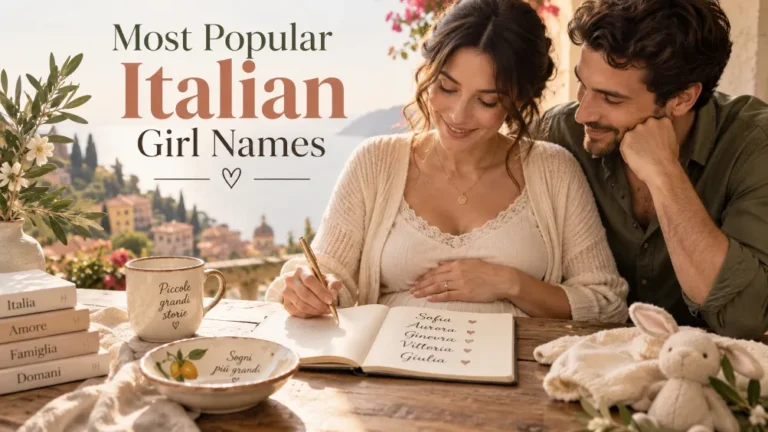
The names of Italian women split cleanly by generation. For newborn girls, Italy’s official statistics institute (ISTAT) puts Sofia, Aurora, Ginevra, Vittoria and Giulia at the top of its 2024 ranking, from 369,944 registered births. Among women born before about 1980, the picture is different: Maria, Anna, Giuseppina, Giovanna, Rosa, Elena and Francesca dominate, the Catholic-core names passed down through grandmothers, exactly as Italian naming tradition prescribes.
The youngest generation of Italian women answers to Sofia (soh-FEE-ah), Greek for “wisdom” and Italy’s number one name for well over a decade; Aurora (ow-ROH-rah), Latin for “dawn”; Ginevra (jee-NEH-vrah), the Italian form of Guinevere, traditionally glossed “white wave”; Vittoria (veet-TOH-ryah), Latin for “victory”; and Giulia (JOO-lyah), from the Latin for “youthful”. These are international names with deep Italian roots, and they travel well outside Italy.
The women of the older generations carry the names of Italy’s Catholic heart. Maria (mah-REE-ah) is the Latin form of the Hebrew Mary, and its exact meaning is debated by scholars, with “beloved” and “wished-for child” the most common readings. Anna (AHN-nah) is the Latin and Greek form of Hebrew Hannah, meaning “grace” or “favor”. Giuseppina (joo-sehp-PEE-nah) is the Italian feminine of Giuseppe, from the Hebrew for “God will add”. Giovanna (joh-VAHN-nah) is the Italian feminine of Giovanni, meaning “God is gracious”. Rosa (ROH-zah) is simply the Latin word for “rose”. Elena (eh-LEH-nah) is the Italian form of Helen, traditionally glossed “bright, shining light”. Francesca (frahn-CHEH-skah) is the Italian feminine of Francesco, though its exact meaning is uncertain and the popular “free one” gloss is folk etymology. Lucia (loo-CHEE-ah) is Latin for “light”. Angela (AHN-jeh-lah) is Greek for “messenger”. Paola (POW-lah) is the Italian feminine of Paolo, meaning “small” or “humble”. Roberta (roh-BEHR-tah) is the Italian feminine of Roberto, from the Germanic for “bright fame”.
One more pattern belongs to the older generations: the double name. Maria Grazia (mah-REE-ah GRAH-tsyah), Maria Teresa (mah-REE-ah teh-REH-zah) and Anna Maria (AHN-nah mah-REE-ah) are compound names worn by countless Italian women over fifty, and they are still perfectly correct Italian. If your grandmother was Italian, there is a good chance her name is on this list.
Famous Italian Women and Their Names
Italian cinema, music, history and sport have given the world a gallery of women whose names are now inseparable from their achievements. Every name below is verified for genuine Italian usage, with its meaning, origin and Italian pronunciation. For more names in this spirit, browse the beautiful Italian girl names collection and the Italian girl names with meanings guide.
Names from Italian cinema
Sofia (soh-FEE-ah): Meaning: wisdom. Origin: Greek, with deep Italian usage. Famous bearer: Sophia Loren, born Sofia Villani Scicolone, the most internationally recognized Italian actress of the twentieth century.
Monica (MOH-nee-kah): Meaning: advisor. Origin: Latin, borne by Saint Monica. Famous bearer: Monica Bellucci, model and actress.
Claudia (KLOW-dyah): Meaning: from the Ancient Roman family name Claudius (no safe one-word gloss). Origin: Latin. Famous bearer: Claudia Cardinale, star of 1960s Italian and French cinema.
Gina (JEE-nah): Meaning: short form of names ending in gina, such as Luigina, Georgina or Regina. Origin: Italian usage, popularized worldwide in the 1950s by Gina Lollobrigida, whose birth name was Luigina.
Giulietta (joo-LYEHT-tah): Meaning: little Giulia, “youthful”. Origin: Italian diminutive. Famous bearer: Giulietta Masina, Federico Fellini’s wife and muse, called the female Chaplin.
Ornella (or-NEHL-lah): Meaning: from Tuscan ornello, “flowering ash tree”. Origin: Italian, created by the author Gabriele d’Annunzio for his 1904 novel La Figlia di Jorio. Famous bearer: Ornella Muti, actress.
Valeria (vah-LEH-ryah): Meaning: strong, healthy. Origin: Latin. Famous bearer: Valeria Golino, actress and director.
Alba (AHL-bah): Meaning: dawn. Origin: Latin. Famous bearer: Alba Rohrwacher, acclaimed actress.
Paola (POW-lah): Meaning: small, humble. Origin: Italian feminine of Paolo. Famous bearer: Paola Cortellesi, actress, comedian and singer.
Stefania (steh-FAH-nyah): Meaning: crown, garland. Origin: Italian feminine of Stefano, from Greek. Famous bearer: Stefania Sandrelli, leading lady of Italian comedy since the 1960s.
Eleonora (eh-leh-oh-NOH-rah): Meaning: often glossed “light”, though the exact origin is uncertain. Origin: Italian form of Eleanor. Famous bearer: Eleonora Duse, the great stage actress of the late nineteenth century.
Isabella (ee-zah-BEHL-lah): Meaning: God is my oath. Origin: Italian and Spanish form of Elizabeth, from Hebrew. Famous bearer: Isabella Andreini (1562-1604), the commedia dell’arte actress who defined the leading romantic role on the Italian stage.
Names from Italian music
Anna (AHN-nah): Meaning: grace, favor. Origin: Latin and Greek form of Hebrew Hannah. Famous bearer: Anna Maria Mazzini, known to the world as Mina, Italy’s most iconic female voice. Note the honesty point: Mina itself is her stage name, not a traditional Italian given name.
Laura (LOW-rah): Meaning: laurel. Origin: Latin. Famous bearer: Laura Pausini, who brought Italian pop to international audiences.
Giorgia (JOR-jah): Meaning: farmer, earth-worker. Origin: Italian feminine of Giorgio, from Greek. Famous bearer: Giorgia, one of Italy’s best-selling singers.
Elisa (eh-LEE-zah): Meaning: God is my oath. Origin: Italian short form of Elisabetta, from Hebrew. Famous bearer: Elisa Toffoli, singer-songwriter known mononymously as Elisa.
Ornella (or-NEHL-lah): Meaning: flowering ash tree (see above). Origin: Italian literary invention. Famous bearer: Ornella Vanoni, admired for more than half a century of Italian song.
Gigliola (jee-LYOH-lah): Meaning: Italian usage; the name is traditionally linked to the floral world. Origin: Italian. Famous bearer: Gigliola Cinquetti, who won Eurovision for Italy in 1964 at sixteen.
Names from Italian history and science
Maria (mah-REE-ah): Meaning: debated; “beloved” and “wished-for child” are the most common readings. Origin: Latin form of Hebrew Mary. Famous bearer: Maria Montessori, the physician whose educational method reshaped classrooms worldwide.
Elena (eh-LEH-nah): Meaning: traditionally “bright, shining light”. Origin: Italian form of Helen, from Greek. Famous bearer: Elena Ferrante, the pen name of the celebrated author of the Neapolitan Novels.
Artemisia (ahr-teh-MEE-zyah): Meaning: of Artemis. Origin: Greek, with Italian usage. Famous bearer: Artemisia Gentileschi, the Baroque painter.
Grazia (GRAH-tsyah): Meaning: grace. Origin: Italian. Famous bearer: Grazia Deledda, Nobel laureate in literature.
Rita (REE-tah): Meaning: pearl. Origin: Italian short form of Margherita. Famous bearer: Rita Levi-Montalcini, Nobel-winning neurologist.
Margherita (mahr-geh-REE-tah): Meaning: pearl. Origin: Italian form of Margaret, from Greek. Famous bearer: Margherita Hack, the beloved astrophysicist.
Caterina (kah-teh-REE-nah): Meaning: uncertain; traditionally linked to “pure”. Origin: Italian form of Katherine, from Greek. Famous bearer: Caterina Sforza, Countess of Forli and a formidable Renaissance ruler.
Lucrezia (loo-KREH-tsyah): Meaning: from the Roman family name Lucretius, possibly “profit”. Origin: Latin. Famous bearer: Lucrezia Borgia, daughter of a pope and Duchess of Ferrara.
Livia (LEE-vyah): Meaning: from the Roman family name Livius (meaning unknown). Origin: Latin. Famous bearer: Livia, wife of Augustus and Rome’s first empress.
Teresa (teh-REH-zah): Meaning: uncertain; traditionally “harvester”. Origin: uncertain, long Italian usage. Famous bearer: Mother Teresa, born in Skopje to an Albanian family, who took the name Teresa in religious life.
Isabella also belongs to history through Isabella d’Este (1474-1539), the Marchesa of Mantua and one of the great patrons of the Renaissance.
Names from Italian sport
Beatrice (beh-ah-TREE-cheh): Meaning: she who brings happiness; blessed. Origin: Italian form of Beatrix, from Latin. Famous bearer: Beatrice “Bebe” Vio, Paralympic fencing champion.
Federica (feh-deh-REE-kah): Meaning: peaceful ruler. Origin: Italian feminine of Federico, from Germanic. Famous bearer: Federica Pellegrini, Olympic swimming champion.
Sara (SAH-rah): Meaning: princess. Origin: Hebrew, with long Italian usage. Famous bearer: Sara Simeoni, Olympic high jump champion.
Carolina (kah-roh-LEE-nah): Meaning: free woman. Origin: Italian feminine of Carlo, from Germanic. Famous bearer: Carolina Kostner, world champion figure skater.
Arianna (ah-ree-AHN-nah): Meaning: most holy. Origin: Italian form of Ariadne, from Greek. Famous bearer: Arianna Fontana, short track speed skating champion.
Samantha (sah-MAHN-tah): Meaning: international name with Italian usage. Origin: English coinage, now used in Italy. Famous bearer: Samantha Cristoforetti, astronaut and the first Italian woman in space.
Names That Sound Italian but Are Not
Not every name on a “women Italian names” list is actually Italian. Competitor lists routinely include masculine names filed as feminine, Spanish names presented as Italian, stage names with no dictionary entry, and outright inventions. We checked each of the following against Behind the Name and excluded it, with the reason stated.
Felice is a masculine Italian name, the Italian form of Felix, yet one major parenting site lists it among girl names. Reina means “queen” in Spanish and carries Spanish usage, yet a competing Italian-names page files it as an Italian royal name. Mina has no Italian usage as a given name; it is the stage name of Anna Maria Mazzini, and as a standalone it is a short form of Wilhelmina or a South Asian name. Milva has no dictionary entry at all; it is the stage name of the singer born Maria Ilva Biolcati. Bianca-Rose and Chiara-Belle are invented English double-barrels presented as Italian on one listicle, and they are not Italian names. Jovanne and Geanna are misspellings of Giovanni and Gianna that appear on a competitor page. Sienna is the English place-name spelling of Siena and an international name, not an Italian one. Verde (“green”), Amore (“love”) and Bambi are Italian words, not given names. Fina is a Spanish short form. Ciandra, Donisha, Venette, Milania, Cira, Zetta, Arlena and Caldonia appear on competitor lists with no verifiable Italian usage anywhere. Donna is an English name taken from the Italian word for “lady”, not an Italian given name. And when a competing page lists Diana via Princess Diana or Sofia via the Queen of Spain as Italian royal names, those are British and Spanish royals, not Italian ones.
A final spelling warning, courtesy of Nameberry’s reporting on ISTAT data: alternative spellings like Giovanny, Adrianna and Luka are perceived in Italy as mistakes, not creative choices. If you want the name to read as genuinely Italian, use the standard Italian spelling.
How to Choose a Women-Style Italian Name
Choose a name the way Italian families do. Pick the generation you want to honor: a grandmother’s name like Giovanna or Rosa carries heritage, while a name like Aurora or Ginevra feels current. Say it out loud with Italian vowels, because the musicality is the point. Check the nickname it will earn, since Italian diminutives (Bice for Beatrice, Gina for Luigina) often become the everyday name. And use the standard spelling, because in Italy a creative respelling reads as an error rather than originality.
Frequently Asked Questions
What is the most famous Italian woman's name?
Sofia is arguably the most famous, carried by Sophia Loren, born Sofia Villani Scicolone, the most internationally recognized Italian actress of the twentieth century. Maria runs a close second through Maria Montessori, whose educational method is used in classrooms worldwide, and through the countless Italian women named after the Virgin Mary. Both names have deep, verified Italian usage.
Is Felice a girl's name in Italian?
No. Felice is a masculine Italian name, the Italian form of Felix, and Behind the Name lists it as masculine with Italian usage. One major parenting site files it among girl names, which is an error. Parents looking for the feminine equivalent should consider Felicita or Felicia, both genuine Italian feminine names meaning fortunate or happy.
Is Reina an Italian name?
No. Reina means "queen" in Spanish and Behind the Name lists it with Spanish usage, not Italian. One competing Italian-names page files it as an Italian royal name, which is incorrect. The Italian word for queen is regina, and Regina is the genuine Italian name with that meaning and verified Italian usage.
Is Mina an Italian name?
Not as a given name. Mina has no Italian usage entry on Behind the Name; it is the stage name of Anna Maria Mazzini, Italy's most iconic female singer. As a standalone name it is a short form of Wilhelmina or a South Asian name meaning fish. The authentic Italian name behind the legend is Anna, meaning grace.
How do you pronounce Italian women's names?
Italian vowels are pure and every syllable is sounded. Chiara is kee-AH-rah, Gioia is JOY-ah, Giulia is JOO-lee-ah, Francesca is frahn-CHEH-skah, Giovanna is joh-VAHN-nah, and Margherita is mahr-geh-REE-tah. Stress usually falls on the second-to-last syllable, the letter C before E or I sounds like "ch" (Lucia: loo-CHEE-ah), and double consonants are held longer, as in the double T of Vittoria (veet-TOH-ryah).