 Skip to content


What Does Vittoria Mean in Italian
Vittoria means “victory” in Italian. It is the Italian form of Victoria, from the Latin word victoria, which comes from the verb vincere, “to conquer”. The name carries the same meaning as the everyday Italian word vittoria, so a girl named Vittoria carries a word Italians use every day. Browse our Italian girl names collection to see how it sits among other classic Italian names for girls.
This guide gives the full answer: the Latin root and the Roman goddess behind it, the three-syllable Italian pronunciation most English speakers miss, how Vittoria differs from Victoria, the December name day, the famous women who carried it, and the short forms families actually use. Each part sticks to facts you can check, and the common mistakes are named plainly.
Victory, Word for Word: What Vittoria Means
Vittoria means “victory” in Italian, nothing more and nothing less. It comes from the Latin noun victoria, built on the verb vincere, “to conquer”, and it entered Italian as both an everyday word and a given name. The meaning has never drifted: in Rome it named a goddess, and today it still names girls after the same single idea, winning.
From vincere to vittoria
The chain is short and easy to follow. The Latin verb vincere means “to conquer”. Its noun victoria means “victory”, the act of winning. Italian kept the word and the name together, so vittoria is both the noun on a sports page and the name on a birth certificate. Behind the Name lists Vittoria as the Italian form of Victoria, with the masculine forms Vittorio and Vittore beside it.
The goddess Victoria and her laurel
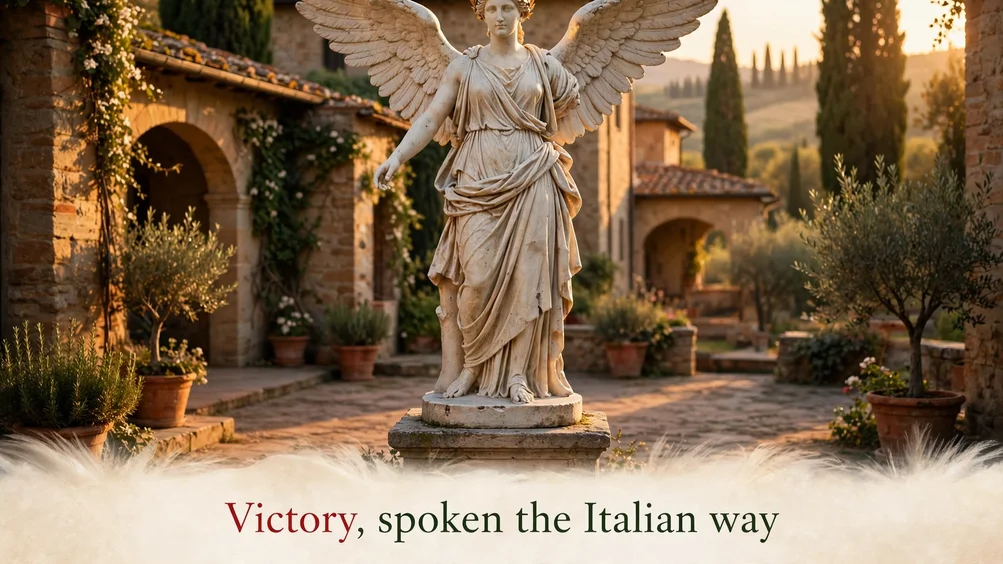
Before it was a name, Victoria was a Roman goddess. She personified victory and was shown with wings and a laurel wreath, the crown given to winners. Her altar stood in the Senate house, where senators offered incense before their sessions, until a Christian emperor had it removed in 382. The goddess faded, but the word stayed, and Christian families later gave the name to daughters and to martyrs.
Why the double T is not a spelling quirk
The double T looks decorative, but it records a real sound change. Latin -ct- became -tt- in Italian, so factum became fatto and victoria became vittoria. The spelling tells you how to say it: hold the T a beat longer than a single T. English speakers who write “Vitoria” with one T have written a different word, the Spanish and Portuguese form.
The Double T and the Gliding Ia: Saying Vittoria the Italian Way
Vittoria is pronounced veet-TOR-yah in Italian, with three syllables and the stress on TOR. The final “ia” glides into a single “ya” sound, so the name ends the way “ya” sounds, not with two separate vowels. The four-syllable veet-TOR-ee-ah you hear in English is a different reading, and it is the most common mistake with this name.
Three syllables: vit, TOR, ya
Say it in three beats: vit, TOR, ya. The first syllable is short, the second carries the stress and the long O, and the third is a quick “ya”. Behind the Name gives the Italian pronunciation as /vit.ˈtɔː.rja/, and that final “rja” is the glide in print. Our guide to how to pronounce Vittoria walks through the same sounds with a five-minute drill.
| Syllable | Sound | Note |
|---|---|---|
| vit | veet | Short and light |
| TOR | TOR | Stressed, with a long O |
| ya | yah | A quick glide, not two vowels |
The held double T
Italian doubles a consonant by holding it longer, and the double T in Vittoria is the clearest test of that rule. Say “veet” and stay on the T for a fraction longer before the O arrives. A single T would rush the name along and flatten its rhythm, so the hold belongs to the sound itself. Practice it slowly, then bring the speed back up.
The four-syllable English reading
English speakers usually say vee-TOR-ee-ah, with four syllables and a separate “ee” before the final “ah”. Name sites repeat that spelling, and MomJunction prints two different English versions on the same page, vee-TAW-ryah in its introduction and vih-toh-ree-ah in its pronunciation section. Neither is the Italian form. If you want the Italian sound, drop the extra syllable and let the ending glide.
Vittoria or Victoria: Same Root, Different Name
Vittoria and Victoria share one root and one meaning, but they are different names in sound and feel. Victoria is the Latin and English form, familiar everywhere and softened by centuries of English use. Vittoria is the Italian form, with the held double T and the gliding ending, and it sounds unmistakably Italian the moment you say it aloud.
| Feature | Vittoria | Victoria |
|---|---|---|
| Form | Italian | Latin and English |
| Pronunciation | veet-TOR-yah, three syllables | vik-TOR-ee-ah, four syllables |
| Sound | Held double T, gliding “ia” | Single T, separate vowels |
| Feel | Italian, bold, uncommon in the US | Familiar, classic, widely used |
Same root, different feel
The choice between them is a choice of sound and setting. Victoria fits anywhere and needs no explanation, which is why it has stayed near the top of English name lists for generations. Vittoria asks a little more of the listener and gives a little more back: the double T, the rolled R, and the quick “ya” ending mark it as Italian before anything else is said.
Which one fits your family
If your family speaks Italian at home or keeps Italian traditions, Vittoria keeps the name in its home language. If most people around you will read it in English, expect to correct the pronunciation now and then. Either way, the meaning stays the same, so the decision is about sound and heritage. Our Italian girl names with meanings page sets Vittoria beside other names families weigh the same way.
December 23: Vittoria’s Name Day
Vittoria’s name day falls on December 23, the feast of Saint Victoria, a virgin martyr of the third century. Italian families mark the onomastico with a greeting, a call, or a small gift, the way they would mark a second birthday. The date is fixed on Italian calendars, so a girl named Vittoria always knows when her day arrives.
Saint Victoria, virgin martyr
The saint behind the date is Victoria of Trebula Mutuesca, a young Christian woman killed in the Sabine hills in the third century, during the persecutions under Emperor Decius. Roman tradition remembers her with her sister Anatolia, and the two are honored together in early martyrologies. Italian calendars kept December 23 as her feast, and the name Vittoria inherited the day with the saint.
A second date in the Martyrology
The records hold a second date worth knowing. The Roman Martyrology lists Victoria and Anatolia under July 10, while the older Martyrologium Hieronymianum mentions Victoria alone under December 19. December 23 is the date Italian families actually celebrate, and it is the one to put on the calendar. The July listing explains why a search sometimes turns up a summer date.
Three Vittorias Who Carried the Name
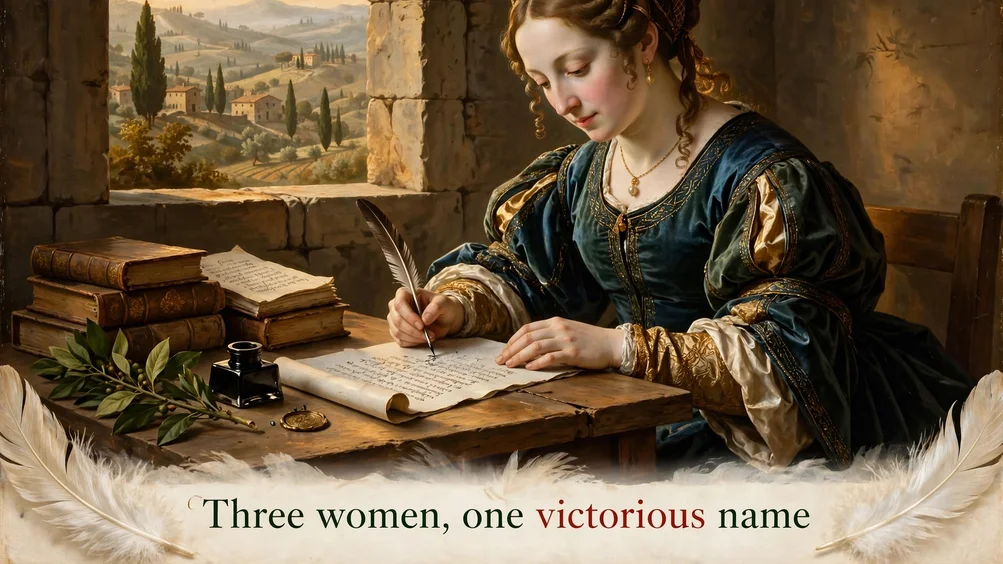
Three women show how wide this name reaches: a Renaissance poet, a duchess whose life became a play, and a supermodel born in Brescia. Vittoria Colonna wrote sonnets and exchanged letters with Michelangelo. Vittoria Accoramboni lived a short, dramatic life that inspired Webster’s The White Devil. Vittoria Ceretti walks the runways of the world’s fashion houses today.
Vittoria Colonna, poet of the Renaissance
Vittoria Colonna was a sixteenth-century Italian noblewoman and poet, among the first Italian women to see a book of her poetry in print. She wrote Petrarchan sonnets, many of them spiritual, and her friendship with Michelangelo was one of the great literary friendships of the Renaissance: he wrote sonnets for her and made drawings for her private devotion. Her name still stands for a woman of letters.
Vittoria Accoramboni, duchess of a tragic tale
Vittoria Accoramboni (1557-1585) was an Italian noblewoman whose short life became one of the famous scandals of Renaissance Rome. Born in Gubbio, the tenth child of a minor noble family, she married into power, lost both husbands to murder and sudden death, and was murdered in Padua at twenty-eight. John Webster turned her story into The White Devil in 1612, and Stendhal and Ludwig Tieck retold it after him.
Vittoria Ceretti, the modern face
Vittoria Ceretti, born in Brescia in 1998, is the name’s modern face. She rose to international fame in the 2010s, appearing on Vogue covers and walking for Chanel, Valentino, and Versace. The actress Vittoria Puccini, born in Florence in 1981, gives the name a second modern bearer, known for leading roles in Italian television dramas. Between them, the name reads current and modern.
Nicknames, Variants, and a Rare Name in America
Vittoria shortens easily, and the short forms are part of its charm. Vicky, Toria, and Ria are the forms families use most, with Tori and Via close behind. The full name stays formal and Italian, while the nicknames fit everyday life, school, and friends. That split is one reason parents pick a long name with ready-made short forms.
Short forms that keep the Italian sound
Not every nickname keeps the Italian sound, so choose with care. Ria keeps the gliding ending and sounds Italian on its own. Toria keeps the stressed TOR and most of the full name. Vicky is the friendly English default, and it softens the name the most. NameRoot lists only Viti and Vitt, but those two are rare in real use.
Variants across languages
| Variant | Language | Note |
|---|---|---|
| Vittoria | Italian | The form this article covers |
| Victoria | Latin, English, Spanish | The familiar form in English and Spanish |
| Viktoria | German, Scandinavian, Slavic | The K spelling of the same name |
| Victoire | French | The French form |
| Wiktoria | Polish | The Polish form |
| Vita | Italian and Slavic | Short form, also a name in its own right |
Vita deserves a note of its own. It works as a short form of Vittoria and as a name in its own right, from the Latin vita, “life”. Some families choose Vita for the short form and keep Vittoria for the birth certificate, which gives the child both names in one.
Rare in America, familiar in Italy
In the United States, Vittoria is rare. Social Security records show 61 girls named Vittoria in 2025, with a peak of 66 in 2023, and the name sits well outside the top 1,000. In Italy the picture is different: one name database reports it was the fourth most common girl name in 2023, behind Sofia, Aurora, and Ginevra.
Choosing Vittoria: A Victory Name That Asks for Confidence
Choose Vittoria if you want a name with a clear meaning, a strong sound, and a real history behind it. If you want a softer name with an equally clear meaning, our guide to what Elena means in Italian covers a name that means torch or light. It suits families who like bold names and do not mind correcting the pronunciation now and then. It asks for a little confidence from the child who carries it, because a name that means “victory” sets a high bar.
Say it with your surname
Say the full name aloud three times, with your surname, at normal speed. The double T and the long O need room, so a very short surname can make the name feel top-heavy, while a longer surname balances it. Try it in a greeting, a roll call, and a formal introduction. If it flows in all three, the sound works.
The confidence question
A name that means “victory” is a promise, and promises invite attention. Some children grow into a bold name and love the story it tells; others prefer to blend in, and Vittoria does not blend in. Talk it over as a family and weigh the meaning against the sound. Our Italian girl names starting with V page shows the other V names families compare before they settle on one.
The popularity question
Vittoria is uncommon enough in the United States that your daughter will rarely share it, and familiar enough in Italy that it never sounds invented. That middle ground suits parents who want a name with roots and without a crowd. If rarity matters more than heritage, a shorter Italian name may fit better; if heritage matters more, Vittoria earns its place.
Frequently Asked Questions
How do you pronounce Vittoria in Italian?
Vittoria is pronounced veet-TOR-yah in Italian, with three syllables and the stress on TOR. Hold the double T a beat longer than a single T, and let the final "ia" glide into a single "ya". The four-syllable vee-TOR-ee-ah is the English reading, not the Italian one.
Is Vittoria the same as Victoria?
Vittoria and Victoria share one root and one meaning, but they are different names in sound. Victoria is the Latin and English form, pronounced vik-TOR-ee-ah with four syllables. Vittoria is the Italian form, pronounced veet-TOR-yah with three syllables, a held double T, and a gliding ending.
When is Vittoria's name day?
Vittoria's name day is December 23, the feast of Saint Victoria, a virgin martyr of the third century. Italian families mark the onomastico the way they would mark a second birthday. The Roman Martyrology also lists Victoria under July 10, which is why a search sometimes turns up a summer date.
What are good nicknames for Vittoria?
Vicky, Toria, and Ria are the short forms families use most, with Tori and Via close behind. Ria keeps the gliding Italian ending, Toria keeps the stressed TOR, and Vicky is the friendly English default. Vita works as a short form too, and as a name in its own right.
How popular is the name Vittoria?
Vittoria is rare in the United States: Social Security records show 61 girls named Vittoria in 2025, with a peak of 66 in 2023, well outside the top 1,000. In Italy it is a classic: one name database reports it was the fourth most common girl name in 2023, behind Sofia, Aurora, and Ginevra.
Conclusion
Vittoria means “victory” in Italian, from the Latin victoria and the verb vincere, and it has carried that single meaning from a Roman goddess to a Renaissance poet to a modern supermodel. Say it the Italian way, veet-TOR-yah, mark December 23 on the calendar, and use the short forms that fit your family. If the sound and the story both feel right, the name is ready.


