 Skip to content


What Does Elena Mean in Italian
Elena means “torch” or “light” in Italian. It is the Italian form of Helen, from the Greek Helene, and Behind the Name calls the torch reading the probable one, with a link to selene, “moon”, as a possible second root. The meaning is bright and simple, and it has stayed close to that light image for more than two thousand years, from Greek myth to modern Italian birth registers. The next name in the series, Beatrice, means “she who brings happiness”: see what Beatrice means in Italian.
On ItalianGirlNames.com, Elena sits among the most searched Italian names, and most searchers want the same two things: the true meaning and the Italian pronunciation. This guide gives both, then follows the name from Helen of Troy to Saint Helena, and ends with the choice between Elena and Helen.
Torch or Light: What Elena Really Means
Elena means “torch” or “light”, from the Greek Helene. The torch reading is the one most scholars favor, while the moon reading stays a guess, since selene is a separate Greek word for moon. In everyday Italian use, the name reads as “shining light”, and that is the meaning parents should carry into the rest of this guide.
The torch reading
Helene, the Greek word behind the name, meant a torch, the kind of flame carried at night. That image fits the name well: a torch gives light in the dark, and Elena has carried that sense of brightness through every language it entered. The torch reading also explains why “light” appears on nearly every name site, since a torch and a light are the same idea in different words.
The moon link, and why it stays a maybe
Some name sites list “moon” as a second meaning, and the idea comes from selene, the Greek word for moon, which sounds close to Helene. Behind the Name notes the possible link and leaves it as a possibility, not a settled fact. The moon reading is attractive, but no source proves it, so this guide treats it as a rumor worth knowing, not as the meaning.
What the name meant in Greek
In ancient Greek, Helene was a name before it was a word puzzle, and its bearers were known for beauty and light. Homer gave the name to the most famous Helen of all, and later writers kept the light image alive. The exact root stays uncertain, since scholars still debate whether Helene came from a word for torch or from an older root that no longer survives.
From Helene to Elena: How the Name Traveled
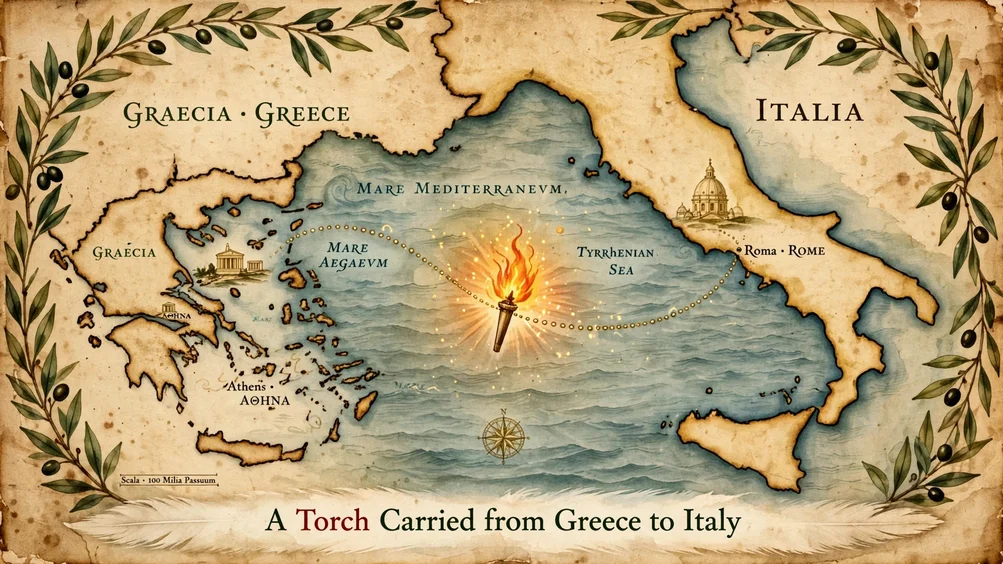
Elena reached Italian from Greek Helene, through Latin Helena, and each step kept the light meaning intact. Greek gave the root, Latin gave the form Helena that spread across the Roman world, and Italian shortened it to Elena. The road is short on paper, but it crosses two thousand years of history, from Homer to Italian birth registers today.
The Greek Helene
Helene is the oldest form of the name, written Ἑλένη in Greek, and it belonged to the ancient world long before Italy existed as a country. The name appears in Homer’s Iliad, where Helen of Troy stands at the center of the Trojan War story. From that one famous bearer, the name spread through the Greek world and into the languages that followed.
Latin Helena and the road into Italian
Latin took Helene and made it Helena, the form that traveled with the Roman Empire. Helena became a Christian name through Saint Helena, mother of Emperor Constantine, and churches across Europe kept it in use. Behind the Name lists Elena as the form of Helen used in Italian, Spanish, Romanian, and other languages, and Italian then shaped Helena into Elena, dropping one syllable and softening the sound.
Elena, Helena, and Helen side by side
The three forms are one name in three languages, and the table below keeps them straight. Elena is the Italian, Spanish, and Romanian form, Helena is the Latin form still used in many countries, and Helen is the English form. A family choosing between them is choosing a language and a sound, not a different meaning.
| Form | Where it is used | English sound |
|---|---|---|
| Elena | Italian, Spanish, Romanian | eh-LEH-nah |
| Helena | Latin, Polish, Czech | heh-LAY-nah |
| Helen | English | HEH-len |
The LEH Sound: Saying Elena the Italian Way
In Italian, Elena is pronounced eh-LEH-nah, with three syllables and the stress on the middle one. The first E sounds like the E in “bed”, the LEH rhymes with “let”, and the final -na is short and open. English speakers who say eh-LAY-nah are using the English reading, not the Italian one.
Three syllables, stress on LEH
Elena breaks into three syllables: E, LEH, na. The stress falls on LEH, the middle syllable, and the other two stay light and quick. Italian vowels stay pure, so each E sounds the same, short and open, and the final A sounds like the A in “father”, never like the A in “cat”.
The eh-LAY-nah trap
The most common mistake is eh-LAY-nah, the English reading that Parenting Patch prints as the name’s pronunciation. English turns the E into a long A sound, while Italian keeps it short, so eh-LAY-nah sounds foreign to an Italian ear. Say eh-LEH-nah instead, with the E of “bed”, and the name lands the way an Italian family would say it.
The full sound-by-sound breakdown
For the full breakdown, with the Italian IPA and practice tips, see how to pronounce Elena on this site. It walks through the E opening, the LEH middle, and the soft -na ending, and it covers the mistakes English speakers make most. A minute of practice is enough to say the name the way an Italian family would.
Saint Helena and the Name Day on August 18
Elena’s name day is August 18, the feast of Saint Helena in the Roman Catholic calendar, and Behind the Name lists August 18 for Elena in Italy. Saint Helena was the mother of Emperor Constantine, and tradition says she found the True Cross in Jerusalem. Italian families with an Elena mark her onomastico on August 18.
The empress who found the Cross
Helena was born around 248 in Drepanum, in Asia Minor, and married the Roman general Constantius, who became emperor. Her son Constantine became the first Christian emperor, and Helena, already in her seventies, traveled to Jerusalem around 326. Tradition says she found the Cross on which Jesus died, and the churches she built in the Holy Land still stand today.
How Italian families mark August 18
In Italy, an onomastico is a small celebration, closer to a birthday than a holiday. Family and friends call or visit, a cake or a bunch of flowers appears, and the Elena of the house gets the day’s greetings. The feast falls in mid-August, near Ferragosto on August 15, so many families fold the name day into the summer holiday week.
A second date worth knowing
The Eastern Orthodox Church honors Helena with her son Constantine on May 21, under the title Equal to the Apostles. Italian Catholic families use August 18, so the May date matters only if the family follows the Orthodox calendar. Either way, the saint behind the name is the same empress, and the August date is the one to put on the calendar.
Helen of Troy: The Story Behind the Name
Helen of Troy is the figure who made the name famous, the daughter of Zeus and Leda whose flight with Paris began the Trojan War. Homer tells her story in the Iliad, and her Greek name, Helene, is the direct source of Elena. Every Elena carries that story, and the name’s light meaning comes from the same Greek root.
The abduction that started a war
In the myth, Helen was the wife of Menelaus, king of Sparta, and Paris, prince of Troy, carried her away to his city. The Greek kings sailed to bring her back, and the ten-year siege of Troy followed. The story is myth, not history, but it gave the name a fame no other Greek name of its age can match.
Why the story still follows the name
The “face that launched a thousand ships” is the line most people know, and it ties Elena to beauty in the public mind. That link is a gift and a weight: the name sounds lovely, yet it carries a story of a woman blamed for a war she did not start. Parents who pick Elena should know the story, since their daughter will hear it sooner or later.
Elena di Troia in Italian
Italian speakers call her Elena di Troia, Elena of Troy, and the phrase shows how close the Italian form sits to the myth. The name needs no translation in Italy: Elena is already the Italian shape of Helene, so the heroine of the Iliad and the girl next door share the same name. That closeness is part of the name’s charm in Italy.
Famous Elenas, from Naples to the Court
The best-known Elenas today are the novelist Elena Ferrante, whose Neapolitan Novels found readers around the world, and the basketball star Elena Delle Donne, a two-time WNBA Most Valuable Player. Behind them stands a long list of Elenas in books, courts, and labs, and the name keeps showing up wherever Italian culture travels.
Elena Ferrante, the novelist nobody knows
Elena Ferrante is the pen name of an Italian novelist whose identity has stayed hidden since her first novel appeared in 1992. Her Neapolitan Novels, starting with My Brilliant Friend in 2011, follow two girls growing up in Naples, and the books became a worldwide success. Her books travel the world, and her face stays out of sight.
Elena Delle Donne, the basketball star
Elena Delle Donne, born in 1989, is an American basketball player who won the WNBA Most Valuable Player award in 2015 and again in 2019. She played for the Washington Mystics, led them to the 2019 championship, and won Olympic gold with the United States in 2016. Her game is known for smooth shooting and calm under pressure, and she has spoken openly about her health and her family.
Elena Kagan, the justice
Elena Kagan, born in 1960, has served as an Associate Justice of the United States Supreme Court since 2010. Before the court, she was the dean of Harvard Law School and the Solicitor General of the United States. Her career gives the name a different kind of weight, built on argument and judgment.
Nicknames and Variants Across Europe
Elena shortens to Lena, Ella, and Ellie, and its variants spread across Europe as Helen, Ellen, Helena, Yelena, and Elaine. Italian families favor Lena and Lella, short forms that keep the Italian sound, while English families reach for Ellie and Nellie. The table below lists the variants by language, so the family can see which form fits its own tongue.
Nicknames that keep the Italian sound
Lena is the nickname most Italian families use, short and warm, and it works in every language Elena travels to. Lella and Eli are the home nicknames, the ones heard at the kitchen table. Ella and Ellie belong more to English, and they soften the name, while Nena, the least common of the group, stays close to the Italian ear.
Variants by language
| Variant | Language | Note |
|---|---|---|
| Helen | English | The English form of the name |
| Ellen | English | Medieval English spelling of Helen |
| Helena | Latin, Polish, Czech | The Latin form, still widely used |
| Helene | German | German form; the French form is Hélène |
| Yelena | Russian | Russian form, written Elena in Cyrillic |
| Jelena | Serbian, Croatian | South Slavic form |
| Elaine | English (Arthurian) | Arthurian form of the name |
| Ilene | English | English variant of Helen |
Elena or Helen: Picking the Form That Fits Your Family
Pick Elena if the family wants the Italian sound, eh-LEH-nah, with the light meaning in its Italian dress. Pick Helen if the family lives in English and wants the form everyone already knows how to spell and say. The meaning stays the same either way, so the choice comes down to sound and spelling.
The sound test with your surname
Say the full name aloud three times, first name plus surname, and listen for the rhythm. Elena pairs well with surnames that start with a consonant, since the open -a ending flows into the next word, and it can clash with surnames that end in -a, where the two vowels run together. If the name trips the tongue, try Helen with the same surname and compare the two out loud.
The popularity question
Elena is a popular name on both sides of the Atlantic, and its US count reached a new high in 2025, with 4,842 babies given the name. In Italy, about 390,000 people carry the name, roughly 1 in 153 residents, according to Mondonomo’s register-based estimate. A family that wants a familiar name will find it, while a family that wants a rare one should look at the Italian girl names with meanings page for quieter choices.
A note on the letter E
Elena belongs to the E names, and families who like its sound often like the other Italian girl names starting with E. That page gathers the whole letter, and it helps to hear Elena next to its neighbors before deciding.
Frequently Asked Questions
How do you pronounce Elena in Italian?
In Italian, Elena is pronounced eh-LEH-nah, with three syllables and the stress on the middle one. English eh-LAY-nah is the English reading, not the Italian one.
Is Elena the same name as Helen?
Yes. Elena is the Italian, Spanish, and Romanian form of Helen, from the Greek Helene. The meaning is the same; only the language and the sound change.
When is Elena's name day?
August 18, the feast of Saint Helena, mother of Emperor Constantine. Behind the Name lists August 18 for Elena in Italy.
Does Elena mean moon?
Not as a settled meaning. Some sites list "moon" from selene, the Greek word for moon, but Behind the Name calls it only a possible link. The established reading is "torch" or "light".
Is Elena a popular name?
Yes. In the United States, 4,842 babies were named Elena in 2025, the highest annual count on record. In Italy, about 390,000 people carry the name, roughly 1 in 153 residents, per Mondonomo's register-based estimate.
Conclusion
Elena means torch or light, and the name has carried that brightness from Greek myth to Italian birth registers without losing a step. Say it eh-LEH-nah, mark August 18 on the calendar, and weigh it against Helen with the sound test above.


