Skip to content

Italian girl names starting with E range from timeless classics like Elena, Emma, and Eva to distinctly Italian choices like Elettra, Elisabetta, and Emanuela. Some are true Italian forms, while others come from Greek, Hebrew, Germanic, or Latin roots and later became common in Italian use.
For names beyond E, browse our full list of Italian names for girls.
Familiar Italian Girl Names Starting With E
The E names below are the most familiar from Italy: beloved Italian forms plus international favorites now common in Italian naming. Pronunciations are approximate Italian.
| Name | Origin | Pronunciation | Meaning and notes |
|---|---|---|---|
| Elena | Italian form of Greek Helen | eh-LEH-nah | Greek roots, though the original meaning of Helen is uncertain. Traditional and widely used. |
| Eleonora | Italian form of Eleanor | eh-leh-oh-NOH-rah | Graceful and formal. The deeper origin of Eleanor is unclear, so simple meanings need caution. |
| Eliana | Used in Italian; linked to French Éliane, likely from Roman Aeliana | eh-lee-AH-nah | Similar spellings belong to unrelated names, so a Hebrew meaning should not be assumed. |
| Elisa | Italian short form of Elisabetta or Elisabeth | eh-LEE-zah | From Hebrew Elisheva, traditionally “my God is an oath.” A lighter alternative to Elisabetta. |
| Elisabetta | Italian form of Elizabeth | eh-lee-zah-BEHT-tah | Hebrew Elisheva, traditionally “my God is an oath.” A distinctly Italian classic with many nicknames. |
| Elsa | Short form of Elisabeth, now an independent name | EHL-zah | Used in Italian and across Europe. Short and easy to pronounce. |
| Emanuela | Italian feminine form of Emmanuel | eh-mah-noo-EH-lah | Hebrew, traditionally “God is with us.” A long traditional name with clear religious history. |
| Emilia | Feminine of the Roman family name Aemilius | eh-MEE-lyah | Strong ancient Roman roots, with a soft pronunciation and clear Italian identity. |
| Emma | Germanic name widely used in Italy | EHM-mah | Connected with an element meaning “whole” or “great.” International and natural in Italian. |
| Erica | Feminine form of Eric, used in Italian | EH-ree-kah | Germanic roots; the spelling also matches the Latin botanical word for heather. |
| Ester | Italian form of Esther | EHS-tehr | Sometimes linked to a Persian word for “star,” though the origin is debated. |
| Eva | Italian form of Eve | EH-vah | Hebrew root connected with living or breathing. Timeless and simple. |
Distinctive and Traditional Italian E Names
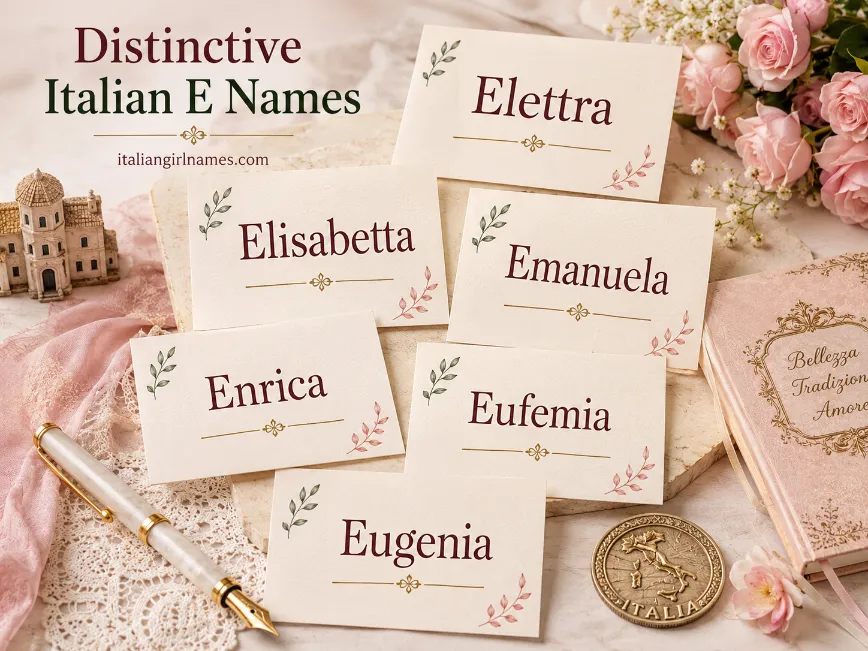
These E names are rarer or more traditional. Several come from ancient history, and their Italian spellings suit parents who want something less common.
| Name | Origin | Pronunciation | Meaning and notes |
|---|---|---|---|
| Elda | Italian form of Hilda | EHL-dah | Germanic root connected with battle. Short, uncommon, traditionally European. |
| Elettra | Italian form of Greek Electra | eh-LEHT-trah | Connected with Greek elektron, “amber.” Unmistakably Italian, with classical character. |
| Elide | Italian; from the Greek region Elis | eh-LEE-deh | Named for Elis in the western Peloponnese. Much less familiar than Elena or Elisa. |
| Elvira | Established in Italian; via Spanish from a Visigothic name | ehl-VEE-rah | The exact meaning is uncertain, so one-word definitions should be viewed cautiously. |
| Emiliana | Feminine of Emiliano, from Roman Aemilius | eh-mee-lee-AH-nah | The same Roman family as Emilia, in a longer and more elaborate form. |
| Enrica | Italian feminine form of Enrico | ehn-REE-kah | Germanic elements traditionally linked to “home” and “ruler.” Strong Italian identity. |
| Erminia | Italian feminine form of Herminius | ehr-MEE-nyah | Literary and traditional; the precise ancient meaning is not securely established. |
| Eufemia | Italian form of Euphemia | eh-oo-FEH-myah | Greek elements connected with speaking words of good omen. Old-world and rare. |
| Eugenia | Feminine of Eugenius, used in Italian | eh-oo-JEH-nyah | Greek, traditionally “well born.” Polished and classical. |
| Eulalia | Greek, used in Italian | eh-oo-LAH-lyah | Traditionally “sweetly speaking” or “well spoken.” Soft rhythm, antique character. |
| Evelina | Latinate form of Aveline, used in Italian | eh-veh-LEE-nah | Related naming traditions overlap here, so one fixed meaning can be misleading. |
| Eloisa | Italian form of Héloïse | eh-loh-EE-zah | Germanic elements for “famous” and “war,” traditionally “famous warrior.” A genuinely Italian form with a bold root. |
| Edvige | Italian form of Hedwig | ehd-VEE-jeh | Germanic elements for “battle” and “war.” Rare in everyday use, with a strong old-world sound. |
| Enrichetta | Italian diminutive of Enrica | ehn-ree-KEHT-tah | The same Germanic “home ruler” elements as Enrica, in a longer and more formal form. |
How to Pronounce Italian E Names
Italian pronunciation follows a few reliable rules. First, every vowel is pronounced: Elena is eh-LEH-nah. Second, double consonants are held slightly longer, giving Elisabetta (eh-lee-zah-BEHT-tah) and Elettra (eh-LEHT-trah) their distinctive rhythm. Third, the letter R is lightly rolled, as in Erica (EH-ree-kah). The soft G in Edvige (ehd-VEE-jeh) sounds like J, the same rule that shapes how to pronounce Giulia.
Stress usually falls on the second-to-last syllable, with exceptions such as Erica. Saying Elena, Elisa, or Eva aloud with the intended surname usually settles which pronunciation you will use day to day.
How to Choose an Italian Girl Name Starting With E
Decide whether you want a name that feels specifically Italian or one that also sounds familiar internationally. Elettra, Elisabetta, Emanuela, Enrica, and Eufemia have especially strong Italian forms, while Emma, Erica, Elena, and Eva travel easily across languages. The Italian feminine names database at Behind the Name is useful for checking established Italian forms and origins.
It also helps to say the complete name aloud with the intended surname. Longer names like Elisabetta or Emanuela can balance a short last name. Shorter names like Elisa, Emma, Eva, and Elda create a brisk rhythm.
If meaning matters, pick names with clear, well-supported roots. Our guide to Italian girl names with meanings collects names whose origins are documented rather than guessed. Be careful with catchy one-word meanings on unsourced lists, since some old names have uncertain or debated origins.
Choosing Your Favorite E Name
The strongest choice depends on the style you want. Elena and Emma feel familiar. Elisa and Eva are short and simple. Elettra, Elisabetta, and Emanuela feel more Italian.
Instead of choosing only by meaning, compare each name’s form, sound, history, and fit with the family surname. That usually creates a more useful shortlist than relying on popularity or a single translated definition.
If none of these quite fits, keep browsing: our A-to-Z list of Italian girl names covers every letter, plus Italian girl names starting with D and Italian girl names starting with F.
Frequently Asked Questions
What is a rare Italian girl name starting with E?
Elide, Eufemia, and Erminia are rare even in Italy. Elide comes from the Greek region Elis, while Eufemia and Erminia have ancient roots and an old-world character.
How do you pronounce Elisabetta in Italian?
Approximately eh-lee-zah-BEHT-tah, with the stress on the bet syllable and the double T held slightly longer. Every vowel is pronounced, as in most Italian names.
Is Emma an Italian name?
Emma is Germanic in origin but is widely used in Italy and feels fully at home there. It is a good example of an international name that works naturally in Italian.
Which E names have the most Italian character?
Elettra, Elisabetta, Emanuela, Enrica, and Eufemia have the most unmistakably Italian forms. Elena, Eva, and Erica travel more easily across languages.