Skip to content
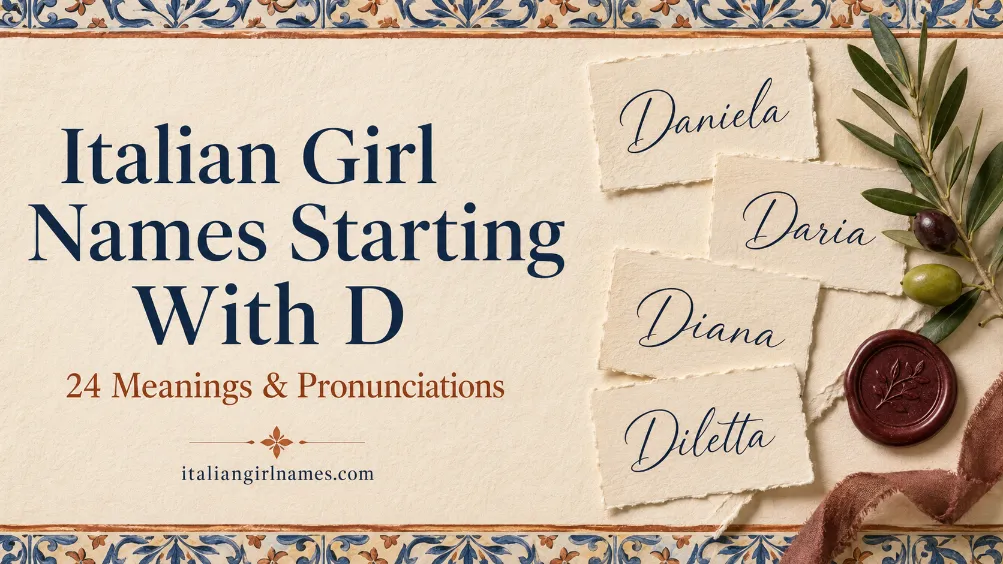
Italian girl names starting with D include short classic names like Dina and Dora. They also include more lyrical choices like Donatella and Desideria. The strongest shortlist depends on what you value most: an unmistakably Italian form, an appealing meaning, easy pronunciation, or a connection to history and faith.
This guide gives you 24 feminine names used in Italian, with concise origin notes and English-friendly pronunciation cues. If you are still choosing initials, browse the complete Italian girl name directory. It lists names from A to Z. The pronunciations below match standard Italian. Regional accents and family traditions may sound a bit different.
24 Italian Girl Names Starting With D
Some choices below originated in Greek, Hebrew, Persian, or Latin before taking an established Italian form. Meanings are therefore presented as careful derivations, not personality promises.
| Name | Meaning or derivation | Italian pronunciation |
|---|---|---|
| Dafne | Italian form of Daphne, from a Greek word meaning “laurel” | DAHF-neh |
| Dalila | Italian form of Delilah; the original meaning is uncertain | DAH-lee-lah |
| Damiana | Feminine form of Damiano; its Greek root means “to tame” | dah-MYAH-nah |
| Daniela | Feminine form of Daniel, “God is my judge” | dah-NYEH-lah |
| Daria | Feminine form of Darius, commonly interpreted as “possessing goodness” | DAH-ryah |
| Debora | Italian form of Deborah, from a Hebrew word meaning “bee” | DEH-boh-rah |
| Delfina | Italian form of Delphina, linked to Delphi; the exact derivation is uncertain | dehl-FEE-nah |
| Delia | A Greek name meaning “of Delos” | DEHL-yah |
| Demetra | Italian form of Demeter, the Greek goddess of agriculture | DEH-meh-trah |
| Desideria | Feminine form of Desiderio, from Latin for “longing” or “desire” | deh-zee-DEH-ryah |
| Diamante | The Italian word for “diamond,” used as a feminine and masculine name | dyah-MAHN-teh |
| Diana | An ancient Roman name meaning “divine” or “goddesslike” | DYAH-nah |
| Diletta | An Italian name meaning “beloved” | dee-LEHT-tah |
| Dina | Italian form of Dinah, linked to “judgment,” or a short form of longer names ending in -dina | DEE-nah |
| Diodata | Feminine form of Diodato, from a name meaning “given by God” | dee-oh-DAH-tah |
| Dionisia | Feminine form of Dionisio, ultimately referring to Dionysus | dyoh-NEE-zyah |
| Domenica | Feminine form of Domenico, from Latin for “of the Lord” | doh-MEH-nee-kah |
| Domitilla | A feminine diminutive of the ancient Roman family name Domitius | doh-mee-TEEL-lah |
| Donata | Feminine form of Donato, from Latin for “given” | doh-NAH-tah |
| Donatella | A diminutive of Donata, also connected with the meaning “given” | doh-nah-TEHL-lah |
| Dora | A short form of Dorotea, Teodora, or Isidora; the meaning depends on the source name | DOR-ah |
| Doretta | An Italian diminutive of Dora | doh-REHT-tah |
| Doriana | Italian feminine form of Dorian | doh-RYAH-nah |
| Dorotea | Italian form of Dorothea, from Greek for “gift of God” | doh-roh-TEH-ah |
What Makes a D Name Italian?
An Italian name does not need to have been invented in Italy. Daniela has Hebrew roots, Daria travels back through Greek to Old Persian, and Dafne comes from Greek mythology. They belong on this list because they are established forms in Italian naming practice.
That distinction matters when choosing a heritage name. If you want vocabulary that is directly Italian, Diamante and Diletta stand out. If you prefer a traditional Italian form of a name shared across cultures, consider Daniela, Debora, or Dorotea. Families can honor Italian language and identity without claiming that every underlying root is Italian.
Familiar Italian D Names for a Shortlist
For an easy name for many English-speaking families, start with Daniela. You can also try Daria. Other options include Diana, Donatella, Dora, or Dafne. Each is recognizable without losing its Italian sound.
Daniela offers the friendly nickname Dani, while Donatella can become Donna or Ella in an English-speaking setting. Diana changes noticeably with Italian pronunciation: it begins with a blended “dyah” sound rather than the common English “dye.” Dafne is brief and phonetic once readers know that the final e is pronounced.
Recognition is not the same as present-day popularity. If popularity matters, check spelling in the official ISTAT baby-name counter. It reports registrations in Italy by year. That is more dependable than assuming a familiar name is currently common.
Distinctive and Historical D Choices
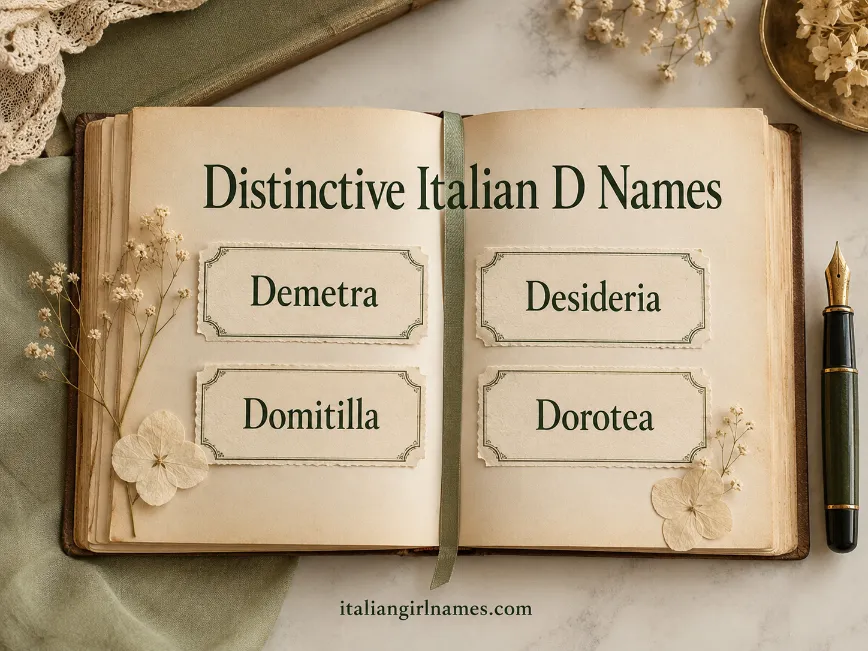
If you want something less expected in English, Demetra, Desideria, Diodata, Dionisia, and Domitilla have substantial historical or classical roots. Demetra connects to the ancient goddess Demeter. Domitilla comes from an old Roman family name. Diodata follows a Latin naming tradition about a divine gift.
For a different kind of statement, Diamante is a bold gemstone name. Diletta has the warm, direct meaning “beloved.” Dorotea feels traditional but is less predictable than Dorothy in an English-speaking context. These options may need an occasional pronunciation reminder, so test each one with the family name before deciding.
How to Choose the Right Name
- Say the full name aloud. Listen for repeated sounds, awkward pauses, and the rhythm between first, middle, and family names.
- Choose the pronunciation you plan to use. An Italian reading may differ from the familiar English one, especially for Diana, Daniela, and Daria.
- Decide what kind of connection matters. You may value Italian linguistic roots, established Italian usage, a saint or historical figure, or a family namesake.
- Check practical details. Look at initials, likely nicknames, spelling corrections, and how the name works in every language your family uses.
The best Italian D name is one whose sound, story, and everyday use all feel right. Daniela and Diana offer easy familiarity, Diletta and Diamante carry vivid Italian meanings, and Domitilla or Desideria provide a more unusual heritage choice. Keep a shortlist, say each option for several days, and let lasting appeal guide the final decision.
Frequently Asked Questions
Which Italian girl name starting with D means beloved?
Diletta means “beloved” in Italian. It is a warm and distinctly Italian choice with the pronunciation dee-LEHT-tah.
Is Diamante only used as a girl’s name in Italy?
No. Diamante, the Italian word for “diamond,” has been used for both girls and boys in Italy, although it works well in a feminine-name shortlist.