Italian girl names starting with E include classic choices like Elena, Emma, and Eva. They also include Italian options like Elettra, Elisabetta, and Emanuela. Some of these names have Italian forms. Others came from Greek, Hebrew, Germanic, or Latin traditions. They later became common in Italian use.
If you want names beyond the letter E, browse our full list of Italian girl names. It offers more ideas by Italian styles and traditions.
Familiar Italian Girl Names Starting With E
Elena
Elena is the Italian form of Helen and one of the most recognizable E names used in Italy. The name has ancient Greek roots, although the precise original meaning of Helen remains uncertain. Elena feels traditional without sounding dated and works naturally in both Italian and English-speaking settings.
Eleonora
Eleonora is the established Italian form of Eleanor. It has a graceful, formal sound and pairs naturally with both short and long surnames. Although Eleonora is sometimes linked to light, the deeper origin of Eleanor is unclear. Treat those simple meanings with caution.
Eliana
Eliana is used in Italian. It is linked to the name Éliane. Éliane likely comes from the Roman name Aeliana. Because several unrelated names share similar spellings, Eliana should not automatically be assigned a Hebrew meaning without identifying the correct linguistic origin.
Elisa
Elisa is a familiar Italian short form of Elisabetta or Elisabeth. The wider Elizabeth name family comes from the Hebrew Elisheva, traditionally interpreted as “my God is an oath.” Elisa offers a lighter, shorter alternative to Elisabetta while keeping the same historical name family.
Elisabetta
Elisabetta is the Italian form of Elizabeth. It is a distinctly Italian choice with a traditional and refined sound. Its longer form also creates several possibilities for affectionate short forms and nicknames.
Elsa
Elsa began as a shortened form of Elisabeth and later became an independent given name. It is used in Italian as well as several other European languages. Its short spelling makes it easy to pronounce while retaining a traditional European character.
Emanuela
Emanuela is the Italian feminine form of Emmanuel. It comes from a Hebrew name traditionally interpreted as “God is with us.” The name has a distinctly Italian form and suits parents looking for a longer traditional name with religious history.
Emilia
Emilia is the feminine form of the ancient Roman family name Aemilius. It has strong historical roots and remains familiar across many countries. Its soft pronunciation and clear Italian association make it one of the most versatile names in this group.
Emma
Emma has Germanic origins and is traditionally connected with a word element meaning “whole” or “great.” Although it did not start in Italy, Emma is widely used in Italy. It also feels natural in many other languages.
Erica
Erica is the feminine form of Eric in several European languages, including Italian. The spelling also matches the Latin botanical word associated with heather. It has a clean, modern sound compared with many of the longer traditional names on this list.
Ester
Ester is the Italian form of Esther. The name is sometimes connected with a Persian word meaning “star,” although its exact historical origin remains debated. Ester is short, traditional, and easy to use internationally.
Eva
Eva is the Italian form of Eve. The name comes from a Hebrew root connected with living or breathing. Its simplicity gives it a timeless quality, and its pronunciation works easily in both Italian and English.
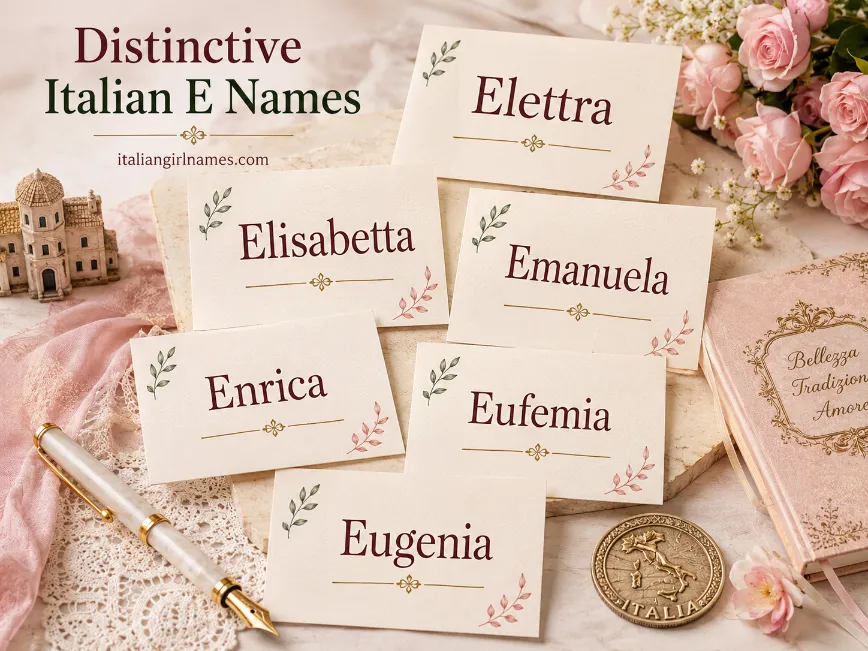
Distinctive and Traditional Italian E Names
Elda
Elda is an Italian form associated with Hilda. The Germanic root behind Hilda is connected with battle. Elda is short and uncommon. It is a great choice for someone who wants a traditional European name. It is not heard everywhere.
Elettra
Elettra is the Italian form of Electra. The Greek name is connected with elektron, meaning “amber.” Elettra stands out because of its unmistakably Italian spelling and strong classical character.
Elide
Elide is an Italian feminine name connected with Elis, the ancient Greek region in the western Peloponnese. It is considerably less familiar than Elena or Elisa, which gives it a distinctive character.
Elvira
Elvira is well established in Italian, although its deeper history is generally traced through Spanish to a Visigothic name. Its exact meaning is uncertain, so neat one-word definitions should be viewed cautiously.
Emiliana
Emiliana is the feminine form of Emiliano and belongs to the same Roman name family as Emilia. It offers a longer, more elaborate alternative for parents who like Emilia but want something less common.
Enrica
Enrica is the Italian feminine form of Enrico. Its Germanic roots relate to the Henry name family.They are traditionally linked to elements meaning “home” and “ruler.” Enrica has a strong Italian identity while remaining easy to recognize.
Erminia
Erminia is the Italian feminine form associated with Herminius. It has a literary and traditional sound, although its precise ancient meaning is not securely established. That uncertainty makes it better to focus on its history and usage rather than assigning a modern meaning.
Eufemia
Eufemia is the Italian form of Euphemia. The name comes from Greek elements associated with speaking words of good omen. It has an old-world, traditional character and is much rarer today than names such as Elena or Emma.
Eugenia
Eugenia is the feminine form of Eugenius and comes from a Greek word traditionally meaning “well born.” It has been used across several European languages, including Italian, and carries a polished, classical style.
Eulalia
Eulalia comes from Greek and is traditionally interpreted as “sweetly speaking” or “well spoken.” It has a soft rhythm and an antique character that may appeal to readers searching for a less common historical name.
Evelina
Evelina is a Latinate form associated with Aveline and is used in Italian as well as other European languages. Its historical development overlaps with several related naming traditions, so assigning one fixed meaning can be misleading.
How to Choose an Italian Girl Name Starting With E
Start by deciding whether you want a name that feels specifically Italian or one that also sounds familiar internationally. Elettra, Elisabetta, Emanuela, Enrica, and Eufemia have especially strong Italian forms, while Emma, Erica, Elena, and Eva travel easily across languages. For additional etymology and language-use references, the Italian feminine names database at Behind the Name is a useful resource for checking established Italian forms and historical origins.
It also helps to say the complete name aloud with the intended surname. Longer names like Elisabetta or Emanuela can balance a short last name. Shorter names like Elisa, Emma, Eva, and Elda create a brisk rhythm.
If meaning matters to you, pick names with clear, well-supported roots. Be careful with catchy one-word meanings on unsourced baby-name lists. Some historically old names have uncertain or debated origins.
Choosing Your Favorite E Name
The strongest choice depends on the style you want. Elena and Emma feel familiar. Elisa and Eva are short and simple. Elettra, Elisabetta, and Emanuela feel more Italian.
Instead of choosing only by meaning, compare each name’s form, sound, history, and fit with the family surname. That usually creates a more useful shortlist than relying on popularity or a single translated definition.
Frequently Asked Questions
Is Eliana an Italian name?
Yes. Eliana is used as an Italian feminine name. The Italian form is usually linked to Éliane and the Roman name Aeliana. So, its origin should be kept separate from unrelated names with similar spellings.
Which E names sound the most distinctly Italian?
Names such as Elettra, Elisabetta, Emanuela, Enrica, and Eufemia have especially recognizable Italian forms. Elena, Emma, Erica, and Eva are also used in Italy but are more international in style.