Skip to content

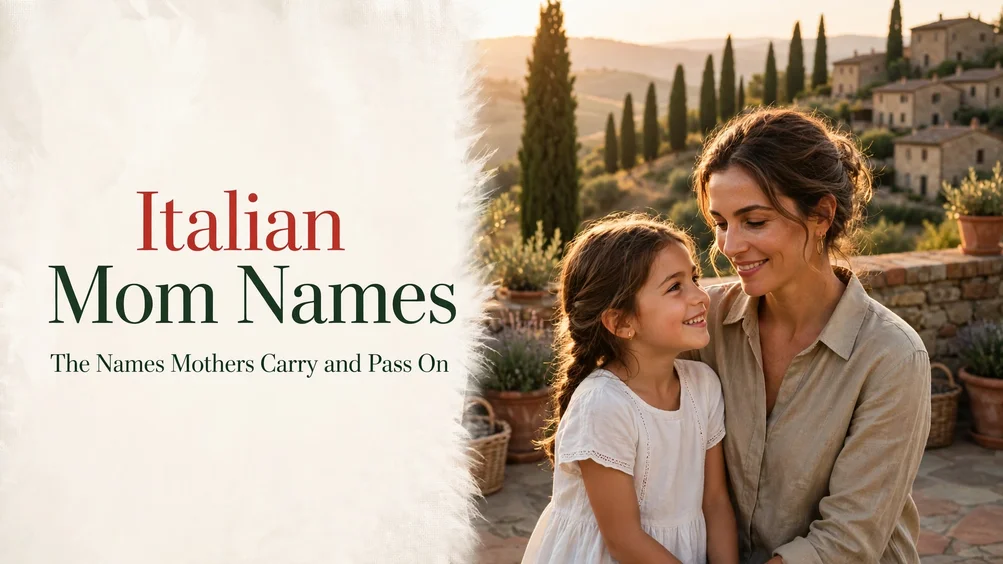
Italian mom names are the names Italian women of the mothers’ generation carry: Maria, Anna, Francesca, Laura, Daniela, Barbara, and Monica lead the list. They sit between the grandmothers’ devotional names, like Giuseppina and Annunziata, and the babies topping Italy’s birth charts today, Sofia and Aurora. This guide lists the names mothers actually have, explains how the generations differ, and shows which names mothers pass on to their daughters.
You can browse the whole collection at ItalianGirlNames.com, where we list Italian girl names by letter and theme, but this page does one narrower job. It sorts the names by generation, so you can tell a mother’s name from a grandmother’s name and from a baby’s name at a glance, and it backs the sorting with real population counts instead of guesswork.
What Are Italian Mom Names?
Italian mom names are the given names most common among Italian women who are mothers today, women born roughly from the 1970s through the 1990s. The list is led by Maria, Anna, Rosa, Angela, and Giovanna. Laura, Daniela, and Monica follow close behind. It is a generation’s list, and birth years define it.
Three generations, three name lists
Italian naming changed fast in one lifetime. Grandmothers born in the early 1900s often carried devotional compound names tied to the Virgin Mary or a local saint: Annunziata, Assunta, Carmela, Filomena, Concetta. Their daughters, born from the 1970s on, kept the saints but dropped the formulas. And today’s babies get Sofia, Aurora, Giulia, and Ginevra, names that barely registered a generation ago.
That three-way split is the whole point of this guide. A name can be traditional without being old, and it can be common among mothers without being common among babies. Once you see which list a name belongs to, the rest of the choices get easier.
How to read the numbers in this guide
The counts in this guide come from Forebears, which tracks how many living people in Italy carry each forename. Maria leads with about 4.5 million bearers, Anna follows with about 1.76 million, and Rosa, Angela, and Giovanna each pass half a million. Those are living-population counts, not birth rankings, so they show which names surround you in Italy today.
For today’s babies, the guide uses ISTAT, Italy’s national statistics institute, which publishes the top names for newborns each year. Sofia has held the top spot since 2010. ISTAT’s public name counter only reaches back to 1999, so no birth ranking exists here for the 1970s or 1980s, and this guide claims none. The generation labels rest on the living-population counts and on the documented shift in naming habits.
Meanings and origins are checked against Behind the Name’s index of Italian names, the standard reference for Italian name etymology, and every table in this guide draws on it. Where a meaning is uncertain, the table says so plainly instead of guessing.
The Names Italian Mothers Actually Carry
The names Italian mothers carry fall into two groups. The first is the devotional core: Maria, Anna, Rosa, Angela, Giovanna, Giuseppina, Francesca, and Paola, each carried by hundreds of thousands of Italian women. The second is a modern wave of shorter names that rose as Italy moved away from compound names: Laura, Daniela, Barbara, Monica, Roberta, Patrizia, Antonella, and Carla.
The devotional core
These eight names are the backbone of the mothers’ generation. About one Italian in fourteen answers to Maria, and about one in thirty-five answers to Anna. They are saint names and Bible names, the kind of names Italian parents chose for centuries, and they stayed popular long after the grandmothers’ generation because they were short, familiar, and easy to wear.
| Name | Meaning | Origin | Pronunciation |
|---|---|---|---|
| Maria | Beloved | Hebrew | mah-REE-ah |
| Anna | Grace, favor | Hebrew | AHN-nah |
| Rosa | Rose | Latin | ROH-sah |
| Angela | Messenger, angel | Greek | AHN-jeh-lah |
| Giovanna | God is gracious | Hebrew | joh-VAHN-nah |
| Giuseppina | God will increase | Hebrew | joo-sehp-PEE-nah |
| Francesca | Frenchwoman, free | Latin | frahn-CHES-kah |
| Paola | Small, humble | Latin | POW-lah |
The modern wave
The second group sounds different. Laura, Daniela, Barbara, Monica, Roberta, Patrizia, Antonella, and Carla are shorter, less devotional, and easier to say outside Italy. They spread as Italian families moved to cities and started choosing names for sound as much as for saints. None of them tops the living-population ranking, but each is carried by 150,000 to 400,000 Italian women, which is the mark of a generation’s shared names.
| Name | Meaning | Origin | Pronunciation |
|---|---|---|---|
| Laura | Laurel | Latin | LOW-rah |
| Daniela | God is my judge | Hebrew | dah-NYEH-lah |
| Barbara | Foreign, strange | Greek | BAHR-bah-rah |
| Monica | Advisor (meaning uncertain) | Latin | MOH-nee-kah |
| Roberta | Bright fame | Germanic | roh-BEHR-tah |
| Patrizia | Noble | Latin | pah-TREE-tsyah |
| Antonella | Little Antonia | Latin | ahn-toh-NEHL-lah |
| Carla | Free woman | Germanic | KAHR-lah |
How Mothers’ Names Differ from Grandmothers’ Names
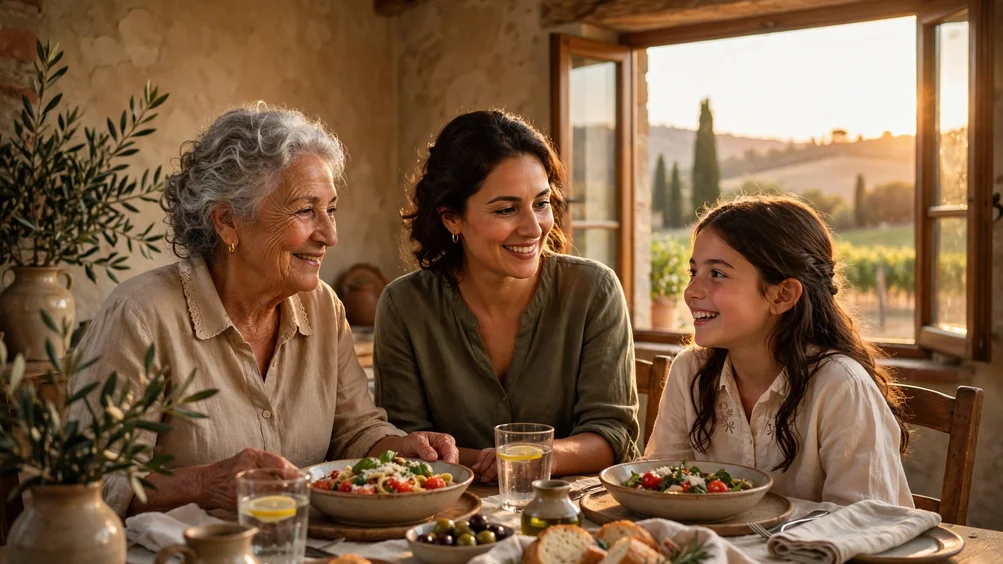
Mothers’ names differ from grandmothers’ names in length, structure, and intent. Grandmothers’ names are often long devotional compounds, Annamaria or Maria Grazia, chosen to honor the Virgin Mary or a saint. Mothers’ names are usually single names, shorter and less formal, chosen for sound and family feeling as much as for faith. The saints stayed; the formulas went.
Shorter names, fewer compounds
The clearest difference is the compound name. In the grandmothers’ generation, Maria rarely stood alone: it arrived as Maria Luisa, Maria Teresa, Maria Grazia, or Annamaria, two names fused into one identity. By the mothers’ generation, the second half had mostly fallen away. Laura, Carla, and Monica need no second name to feel complete, and parents liked the clean sound.
Shorter names also travel better. A mother named Daniela or Roberta can introduce herself anywhere in Europe without spelling her name twice, while a compound name invites questions. That practical edge mattered as more Italian women worked, studied, and lived outside their home towns.
The saints stayed, the formulas changed
Faith did not leave the list, it changed shape. Mothers still carry saint names, Lucia, Caterina, Teresa, and Elena among them, but parents choose them as names first and devotions second. Naming a daughter after the Virgin’s titles, Annunziata, Assunta, Immacolata, Addolorata, faded because it tied a child to one feast day. Lucia still honors a saint, and it also works as a plain, pretty name on its own.
The older layer has not vanished, and it is worth reading on its own terms. Our guide to old Italian names covers the grandmothers’ generation in full, and our page on traditional Italian girl names covers the classic names that still turn up as middle names and honor names today.
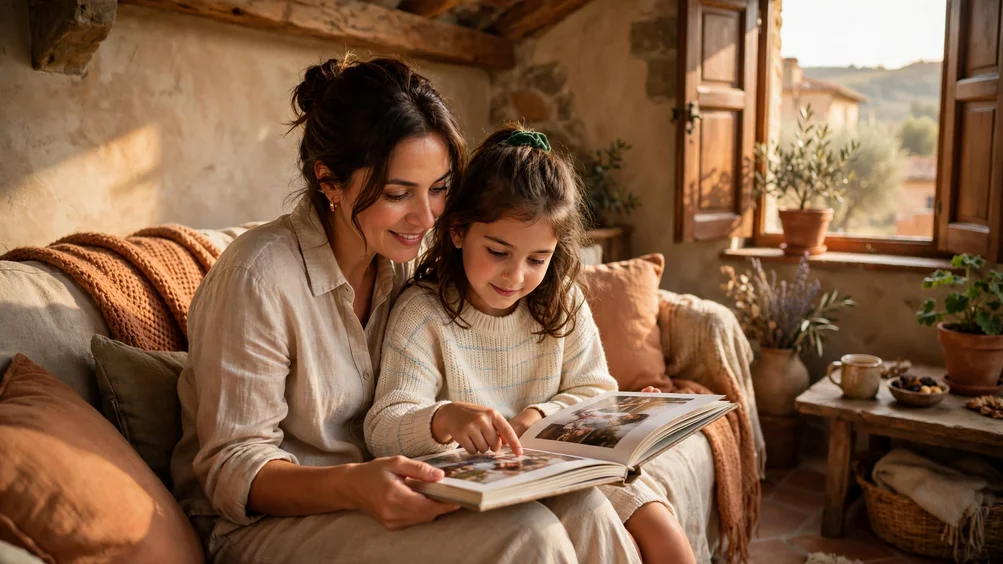
Names Mothers Pass On to Their Daughters
Italian mothers pass names to their daughters as a first name, as a middle name, or in pieces, through a compound name or a diminutive. The bridge names work in both generations, familiar on a mother and fresh on a baby. Elena, Lucia, Silvia, Valentina, Federica, Chiara, Elisa, and Giulia lead that group.
The bridge names
A bridge name has to pass two tests. It must sound right on a woman in her forties and on a baby born this year, and it must carry a meaning a family is happy to explain. Elena means bright light, Lucia means light, and Chiara means clear and bright. Giulia and Elisa are short, easy to spell, and familiar outside Italy.
| Name | Meaning | Origin | Pronunciation |
|---|---|---|---|
| Elena | Torch, bright light | Greek | EH-leh-nah |
| Lucia | Light | Latin | loo-CHEE-ah |
| Silvia | Of the forest | Latin | SEEL-vyah |
| Valentina | Strong, healthy | Latin | vah-lehn-TEE-nah |
| Federica | Peaceful ruler | Germanic | feh-deh-REE-kah |
| Chiara | Clear, bright | Latin | kee-AH-rah |
| Elisa | God is my oath | Hebrew | eh-LEE-sah |
| Giulia | Youthful, from the Roman family Julius | Latin | JOO-lyah |
If you want the full story behind any of these names, our guide to Italian girl names with meanings lists each meaning with its origin and history. The tables here give the short version; the meanings guide gives the long one.
Middle names and honor names
The most common way a mother’s name reaches her daughter is through the middle name. A baby called Sofia Elena or Aurora Lucia carries her mother’s name without carrying her mother’s exact identity, and the family gets both the modern first name and the family link. In Italy, where families use middle names more freely than in the United States, this is the standard compromise.
Compounds work the same way in reverse. A mother named Annamaria may give her daughter Anna as a middle name, keeping the family sound while dropping the weight of the double name. Diminutives help too: a Giuseppina becomes Pina at home, and a granddaughter called Pina as a nickname keeps the link alive without the formal name.
Why Italian Mothers Choose the Names They Do
Italian mothers choose names for their daughters the way their own mothers did: honoring a relative comes first, and the sound of the name with the family surname comes next. The saint’s day matters too, and current fashion matters least. That order explains why the birth charts change slowly in Italy.
Family first, fashion second
Naming after a grandmother is still the default in many Italian families, especially in the south. A baby girl may be called Rosa after her nonna Rosa, or Anna after her nonna Anna, and nobody in the family finds that boring. The name is a thread, not a fashion choice, and repeating it is the point.
That habit is also why the mothers’ names keep reappearing. A name like Francesca or Paola may dip in the birth charts for a decade, then return when the granddaughters of the first Francescas start having babies. Fashion moves in waves; family names move in generations.
The name day still matters
Every saint has a feast day, and in Italy that day is the onomastico, a second birthday of sorts. A girl named Lucia is often born near December 13, the feast of Saint Lucia, and a girl named Caterina may be born near November 25. Mothers still check the calendar, and a name that lands on a family birthday or a feast day carries extra weight.
The onomastico also explains why some names survive even when they sound old-fashioned. A name tied to a beloved saint and a family feast day is hard to retire, and it gives a daughter a celebration of her own every year.
Pronunciation Traps in Mothers’ Names
Mothers’ names are easy to say once you know two Italian rules: every vowel is pronounced, and double consonants get held a beat longer. The traps are the names that look familiar in English but sound different. Lucia is loo-CHEE-ah, not LOO-sha. Chiara is kee-AH-rah, not chee-AH-rah. Daniela is dah-NYEH-lah, with the gn sounding like the ny in canyon.
The sounds Americans get wrong
Three sounds cause most of the trouble. The gn in Daniela and Giovanna sounds like ny, so Giovanna is joh-VAHN-nah, not gee-oh-VAH-nah. The gl in Giulia sounds like the lli in million, so Giulia is JOO-lyah. And the ch in Chiara and Francesca sounds like k, so Francesca is frahn-CHES-kah with a hard k, not a soft ch.
Stress is the other trap. Italian names usually stress the second-to-last syllable, so Monica is MOH-nee-kah, Roberta is roh-BEHR-tah, and Valentina is vah-lehn-TEE-nah. Get the stress right and the name sounds Italian even if the rest of your accent is not.
How to Choose a Mom Name for Your Daughter
Choose a mom name for your daughter by testing it against your surname, against the grandmother it honors, and against the accent your daughter will actually use. If it passes all three, it works. The names in this guide have already passed the hardest test: thousands of Italian women have worn them for decades, and they still sound good.
Start with the family name you want to honor, then look for the form that fits a baby today. Giuseppina can become Pina as a nickname, Giovanna can shorten to Gianna, and Francesca can shorten to Cesca. The full name stays on the birth certificate, and the short form does the daily work.
Then check the current birth charts before you commit. A name like Giulia is beautiful and bridges the generations, but it is also one of today’s most popular Italian girl names, so your daughter may share it with classmates. If that matters to you, pick a bridge name further down the charts, like Silvia or Elisa, and keep the family link without the crowd.
Finally, say the full name aloud with your surname, in both Italian and English if your family uses both. Italian names are musical, but a long first name with a long surname can feel heavy, and a name ending in a vowel can blur into a surname that starts with one. The right choice sounds clean in both languages and needs no spelling lesson.
Frequently Asked Questions
What names did Italian mothers have in the 1970s and 1980s?
The names of that generation include Laura, Daniela, Barbara, Monica, Roberta, Patrizia, Antonella, and Carla, alongside the devotional core of Maria, Anna, and Francesca. They rose as Italian families moved away from long compound names toward shorter, modern-sounding single names. No official birth ranking exists for those decades, since ISTAT's public name counter only reaches back to 1999, so the grouping rests on living-population counts and the documented shift in naming habits.
How are Italian mom names different from old Italian names?
Old Italian names are the classic and vintage names of the grandmothers' generation: long devotional compounds like Annamaria and Maria Grazia, and Virgin-title names like Annunziata, Assunta, and Carmela. Italian mom names are the shorter single names of the mothers' generation, Laura, Daniela, Monica, and Barbara, chosen for sound and family feeling as much as for faith. The saints stayed; the formulas went.
Do Italian mothers pass their names to their daughters?
Yes, usually through the middle name. A baby called Sofia Elena or Aurora Lucia carries her mother's name without carrying her mother's exact identity. Compounds work the same way in reverse: a mother named Annamaria may give her daughter Anna as a middle name. Diminutives help too, so a Giuseppina becomes Pina at home, and a granddaughter called Pina keeps the link alive.
What is the Italian word for mom?
Children call their mother mamma, and madre is the formal word for mother. Affectionate diminutives include mammina, mami, and mammi. Mother's Day in Italy, La Festa della Mamma, falls on the second Sunday of May.
What are some Italian nicknames for mom?
Mamma Dolce means sweet mom, Tesoro means treasure, Stellina means little star, Mamma Gioiello means jewel mom, and Sole Mio means my sunshine. These are pet names families use to call their mother, not given names, and they sit alongside the real names in this guide: the nickname is what you call her, and the given name is what she was christened with.
Conclusion
Italian mom names are a generation’s names, not a style. Maria, Anna, Laura, Daniela, and Monica are the names Italian women born in the 1970s, 1980s, and 1990s carry, and they sit between the grandmothers’ devotional compounds and the babies’ Sofia and Aurora. Pick one for your daughter and you continue a family line. Say it with your surname, check the saint’s day, and let the family decide the rest.