Skip to content

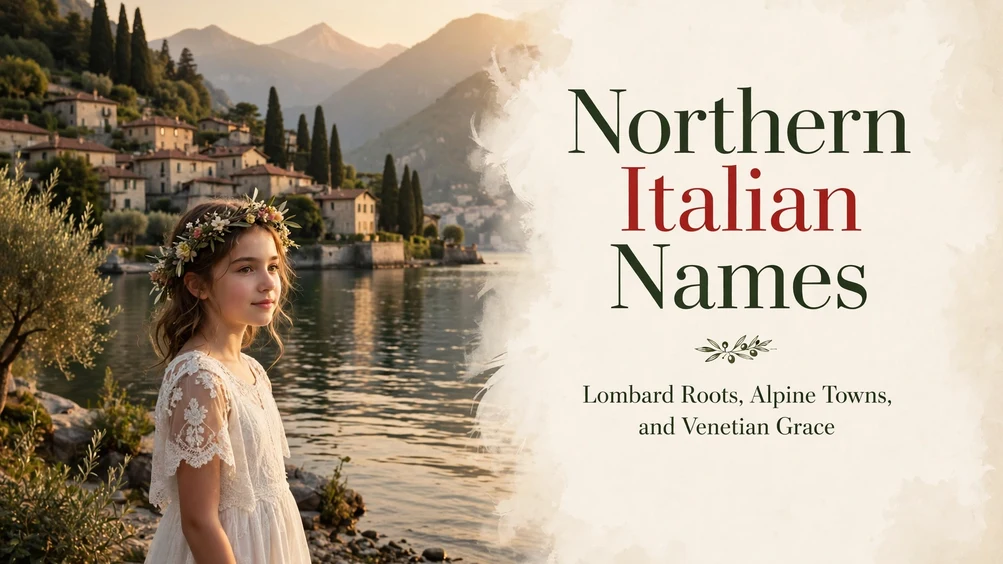
Northern Italian names are the girl names tied to Italy’s north by Lombard and Germanic roots, northern cities and saints, or the ruling families of Milan, Turin, Venice, and Ferrara. There is no official list. Most names on rival lists are pan-Italian: Sofia, Giulia, and Aurora are used from Sicily to the Alps. This guide sorts the real northern names by region and marks each link as strong or thin.
Start with our guide to Italian names for girls for the full A to Z collection, then use this page for the northern corner of it. The regions below run west to east, from Piedmont to Friuli, with Emilia-Romagna and Trentino-Alto Adige closing the map. Each table gives the meaning, the northern link, and the Italian pronunciation.
What Makes a Name Northern Italian?
A northern Italian name earns the label in one of three ways: a Germanic or Lombard root that settled in the north, a tie to a northern city, saint, or ruling house, or steady use in the north over generations. Popularity in Milan alone does not qualify: Milanese parents use Sofia and Giulia as often as parents in Naples do.
The three kinds of northern
The first kind is the Lombard kind. The Lombards ruled the north from 568, and their names stayed after their kingdom fell. Adelaide, Matilde, Gisella, and Clotilde come from that stock. The second kind is the place kind: names taken from northern cities, saints, and ruling families. The third kind is the usage kind: names more common in the north, where the evidence is thinner and this guide flags it.
Meanings and origins below come from Behind the Name’s Italian names index, the reference this site uses for every name fact. Where a name’s northern link rests on a single family story or an old local claim, the table says so instead of dressing it up. That honesty is the point of this page: a short list you can trust beats a long list padded with pan-Italian names.
The honesty test most lists fail
Open any rival list and the same names appear: Sofia, Giulia, Aurora, Isabella, Chiara. Sofia and Giulia are pan-Italian. Aurora is a Latin dawn name used across the country. Chiara belongs to Assisi, in Umbria, which is central Italy, not the north. Isabella is Spanish in origin and Italian everywhere. None of them is a northern name, and a list that calls them northern is padding, not research.
The same test catches place names. Sienna, spelled with a double n, is the English spelling of Siena, a Tuscan city, and Tuscany is central Italy. Napoli is Naples, firmly southern. Roma is the capital, not a northern city. A name has to point north on the map, not merely sound Italian, and the tables below apply that test to every entry.
Lombardy: Lombard Roots and Milanese Names
Lombardy gives this article its backbone: Germanic names the Lombards carried south in the sixth century, plus the names of the Visconti and Sforza women who ruled Milan. Eight names below carry a documented Lombard root or a Milanese bearer, and the table separates the two, so you can see which claim each name rests on.
Germanic names the Lombards left behind
The Lombards crossed the Alps in 568 and ruled the Po valley for two centuries. Their naming stock was Germanic: strong elements meaning battle, peace, fame, and nobility, later softened into Italian forms. Several of these names also appear in our collection of old Italian names, since Lombard names are among the oldest in Italian use. The table gives the Italian form, the meaning, and the northern link for each.
| Name | Meaning | Northern link | Pronunciation |
|---|---|---|---|
| Adelaide | Nobility | Germanic root; ruled Turin as marchioness, 1034-1091 | ah-deh-LAH-ee-deh |
| Matilde | Strength in battle | Germanic root; Matilda of Canossa held lands in Emilia | mah-TEEL-deh |
| Gisella | Pledge | Germanic root; Italian form of Giselle | jee-ZEL-lah |
| Clotilde | Famous in battle | Frankish root; Saint Clotilde, wife of King Clovis | klo-TEEL-deh |
| Federica | Peaceful ruler | Germanic root; common in the north, used across Italy | feh-deh-REE-kah |
| Ludovica | Famous warrior | Germanic root; the Sforza dukes of Milan carried the male form | loo-doh-VEE-kah |
| Bianca | White | Milanese bearer: Bianca Maria Visconti, Duchess of Milan 1450-1468 | BEE-ahn-kah |
| Rosalinda | Gentle horse | Germanic roots; Latinate form of Rosalind | roh-zah-LEEN-dah |
Milan’s own names
Bianca is the Milanese name with the firmest footing. Bianca Maria Visconti, born near Pavia in 1425, became Duchess of Milan in 1450 and ruled as regent while her husband Francesco Sforza campaigned. Ludovica carries the Sforza echo too: her male form, Ludovico, belonged to Ludovico il Moro, Duke of Milan. Both names work as first names today without any history lesson attached.
One caution: Adelaide is often filed under Susa, a small Piedmont town, because of the nickname Adelaide of Susa. She was born in Turin and ruled from Turin, and the Susa label is a later habit, not her home. The table files her under Lombardy for her Germanic root, and Piedmont claims her too, which is fair: the north’s borders were never tidy.
Piedmont and Liguria: Alpine and Coastal Names
Piedmont and Liguria sit at Italy’s northwestern corner, where the Alps meet the sea, and their names show it: Savoyard court names in Turin, a dawn name from a Piedmontese hill town, and saints of the Genoese coast. Six names below carry a documented link to one of the two regions, and each link names its place.
Piedmont: the Savoy connection
Turin was the seat of the House of Savoy, and its court names still read as Piedmontese. Margherita of Savoy, born in Turin in 1851, became Queen of Italy, and the pizza Margherita carries her name. Adelaide of Susa, Marchioness of Turin from 1034 to 1091, is the region’s great medieval figure, and Berta of Milan, her mother, gives the region its oldest Germanic name.
| Name | Meaning | Northern link | Pronunciation |
|---|---|---|---|
| Alba | Dawn | Piedmont city of Alba, famed for white truffles | AHL-bah |
| Berta | Bright | Germanic root; Berta of Milan, mother of Adelaide of Susa | BER-tah |
| Adelina | Noble | Diminutive of Adelaide, the Piedmontese marchioness’s name | ah-deh-LEE-nah |
| Margherita | Pearl | Margherita of Savoy, born in Turin, Queen of Italy | mar-geh-REE-tah |
| Caterina | Pure | Saint Catherine of Genoa (1447-1510), Genoese mystic | kah-teh-REE-nah |
| Marina | Of the sea | Sea name; fits the Ligurian coast, used across Italy | mah-REE-nah |
Liguria: the sea in the name
Liguria is a narrow strip between mountains and sea, and its names lean seaward. Marina is the plainest of them, a sea name that suits a Genoese family without needing a saint or a duchess behind it. Caterina belongs here too, for Catherine of Genoa, the fifteenth-century mystic whose writings still shape Catholic devotion. Her feast day is 15 September.
Veneto and Friuli: Lagoon and Border Names
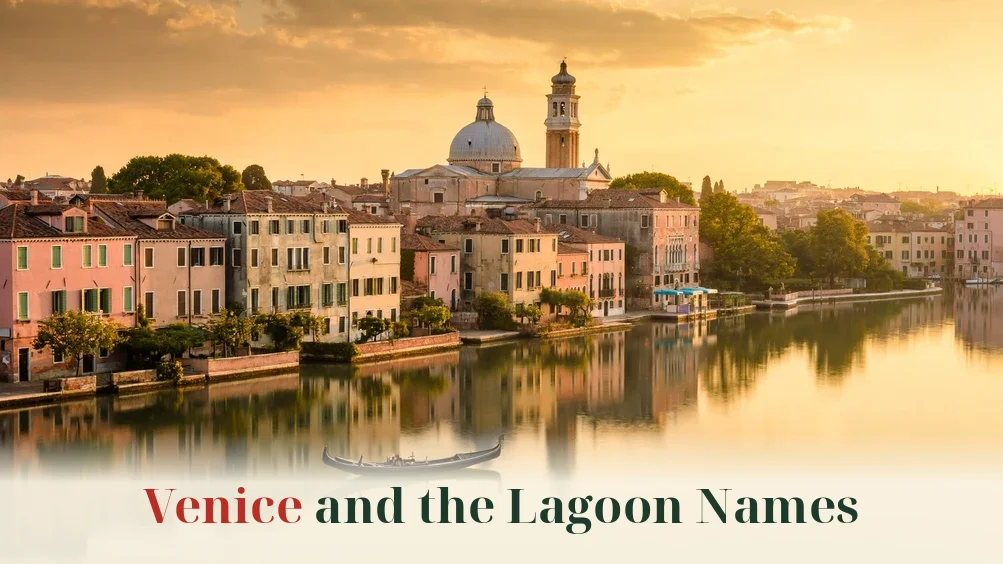
Veneto is the region of the lagoon, and its names run from the grand, Venezia itself, to the quietly local, Giustina of Padua. Four names below carry a Venetian link, and the fuller lagoon list lives in our Venetian names guide, which this article points to rather than repeating. Friuli, east of Venice, gets an honest paragraph of its own.
Venice and the lagoon
Our guide to Venetian names covers the lagoon names in full, from the city’s own name to its saints and doges, so this section keeps only the four with the clearest Venetian footing. Venezia is the boldest choice, the city itself as a name. Verona, the city of Romeo and Juliet, works the same way, and Nameberry lists it among Italian place names for girls.
| Name | Meaning | Northern link | Pronunciation |
|---|---|---|---|
| Venezia | Venice | The city itself as a name; the boldest Venetian choice | veh-NEH-tsee-ah |
| Verona | Verona | City in Veneto; Shakespeare’s setting for Romeo and Juliet | veh-ROH-nah |
| Giustina | Just | Saint Justina of Padua, martyred about 304, patron of Padua | joo-STEE-nah |
| Elena | Bright, shining light | Elena Cornaro Piscopia of Venice, first woman to earn a doctorate, 1678 | EH-leh-nah |
Friuli and the eastern border
Friuli-Venezia Giulia is the honest gap in this guide. The region’s naming overlaps Veneto and the Lombard stock so closely that few girl names belong to Friuli alone, and no rival list names one with evidence. Gisella and Adelaide traveled through Friuli with Germanic settlement, and Trieste’s border history touches surnames more than first names. Rather than invent a Friulian list, this guide says so and moves on.
Emilia-Romagna and Trentino-Alto Adige: Crossroads Names
Emilia-Romagna is the crossroads of the north, where the Roman road Via Aemilia gave the region its name and the Este court of Ferrara gave it its most famous duchesses. Trentino-Alto Adige, at the Alpine border, is the bilingual corner, where Germanic names sit beside Italian ones. Five names below carry a documented link to one of the two regions.
Emilia-Romagna: the Este and the road
Ferrara’s Este court produced two of the north’s most famous namesakes. Lucrezia Borgia became Duchess of Ferrara by marriage, and Isabella d’Este, born in Ferrara, became Marchioness of Mantua and the great patron of the Renaissance. Beatrice d’Este, a thirteenth-century Ferrarese noblewoman, carries the older Este story. Emilia itself is the region as a name, from the Roman road that still runs its length.
| Name | Meaning | Northern link | Pronunciation |
|---|---|---|---|
| Emilia | Rival (Roman family name) | The region itself as a name, from the Via Aemilia | eh-MEE-lee-ah |
| Lucrezia | Uncertain (Roman family name) | Lucrezia Borgia, Duchess of Ferrara 1502-1519 | loo-KREH-tsee-ah |
| Isabella | Pledged to God | Isabella d’Este, born in Ferrara, Marchioness of Mantua | ee-zah-BEL-lah |
| Beatrice | She who brings happiness | Beatrice d’Este of Ferrara, thirteenth century | beh-ah-TREE-cheh |
| Ravenna | Ravenna (city) | City in Emilia-Romagna; also a rare place name for girls | rah-VEN-nah |
Trentino-Alto Adige: two languages, one naming pool
Trentino-Alto Adige is Italy’s bilingual region, Italian in the south of the province and German-speaking in the north, and its girl names show both tongues. Adelaide, Matilde, and Gisella, listed under Lombardy above, are as much at home here as anywhere in the north, and Germanic diminutives in -ella and -ina cross the border freely. No separate table is needed: the Lombard table is the Trentino table too.
Northern Saints and Name Days
Northern Italy keeps the onomastico, the name day, as warmly as the south does, and its saints give several of these names a date on the calendar. Three northern saints anchor the names in this guide: Giustina of Padua, Giulia of Corsica, whose relics rest in Brescia, and Adelaide of Susa. Italian families still mark their feast days.
Saints of the north
Saint Justina of Padua, martyred about 304, is the patron of Padua, and Giustina carries her name into the present. Saint Julia of Corsica, martyred in the fifth century, has her relics in Brescia, where the Lombard king Desiderius brought them in 762, which ties Giulia to Lombardy by relic as well as by name. Adelaide of Susa is remembered on 19 December, and Catherine of Genoa on 15 September.
How name days work in the north
The onomastico is a second birthday of sorts: family and friends call, a small gift arrives, and the saint’s day is marked at home. The custom holds across Italy, and the north is no exception, though city families now mark it more lightly than village families once did. A name with a documented saint gives a daughter two dates to celebrate, her birthday and her name day.

How to Choose Northern Italian Names
Choose a northern Italian name the way northern families do: by the region it points to, by how it sounds with your surname, and by whether the meaning still holds up. A name with a documented northern link beats a prettier name with a borrowed label. The three checks below take five minutes, and they keep the choice honest.
Sound it with your surname
Say the full name aloud three times, slowly, then fast. Italian double consonants must be held: Matilde’s double t, Gisella’s double l, and the double s in Rosalinda all change the name if they are swallowed. GN sounds like ny, as in Giustina, and SCI sounds like sh, as in Lucrezia. If an English speaker in your family cannot say it after two tries, weigh that before you commit.
The family test
Ask where your family comes from. A Lombard surname pairs with a Lombard first name, and a Venetian grandmother’s name carries more weight than a name picked from a list. If the answer is a traditional name rather than a regional one, our guide to traditional Italian girl names covers that ground. If meaning matters most, our guide to Italian girl names with meanings ranks names by what they mean.
What to do when the link is thin
Some names you love will fail the northern test, and that is fine. Sofia, Giulia, and Aurora are beautiful Italian names, and no one in Milan will fault you for choosing one. Use this guide’s tables for names with a northern link, and use the rest of the site’s collection for everything else. The label is a guide, not a rule, and a name chosen with love outlasts a label.
Frequently Asked Questions
Are Sofia and Giulia northern Italian names?
No. Sofia, Giulia, and Aurora are pan-Italian names, used across the whole country from Sicily to the Alps. They are popular in Milan, but popularity in one city does not make a name northern. Chiara belongs to Assisi in Umbria, which is central Italy, so it fails the test too.
What is the most northern Italian girl name?
Adelaide has the strongest claim: a Germanic root meaning nobility, plus Adelaide of Susa, who ruled Turin as marchioness from 1034 to 1091. Matilde runs close behind, with a Lombard root and Matilda of Canossa's lands in Emilia. Either name points north by both origin and history.
What are Venetian girl names?
Venetian girl names center on the lagoon: Venezia, the city itself, Verona, Giustina of Padua, and Elena, for Elena Cornaro Piscopia of Venice. Our Venetian names guide covers the fuller lagoon list, from saints to doges, while this article keeps only the four with the clearest Venetian footing.
Do northern Italian names sound different from southern ones?
Not much. The whole country shares the same vowel endings, double consonants, and -a endings for girls, so a northern name sounds Italian rather than northern. The difference sits in the origin: Germanic roots and Lombard history in the north, Greek and Arabic traces in the south.
What northern Italian name means dawn?
Alba means dawn in Italian, and Alba is also a hill town in Piedmont, famed for white truffles, so the name carries both a meaning and a place. Aurora also means dawn, but it is a Latin name used across Italy, not a northern one.
Conclusion
Northern Italian names reward a reader who checks the map. Adelaide, Matilde, and Gisella carry Lombard roots into the present, Bianca and Ludovica carry Milan, Alba and Margherita carry Piedmont, and Venezia and Giustina carry the lagoon. Pick the region first, then the name, and the choice will hold up when someone asks where it comes from. That is the whole test, and these names pass it.