 Skip to content

Rossi means red. It comes from the Italian word rosso, a nickname given to a red-haired ancestor, and the plural ending turns one man into a whole family: the Rossi, the red-haired ones. It is the most common surname in Italy, carried by about one Italian in every 176, and it has stayed at the top of the list for centuries.
If you are choosing a name for a daughter, Rossi is usually the surname you are pairing, not the first name. Our guide to Italian girl names lists first names by letter and theme, and the pairing section near the end of this article shows how to test a first name against a surname as common and as short as this one.
What Does Rossi Mean?
Rossi means the red-haired family. It comes from rosso, the Italian word for red, which itself comes from the Latin russus. A medieval neighbour with red hair or a ruddy face was called Rosso, the red one, and his household took the plural form Rossi, so the name describes a whole family.
From rosso to Rossi: the plural that made a family
Italian surnames usually name a household. Rossi is the clearest example of the pattern. The singular Rosso described one man. The plural Rossi described his people, and once the name passed to his children it stayed plural forever. That is why so many Italian surnames end in i: the ending is a family in miniature. Behind the Name’s Rossi entry gives the same chain, from Latin russus through Italian rosso to the family plural.
The same habit explains the colour pair at the top of the name lists. Bianchi, from bianco, white, is the fair-haired mirror of Rossi, and the two names sit near each other in every ranking because medieval Italy named people by the hair it could see. Our guide to Italian surnames and meanings sets the two side by side with the other colour names. Put together, that is the Rossi surname meaning: a colour word, a nickname, and a family in the plural.
Why red hair was worth naming a family after
Red hair was rare in medieval Italy, and rare things make good nicknames. A village might hold one red-haired man, so Rosso told neighbours exactly who you meant, the way a tall man became Longo and a curly-haired one became Ricci. The nickname only became a surname when hereditary family names settled across Italy, roughly between the 12th and 14th centuries, and the parish registers that followed the Council of Trent in 1564 fixed the spelling for good.
Some surname sites get this wrong and call Rossi a place name, about red soil or roses. No source that specialises in Italian surnames supports that reading, and the Latin root points the other way: russus is a colour word, and the name behaves like every other nickname surname in the lists. If a page offers a meaning with no source you can open, treat it as decoration.
Where the Name Comes From in Italy
Rossi runs thickest in the centre and north of Italy, with Liguria the densest region of all. As of 2014, about 63 in every 100 Rossi bearers worldwide still lived in Italy, roughly one Italian in 176, and the name thins steadily toward the south, where its cousin Russo takes over. The table below lists the eight densest regions.
Thickest in the centre and north
| Region | One person in every |
|---|---|
| Liguria | 87 |
| Umbria | 92 |
| Tuscany | 96 |
| Emilia-Romagna | 98 |
| Marche | 115 |
| Lombardy | 116 |
| Lazio | 122 |
| Veneto | 172 |
The pattern goes back centuries. The name formed in the centre and north, spread through the towns along the Po valley and the Tuscan hills, and never took root in the south the way it did above Rome. If your Rossi family comes from Liguria or Emilia-Romagna, the records are likely to sit in the same province where the name is densest today.
The name also travelled, and the contrast is sharp. Rossi sits at the top of every list of Italian last names, yet in the United States the 2020 Census counted only 25,108 bearers and ranked the name 1,387th nationally. Brazil holds the second largest Rossi population, about 63,000 bearers, followed by Argentina with about 34,000, all from the emigration waves of the late 19th and early 20th centuries.
Rossi and Russo: the north-south split
Russo is the same name in a southern spelling. The north kept the plural Rossi, while Naples and the south kept the singular Russo, so the two spellings mark a line across the country rather than two families. An American Rossi and an American Russo can easily be cousins, separated only by which side of that line their ancestors lived on.
The south also favours singular forms in general, and its best-known surname story is a different one. Esposito, the most common name in Naples, was given to foundlings left at churches, from esposto, exposed, and our guide to Esposito explains how that name worked. Rossi has no such story: it is a nickname that any family could earn, which is part of why it spread so far.
How to Say Rossi
Say Rossi as ROHS-see, with the stress on the first syllable and a real hold on the doubled S. The two S letters do real work: Italian holds a doubled consonant, so the sound pauses on the S before moving to the ee ending. Say ROH-see with a single S and an Italian hears a different word.
The doubled S that gives Americans away
English does not hold doubled consonants, so an American mouth usually smooths Rossi into ROH-see without noticing. In Italian the hold is the difference between the name and a near miss, and it is the single most useful thing to practise if the name is yours. Say ROHS, stop on the S for a beat, then finish with see, and the name lands the way it does in Liguria or Parma.
The same rule fixes the cousins. Rosso is ROHS-soh, Russo is ROOS-soh, and Rossini is rohs-SEE-nee, with the stress moving to the middle. Once the doubled consonant clicks, the whole family of names reads cleanly, and the spelling on a birth record usually tells you which branch a family belongs to.
Rossi, Rosso, and De Rossi: what changes
The variants are spelling differences within one family of names. Rosso is the singular form, densest in Piedmont, and De Rossi and Di Rosso add the little word of, marking a son of the family or a branch that split off. Rossini and Rossetti add a diminutive ending, little Rossi, and both became surnames in their own right. A parish clerk spelling by ear could turn one into another in a single generation.
That matters for record searches. If Rossi comes back empty in an archive, try Rosso, Russo, and De Rossi before giving up, and search the second word alone when the name carries a prefix. Italian civil records file names the way the clerk wrote them, and the clerk wrote what he heard.
The Rossi Counts of Parma
One Rossi family left a paper trail most surnames never get: the Rossi counts of Parma, documented from 1323, who held castles across the Parma Apennines for over a century. Their rise began with a bishop’s appointment: Ugolino Rossi was made Bishop of Parma in 1324, at the age of 23.
Ugolino and the bishop’s mitre
Ugolino’s appointment handed his family the revenues of Berceto, Bardone, Corniglio, and the other parishes of the Parma hills, and his three brothers took the secular half. Rolando, Marsilio, and Pietro were made Counts of Berceto on 5 March 1331, and the title stayed with the Rossi alone. From there the family bought, married, and sued its way to a county, castle by castle.
The quarrels lasted as long as the power. The Rossi fought the Pallavicino family over land on the Po for more than a century, lost ground in the 1400s, and still emerged with eight towns and a string of castles centred on Felino. Few Italian surnames can point to a single family whose castles, lawsuits, and bishoprics are all on the record.
Torrechiara Castle
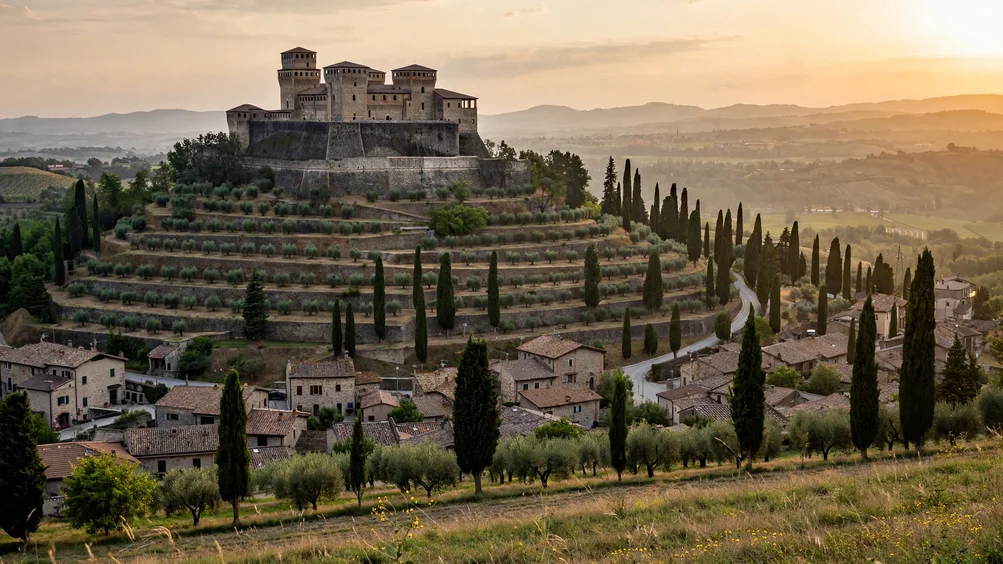
The family’s best-known monument is Torrechiara Castle, built between 1448 and 1460 by Pier Maria II de’ Rossi on a terraced hill south of Parma. It was both a working fortification and a noble residence, raised for his mistress Bianca Pellegrini, and its Golden Chamber holds frescoes of Bianca crossing the couple’s own lands in search of her lover.
The towers still tell the story. The Lion Tower carries the lion of the Rossi arms, the Lily Tower carries Bianca’s, and the castle is the family’s signature in stone. A surname that most people meet on a class list or a football shirt turns out to have a castle with a love story painted into its bedroom.
Famous Bearers Named Rossi
The name shows up wherever Italy exports talent: a nine-time motorcycle world champion, a World Cup winning striker, a rock singer who fills stadiums, and a fashion designer whose shoes carried the name worldwide. The table below picks the bearers a reader is most likely to know.
| Name | Field | Known for |
|---|---|---|
| Valentino Rossi | Motorcycle racing | Nine-time world champion, born 1979 |
| Paolo Rossi | Football | 1982 World Cup winner, 1956-2020 |
| Vasco Rossi | Music | Rock singer-songwriter, born 1952 |
| Sergio Rossi | Fashion | Luxury shoe designer, 1935-2020 |
| Properzia de’ Rossi | Sculpture | Renaissance sculptor, 1490-1530 |
| Bruno Rossi | Science | Physicist, 1905-1993 |
| Portia de Rossi | Acting | Australian actress, born 1973 |
| Anthony T. Rossi | Business | Founded Tropicana Products |
Sport and speed
Valentino Rossi is the name most people think of first, and his nine world titles made the surname a global brand in motorcycle racing. Paolo Rossi did the same for football, scoring six goals at the 1982 World Cup and winning the tournament for Italy. Between them they explain why the name feels fast even to people who have never met a Rossi.
Music, film, and design
Vasco Rossi has filled Italian stadiums since the 1980s, and his surname is now a shorthand for Italian rock. Sergio Rossi built a luxury shoe house on the name, and Portia de Rossi carried it into Australian and American television. The older arts are there too: Properzia de’ Rossi carved marble in Renaissance Bologna, and Salamone Rossi composed for the Mantuan court around 1600.
Pairing Rossi with a Girl’s First Name
Rossi pairs best with a short first name. The surname is two syllables with a hard double S, so a one or two syllable first name keeps the full name crisp. Say the pair out loud: the first name should end cleanly before the ROHS-see snap, and its meaning should carry the weight, since Rossi only means red.
Sound first: short first names
One and two syllable names sit best against Rossi. Giulia Rossi, Elena Rossi, and Sofia Rossi each land cleanly, because the first name finishes before the surname starts. Three syllable names can work too, but say them slowly: a first name ending in a vowel can blur into the R of Rossi, and a first name ending in S can tangle with the double S that follows.
The spelling check
Write the full name down before you commit to it. Rossi is spelled the same way in Italy and abroad, which is a gift, but the doubled S is the part an English speaker will drop first, on forms and in email addresses. Check the spelling your family uses on birth records, and pick a first name whose meaning you love from our guide to Italian girl names with meanings, since the surname adds sound to the pair while the first name carries the meaning.
Frequently Asked Questions
Is Rossi Italian or Spanish?
Rossi is Italian. It comes from the Italian word rosso and the Latin russus, and its history sits in the centre and north of Italy, thickest in Liguria and Emilia-Romagna. The same spelling can turn up in Spanish records through migration, but the name itself is Italian, and the Finnish Rossi families are a separate line with no connection to it.
How do you pronounce Rossi in Italian?
Say ROHS-see, with the stress on the first syllable and a real hold on the doubled S. Italian holds doubled consonants, so pause on the S before the ee ending. Saying ROH-see with a single S is the most common mistake, and an Italian hears a different word.
What is the difference between Rossi and Russo?
They are the same name in two regional spellings. Rossi is the northern plural form, thickest in Liguria and Emilia-Romagna, while Russo is the southern singular form, centred on Naples and below. The two spellings mark a line across Italy rather than two families, and an American Rossi and an American Russo can easily be cousins.
Is Rossi really the most common surname in Italy?
Yes. About 347,000 people in Italy carry the name, roughly one Italian in every 176, ahead of Russo and Ferrari. The gap is widest in Liguria, where one person in every 87 is a Rossi. In the United States the picture flips: the 2020 Census counted only 25,108 bearers, ranking Rossi 1,387th.
Can Rossi be used as a girl's first name?
It can, though it is rare as a first name. Rossi works best as a middle name or a bold first name paired with a short, soft surname, and the red meaning gives it a clear story. Say the full name out loud first: a surname starting with S can tangle with the doubled S, so test the join before you commit.
Conclusion
Rossi earns its place at the top of the Italian lists with a simple story: a red-haired neighbour, a plural ending, and seven centuries of families keeping the name. Say it as ROHS-see, hold the double S, and remember that the most common surname in Italy is also one of the oldest nicknames still in daily use. That is a lot of history for four letters.


