 Skip to content

What Does Martina Mean in Italian
Martina means of Mars in Italian. The name is the feminine form of Martinus, a Roman family name built on Mars, the god of war, so its sense is dedicated to Mars, or warlike. Italians say it mar-TEE-nah, and its name day falls on January 30, the feast of Saint Martina of Rome. Among Italian girl names with meanings, Martina is one of the strongest choices on the list.
That war-god root sets Martina apart from softer Italian names, and it has shaped the name’s whole history. Two tennis champions carried it to the top of their sport, a third-century martyr gave it a Roman feast day, and a whole town in Puglia carries it in its name. Each part of that story matters for parents weighing the name.
What Martina Means: Of Mars, the Roman God of War
Martina means of Mars, the Roman god of war. It is the feminine form of Martinus, a Latin family name that comes straight from Mars, so the name carries a sense of war, strength, and daring. Italian name books gloss it simply as warrior, which is the shortest honest version of the meaning.
The Latin root Martinus
Martinus was a Roman family name, a cognomen, formed from Mars with a Latin ending that means belonging to. Romans gave such names to mark a connection with a god, a place, or a family line. The ending does the work here: Martinus is a man of Mars, and Martina is the same name in its feminine form.
Mars was more than a war god to the Romans. He was a father of the city’s founders in legend, a guardian of soldiers and farmers alike, and the god who gave March its name. A name tied to Mars carried that whole weight, which is why Martina still sounds bold two thousand years later.
Feminine of Martin, not a nickname
Martina is the feminine form of Martinus, and Martin is the shorter form that came later. The chain runs Martinus to Martin to Martina, with Martino as the Italian masculine form. Behind the Name lists Martina as the feminine form of Martinus, used in Italian, German, Spanish, Czech, and a dozen other languages.
That order matters, because some name lists call Martina the feminine of Martin as if Martin came first. Martin is the familiar English form, so the mistake spreads easily. The Italian form never passed through English at all. It came straight from the Latin family name, which is why it keeps its full four syllables in Italian.
What “warrior” does and does not promise
Warrior is a fair gloss, but it can mislead. The name does not mean a girl will fight, or that her parents wanted a fighter. It means the name itself comes from the war god, the way Victoria means victory and Diana names a moon goddess. The meaning is a root, not a forecast.
Parents who like that kind of honest root usually like other names with clear Latin meanings too. Our guide to Italian girl names with meanings collects the ones whose meanings hold up under the same check, so Martina can be weighed beside names with roots just as plain.
The Italian Sound of Martina: mar-TEE-nah
In Italian, Martina is pronounced mar-TEE-nah, with the stress on the second syllable and every vowel sounded cleanly. The r rolls lightly, the t is soft and dental, and the final a stays open. English speakers usually say mar-TEE-nuh, which flattens the ending and hides the Italian rhythm.
The stress trap English speakers fall into
The trap is the first syllable. English speakers often stress it hard and say MAR-ti-na, which turns a flowing name into a flat one. Italian keeps the first syllable light and puts the weight on TEE, the second syllable. Say it slowly as mar, TEE, nah, and the rhythm falls into place.
The final vowel is the other detail worth copying. English turns a final a into uh, so Martina comes out as mar-TEE-nuh. Italian keeps the a open, the way it sounds in pasta or mamma. A rolled r and an open final a are enough to make the name sound Italian rather than anglicized.
Diminutives Italians actually use
In Italy, Martina shortens most often to Tina, a warm two-syllable form that has stood on its own as a full name for generations. Ina is the other everyday short form, used in Italian and German families alike. Both keep the name’s sound without losing its shape.
Martie is the English short form, and it suits a child better than an adult. Parents who want a nickname that grows up with the name usually pick Tina, which works at every age. The full form stays in use for formal moments, and the short form does the everyday work.
January 30: Martina’s Name Day and Saint Martina of Rome
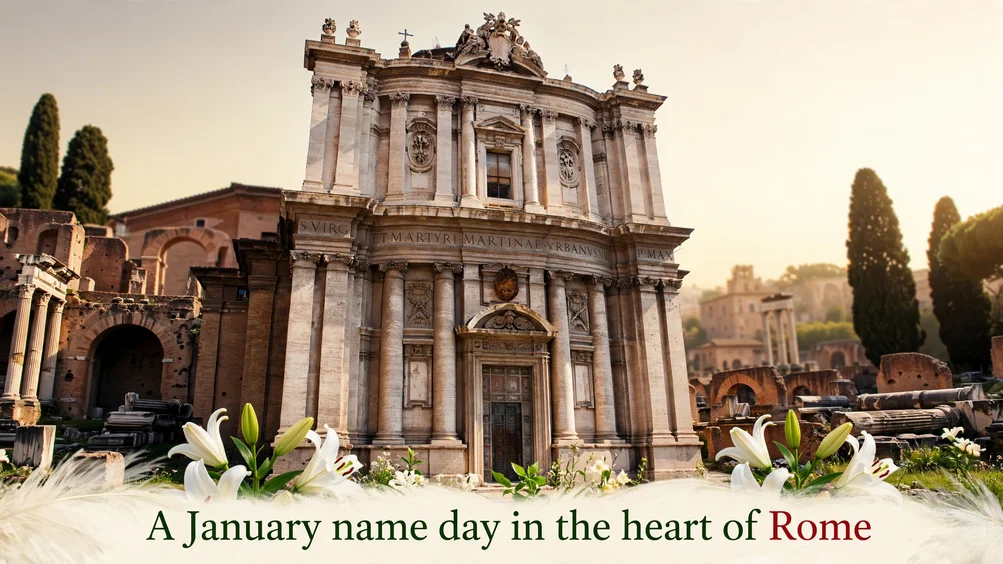
Martina’s name day in Italy falls on January 30, the feast of Saint Martina of Rome, a third-century martyr and one of the patron saints of Rome. Italian families celebrate the onomastico the way other countries mark a second birthday, with a call, a gift, or a dinner. For a Martina, that celebration lands in the coldest week of winter.
Who Saint Martina was
Saint Martina was a Roman virgin and martyr of the third century, killed for her faith around the year 226 or 228, under Pope Urban I. Her story survives mostly through the church that bears her name, since few details of her life were ever written down. What the record does show is a cult that lasted, with a chapel in her honor standing in Rome by the seventh century.
Rome counts her among its particular patrons, and she is also named as a patron of nursing mothers. Her relics were found in the ruins of her old church in 1634, and Pope Urban VIII rebuilt the church in her honor. The feast was fixed on January 30 in 1635, which is the date Italian families still keep.
The church in the Roman Forum
The church of Santi Luca e Martina stands in the Roman Forum, at the foot of the Capitoline Hill, on the ruins of an older church. Its facade carries her name in Latin, and its Baroque rebuilding under Urban VIII made it one of the Forum’s landmarks. A Martina who visits Rome can walk into the church that has carried her name for centuries.
A feast day Rome still keeps
Saint Martina’s feast was removed from the General Roman Calendar in 1969, so it no longer appears on every Catholic calendar in the world. Rome kept it anyway, and local calendars still mark January 30 as her day. That split is worth knowing: the name day is real in Italy even though the feast no longer sits on the worldwide calendar.
Do not mix her day up with Saint Martin’s. Martin of Tours, the soldier saint who shared his cloak with a beggar, has his feast on November 11. Martina’s day belongs to Saint Martina of Rome, a different saint with a different story, and January 30 is the date to keep.
Martina in Italy: A Top Name at Home, a Quiet One Abroad
Martina is a top name in Italy and a quiet one everywhere else. Italian birth records put it second among girls’ names in 2024, while in the United States it ranked 1,371st in 2025, given to 161 girls. Spain keeps it near the top too, which makes Martina an Italian home favorite that travels as a rare choice abroad.
Italy’s number two
In Italy, Martina has sat near the top of the girls’ charts for years, and the 2024 birth records put it at number two. That is a very different picture from the English-speaking world, where the name barely registers. For Italian parents, Martina is a familiar classic, not an unusual pick.
The gap comes from history. Martina survived in Italy through the cult of Saint Martina and the long use of Martin as a saint’s name, while English speakers leaned on Martin for boys and rarely used the feminine form. A name can be a top-ten classic in one country and a curiosity in the next.
The long American flat line
In the United States, Martina has never had a big moment. It first appeared in the records in 1880, peaked at 534th in 1899, and has hovered in the low thousands ever since. The busiest year was 1964, with 335 girls given the name, and the 2025 figure of 161 girls put it at 1,371st.
That flat line is good news for parents who want a name nobody else in the class will share. Martina is recognizable, easy to spell, and tied to two famous athletes, yet it stays rare enough that a child will usually be the only Martina around. Rare and familiar is a hard pair to find.
Where Martina ranks strongest
Spain keeps Martina near the top of its girls’ charts too, with national figures putting it in the top ten in 2024. Germany’s registry put it near fortieth the same year, a solid mid-chart showing. The pattern is plain: Martina is strongest in Italy and Spain, steady in Germany, and a rare import in the United States.
Famous Martinas: Two Tennis Champions and a Country Voice
Two of the most famous Martinas are tennis champions, and the third is a country singer. Martina Navratilova won 18 Grand Slam singles titles, Martina Hingis spent 209 weeks ranked world number one, and Martina McBride built a long career on a powerful voice. Together they give the name a sporty, determined edge.
Martina Navratilova, 18 Grand Slam singles titles
Martina Navratilova was born in Prague in 1956 and became one of the greatest tennis players in history. She won 18 Grand Slam singles titles and 31 Grand Slam doubles titles, and she held the world number one ranking in both singles and doubles. Her serve-and-volley game set the standard for a generation of players.
She is also known for speaking openly about her life off the court, including her advocacy for LGBTQ rights. That public courage sits well beside a name that means of Mars. Navratilova made Martina a name that sounds tough, disciplined, and unafraid to stand apart.
Martina Hingis, 209 weeks at world number one
Martina Hingis of Switzerland turned professional as a teenager and reached world number one at sixteen. She won five Grand Slam singles titles and thirteen doubles titles, and she held the top ranking for 209 weeks. Her game was built on placement and timing rather than power, which made her a different kind of champion from Navratilova.
Hingis kept coming back to the game, retiring and returning more than once before her final retirement in 2017. That persistence fits the name’s meaning in a quieter way than Navratilova’s power did. Two champions carried the same name to the top by very different routes.
Martina McBride, the country singer
Martina McBride, born in Kansas in 1966, is an American country singer known for a powerful voice and a long recording career. Her hits include Independence Day and A Broken Wing, songs that made her one of the most awarded women in country music. She gives the name a musical bearer to balance the two athletes.
Martina Around Europe: Variations, Lookalikes, and a Puglian Town
Martina travels well across Europe, with a French form, a Polish form, and an English cousin. It also has lookalikes that share nothing but letters, and a town in Puglia that carries the name for a different reason entirely. Knowing which forms are real and which are only similar keeps the choice clean.
The spellings that change
The same name appears as Martine in French, Martyna in Polish, and Marcia in English, all from the same Latin root. Martina itself is the form used in Italian, Spanish, German, Czech, and Croatian. The table that follows sets out the main forms, so parents can see which spelling belongs to which language.
| Form | Language | Note |
|---|---|---|
| Martine | French | Same root, softer ending |
| Martyna | Polish | Same root, y spelling |
| Marcia | English | Same root, older English form |
| Tina | Italian and German | Everyday diminutive |
| Ina | Italian and German | Everyday diminutive |
| Martino | Italian | Masculine form |
The lookalikes that are not related
Marina looks like Martina with two letters changed, but it means of the sea, from the Latin word for sea. Marta is another near miss: it comes from an Aramaic word for lady or mistress, not from Mars at all. The two names sound like sisters and share nothing in their roots. Giorgia is another Italian name with a Greek root and a saint’s day of its own: see what Giorgia means in Italian.
Parents who like Martina’s sound but want a different meaning often look at other M names. Our page of Italian girl names starting with M lists the full set, from Maddalena to Matilde, so the sound can be kept while the meaning changes.
Martina Franca, the town that shares her name
Martina Franca is a Baroque town in Puglia, in the Valle d’Itria, and its name trips up a lot of readers. The Martina in its name honors Saint Martin of Tours, not Saint Martina of Rome. The town grew up around a hill settlement devoted to Martin, and the name stuck.
Franca came later, in 1310, when Philip I of Anjou granted the town tax exemptions, called franchigie, to draw settlers to the hill. The town’s full name therefore mixes a saint’s name with a tax break, which is a very Puglian kind of history. Visitors still find the Basilica of San Martino at its heart.
Does Martina Fit a Strong, Sporty Girl? A War-Goddess Test
Martina fits a strong, sporty girl well, because the name itself means of Mars and its most famous bearers are athletes. The war-god root gives it a bold edge, and the tennis champions give that edge real faces. The fit depends on the surname and the family, not on the meaning alone.
Where the war-god meaning helps
The meaning helps when parents want a name with backbone. Martina sounds strong without sounding harsh, and it pairs well with soft middle names like Rose, Grace, or Elena. A girl called Martina can grow into the name at her own pace, since it suits a toddler, a teenager, and an adult equally.
Where the meaning can mislead
The meaning can mislead when it is read as a promise. A name does not make a child athletic, brave, or competitive, and Martina’s war-god root says nothing about the girl who carries it. Parents who pick it for the meaning alone may be disappointed if the child turns out quiet, bookish, or uninterested in sport.
The surname test
Say the full name out loud before deciding. Martina runs four syllables, so it sits best beside a short surname, and it can crowd a long one. Martina Rossi flows easily, while Martina with a three-syllable surname needs a pause between the two. The test takes ten seconds and saves years of awkward introductions.
Check the initials too, and say the name with the family’s usual nickname. Tina Rossi and Martina Rossi give two different first impressions, and both are worth hearing before the birth certificate is signed. A name that passes the surname test and the nickname test is a name worth keeping.
Frequently Asked Questions
How do you pronounce Martina in Italian?
In Italian, Martina is pronounced mar-TEE-nah, with the stress on the second syllable and the final a kept open. English speakers often say mar-TEE-nuh, which flattens the ending.
When is Martina's name day?
Martina's name day falls on January 30, the feast of Saint Martina of Rome, a third-century martyr and one of the patron saints of Rome. Italian families mark the onomastico with a call, a gift, or a dinner.
Is Martina a popular name?
Martina is very popular in Italy, where birth records put it second among girls' names in 2024, and near the top in Spain too. In the United States it is rare, ranking 1,371st in 2025 with 161 girls given the name.
What are common nicknames for Martina?
Tina is the most common nickname in Italy, and Ina is used in Italian and German families. Martie is the English short form, and the full name stays in use for formal moments.
Is Martina a boy or a girl name?
Martina is a girl's name in Italian use. The masculine forms are Martino in Italian and Martin in English. Nameberry notes that Martina has occasionally been given to boys in the United States, but that use is very rare.
Conclusion
Martina is a name with a plain root and a long record. It means of Mars, it carries a Roman saint’s feast day on January 30, and it has been worn by two tennis champions and a country singer. That is a lot of history for four syllables, and none of it needs dressing up.
Parents who want a strong name that stays rare in the United States will find Martina hard to beat. Say it with the surname, try the nickname Tina, and mark January 30 on the calendar. If all three feel right, the name is ready.


