 Skip to content


What Does Paola Mean in Italian
Paola means small and humble in Italian. It is the feminine form of Paolo, which comes from the Latin family name Paulus, and Italians say it PAH-oh-lah, with the stress on the first syllable. The name carries two name days in Italy, April 2 for Saint Francis of Paola and January 26 for Saint Paula of Rome. Among Italian girl names, Paola stands out as a quiet classic, a name that has stayed in steady use for centuries without ever chasing a trend.
The meaning sounds modest. In ancient Rome, Paulus was a plain descriptive word, and families wore it as a surname for generations before it became a first name. Paola keeps that plainness, which is why it still sounds fresh on a baby born today and dignified on a woman of eighty.
What Paola Means: Small and Humble
Paola means small and humble. The meaning comes from the Latin word paulus, meaning small, which became the Roman family name Paulus and then the Italian Paolo. Paola is the feminine form of Paolo, so the name carries the same plain Latin meaning into Italian, Spanish, and Portuguese, with no change in sense.
From Paulus to Paola, the Latin chain
The chain runs paulus to Paulus to Paolo to Paola. Paulus began as an ordinary Latin adjective meaning small, and Roman families adopted it as a surname, the way other families took Rufus for red hair or Longus for height. Over centuries the name passed into Italian, where Paolo became the standard masculine form and Paola its feminine match.
Behind the Name lists Paola as the Italian and Spanish feminine form of Paul, with the same Latin root, and that is the cleanest statement of the facts. The name never passed through a different language on its way into Italian. It is a straight Latin inheritance, which is why its meaning has stayed stable for two thousand years.
Why “small” was a compliment in Rome
A modern parent hears small and thinks of size, but a Roman heard humility. Paulus described a person who did not push forward or claim more room than others, and that restraint was a virtue in Roman culture. The name promised modesty rather than grandeur, and Christian families later heard the same quality as a spiritual strength.
That is why Paola has never sounded weak, even though its meaning is gentle. Small, in this name, means unshowy, steady, and sure of itself. Parents who choose Paola usually like exactly that: a name with a soft sound and a firm meaning, one that does not need to announce itself to be taken seriously.
Paola, Paula, and Paolo: the family of forms
Paolo is the Italian masculine form, and Paola is its feminine match. Paula is the form English, Spanish, and Portuguese speakers use, and it is the one most Americans know first, which is why Paola often gets misheard as Paula on the phone. The two names share one root, but Paola keeps the Italian ending, and that ending is the whole difference in sound.
| Form | Language | Notes |
|---|---|---|
| Paola | Italian, Spanish | The standard form in Italy |
| Paula | English, Spanish, Portuguese | The form most Americans know first |
| Paule | French | French feminine form |
| Paulina | Polish, German | Longer Slavic and German form |
| Pavla | Czech, Slovak | Czech and Slovak form |
| Polina | Russian | Russian and East Slavic form |
| Paolo | Italian | Masculine form |
Paola is one of many Italian names whose meaning rewards a closer look. Our guide to Italian girl names with meanings collects the strongest examples, from quiet virtues like Paola to names built on light, grace, and strength, each with its own story.
How Italians Say Paola: PAH-oh-lah
In Italian, Paola is pronounced PAH-oh-lah, with the stress on the first syllable and three clear vowels in a row. The middle of the name holds three vowels together, a, o, a, and each one gets its own sound. English speakers often flatten it to two syllables, PAOW-la, which is the most common mistake to avoid.
The three-vowel middle that trips up English speakers
English rarely stacks three vowels in the middle of a word, so the eye skips one. Readers see Paola and say PAOW-la, dropping the middle o, or they reach for Paula, the name they already know. Saying it once out loud usually fixes it: PAH, oh, lah, with the same open a at both ends and a soft o between them.
One popular name site prints the pronunciation as pow-LAH, with the stress on the last syllable. That reading is not Italian. In Italian the stress sits on the first syllable, PAH, and the last syllable stays light, so the name opens strong and ends soft. Copy the Italian stress and the name sounds right the first time.
Nicknames Italians actually use
In Italy, the everyday short form is Pao, a warm two-letter form that works for a child and an adult alike. Paoletta is the affectionate diminutive, the form a grandmother or an aunt uses, and Paolina is the longer pet form that still sounds like a full name. All three keep the name’s soft sound, and none of them needs explaining to an Italian speaker.
English speakers sometimes reach for Polly, which comes through Paula and Pauline rather than Paola itself. It works, and nobody will correct it, but it leans English where Pao leans Italian. For a family choosing the name for its Italian sound, Pao is the short form that keeps the name Italian.
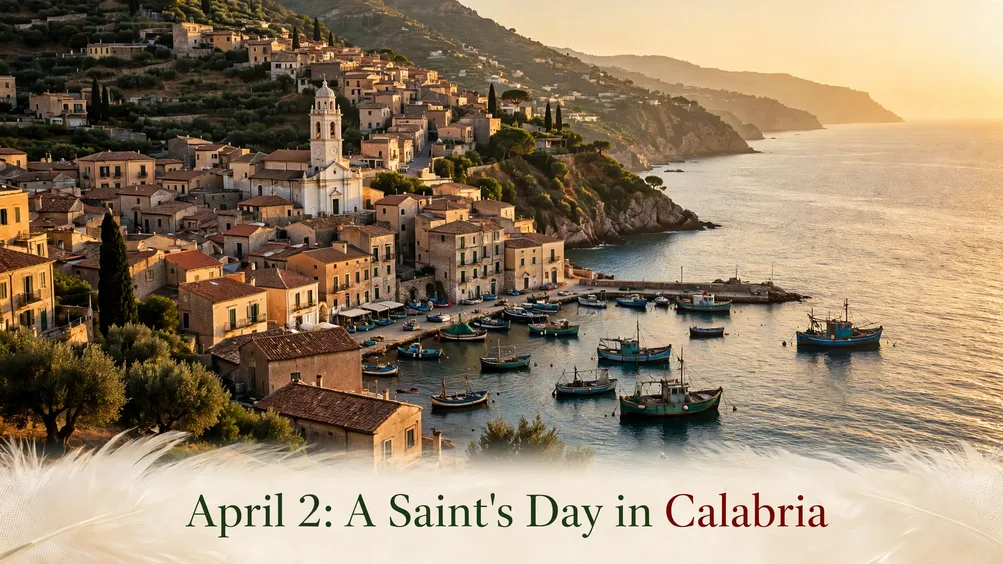
April 2: Paola’s Name Day and the Town That Gave the Saint His Name
Paola’s main name day in Italy falls on April 2, the feast of Saint Francis of Paola, a fifteenth-century hermit born in the Calabrian town of Paola. A second name day falls on January 26, the feast of Saint Paula of Rome. Italian families pick one date and celebrate the onomastico with a call, a gift, or a small dinner.
Saint Francis of Paola, the hermit from Calabria
Francis was born in the town of Paola, in Calabria, on March 27, 1416, and his parents named him after Francis of Assisi, to whom they had prayed for a child. At fifteen he became a hermit near Paola, and the community that gathered around him became the Order of Minims, named for their humility. He died on April 2, 1507, and the Church fixed his feast on that date.
Francis became the patron saint of Calabria and of sailors, after Pope Pius XII named him patron of Italian seafarers in 1943, because many of the miracles tied to him happened at sea. The town of Paola still celebrates him every year, and the sanctuary built on the site of his hermitage draws pilgrims from across southern Italy. A Paola who celebrates on April 2 shares her name day with a saint born in the town that shares her name.
Saint Paula of Rome and the January 26 option
Paula of Rome was a wealthy fourth-century widow who followed Saint Jerome to Bethlehem, where she died on January 26, 404. She gave away her fortune, helped Jerome with his biblical work, and became the patroness of widows. Families who prefer a January name day, or who feel closer to Paula’s story, celebrate Paola on her feast instead.
One low-quality name site lists January 25 as Paola’s name day, in honor of Saint Paul. That date is the feast of the Conversion of Saint Paul, not a name day for Paola, and it shows why a date should be checked against a saint’s calendar rather than copied from a list. April 2 and January 26 are the two dates the tradition actually supports.
How Italians celebrate the onomastico
In Italy the onomastico works like a second birthday. Friends and family call or visit, and a small gift, a cake, or a dinner is normal. For most names the date passes quietly, one saint among many, but Paola has two real options, so a family can pick the spring date or the winter one and make it their own.
The April date has one practical edge. It falls in spring, when a dinner outside is easy and the Calabrian coast is warming up, and it lands on a saint whose whole story fits the name’s meaning. Francis called his order the Minims, the least ones, because humility was the rule. A name day built on humility suits a name that means small.

Famous Paolas: From a Queen to a Volleyball Star
The best-known Paola today is Paola Egonu, the Italian volleyball star who helped Italy win Olympic gold at Paris 2024. The name also belongs to Queen Paola of Belgium, born Donna Paola Ruffo di Calabria, and to the actress and director Paola Cortellesi, whose film C’e ancora domani became a record hit. The bearers span sport, film, art, and royalty.
Queen Paola of Belgium
Queen Paola was born Donna Paola Ruffo di Calabria in 1937, into one of Italy’s oldest noble families, and married the future King Albert II of Belgium in 1959. She served as queen consort from 1993 until Albert’s abdication in 2013. Her full name carries the Calabrian town in it, Ruffo di Calabria, which ties the most famous Paola alive to the same southern region as the saint.
Paola Egonu and Paola Cortellesi
Paola Egonu, born in 1998 to Nigerian parents in Cittadella, is the opposite-spiker who led Italy to Olympic gold at Paris 2024, where she was named the tournament’s most valuable player. She is one of the most dominant volleyball players of her generation, and her name is now the one young Italian players ask about first.
Paola Cortellesi is the actress, comedian, and director whose 2023 film C’e ancora domani became one of the highest-grossing Italian films ever made. She spent two decades as one of Italy’s best-loved comic actresses before stepping behind the camera, and the film’s success made her name familiar well beyond Italy. Together, Egonu and Cortellesi show the name working at the top of two very different fields.
Paola Antonelli and Paola Pivi
Paola Antonelli is the senior curator of architecture and design at the Museum of Modern Art in New York, where she has shaped how museums treat design as a cultural force. Paola Pivi is the contemporary artist known for large, playful installations, including her famous upside-down donkeys and feather-covered polar bears. Both carry the name into the art world, one through curation and one through sculpture.
The list also reaches beyond Italy. Paola Suarez was a top-ten Argentine tennis player, Paola Nunez is a Mexican actress, and Maria Paola Buonaparte was the birth name of Pauline Bonaparte, Napoleon’s sister. The name travels well because it is short, melodic, and spelled the same in Italian, Spanish, and Portuguese.
How Popular Is Paola Today?
Paola is a quiet classic in the United States: 178 American girls received the name in 2025, putting it around 1,260th in the national ranking, far below its 1999 peak of about 300th. The name has eased downward for two decades without ever disappearing. In Italy it remains a familiar, steady choice, strongest among older generations.
The American numbers: a peak in 1999, a slow settle since
Paola first appeared in American birth records in 1950, with five girls, and climbed slowly for fifty years. It peaked in 1999 at about 300th in the national ranking, and the largest single year came later, in 2006, when 1,089 girls received the name. Since then the count has fallen most years, reaching 178 in 2025, which is roughly one girl in every 9,000 born that year.
About 24,000 Americans named Paola are alive today, and the typical Paola is now in her early twenties, born around 2003. The name is strongest in Texas, California, and Florida, the states with the largest Italian and Latin American communities. One site still lists Paola at 770th, but that figure is out of date; the 2025 records put it near 1,260th.
Paola in Italy: a steady classic, not a trend
No verified ISTAT ranking for Paola in Italy was available at the time of writing, so this article gives no Italian number rather than guessing one. What the record does show is steady use across generations: the name is carried by grandmothers, mothers, and daughters alike, in Italy and in Italian families abroad. That kind of staying power is rarer than a spike, and it is the reason Paola still sounds current.
If Paola feels right but you want to compare it with its neighbors, our list of Italian girl names starting with P puts it beside the other P names in one place, so you can hear how each one sounds next to your surname before you decide.
Is Paola the Right Name for Your Daughter? A Quiet Classic Test
Pick Paola if you want a name that sounds Italian, spells the same in three languages, and carries a real meaning rather than a fashion. It suits a family that values understatement and wants a name that works for a baby, a teenager, and a professional. Skip it if you want a name nobody has heard.
Pick Paola if you love quiet names with real roots
Paola fits a family that likes names with a clear meaning and a long history, and it pairs well with Italian surnames of any length. It also travels: the same spelling works in Italian, Spanish, and Portuguese, and the pronunciation stays close in all three. For a family with roots in more than one of those languages, that is a practical advantage, and the sound is a bonus.
The name also ages well. Paola sounds right on a birth announcement and on a business card, and it never locks its bearer into a single style. A Paola can be an athlete, a curator, a queen, or a teacher, and the name fits each one. That range is worth more than novelty, because a name has to last eighty years, not just one playground season.
Think twice if you want rare, or if Paula confusion will bother you
Paola is not rare, and it is not rising. About 24,000 Americans carry the name, and most of them are adults, so a baby Paola will meet plenty of grown-up namesakes and very few classmates with the name. If you want a name that feels brand new, Paola will feel familiar instead. That familiarity is a strength for some families and a drawback for others.
The other honest check is the Paula problem. English speakers will mishear Paola as Paula, misspell it as Paula, and sometimes call her Paula for years. The correction is small, one vowel, but it repeats for life. If that sounds tiring, a name with no close twin may fit better. If it sounds like a small price for a beautiful Italian name, Paola is the right call.
Frequently Asked Questions
How do you pronounce Paola in Italian?
In Italian, Paola is pronounced PAH-oh-lah, with the stress on the first syllable and three clear vowels in the middle. English speakers often flatten it to PAOW-la, dropping the middle vowel, but saying it slowly as PAH, oh, lah fixes the rhythm at once.
Is Paola a boy or a girl name?
Paola is a girl's name. Since 1880, American records show about 24,496 girls and only 148 boys given the name, so the male use is a rounding error. In Italy it is used only for girls.
What is Paola's name day?
Paola has two name days in Italy: April 2, the feast of Saint Francis of Paola, and January 26, the feast of Saint Paula of Rome. Most families celebrate on April 2, the spring date tied to the Calabrian saint.
How popular is the name Paola?
In the United States, 178 girls were named Paola in 2025, putting it around 1,260th in the national ranking, well below its 1999 peak near 300th. About 24,000 Americans named Paola are alive today, most of them adults in their twenties.
What are common nicknames for Paola?
The most common nicknames are Pao, the everyday short form, and Paoletta, the affectionate Italian diminutive. Paolina is the longer pet form, and Polly works through the English form Paula. Lola is sometimes offered, but it properly belongs to Dolores.
Conclusion
Paola is a quiet name with a long history. Its meaning is small and humble, its sound is soft and melodic, and its bearers range from a Roman saint to a queen, a volleyball champion, and a record-breaking director. It will never be the loudest name in the room, and that is exactly why it lasts. For a family that wants an Italian name with real roots and a quiet confidence, Paola is an easy yes. The next name in this series, Martina, means of Mars, the Roman god of war: see what Martina means in Italian.


