 Skip to content

What Does Silvia Mean in Italian
Silvia means “of the forest” in Italian. The name comes from the Latin word silva, meaning forest or wood, and it is the feminine form of the Roman name Silvius. Italians say it SEEL-vyah, with the stress on the first syllable, and the name day falls on November 3, through Saint Silvia, mother of Pope Gregory the Great.
Parents browsing ItalianGirlNames.com meet Silvia as one of the quiet classics, a name that has stayed in Italian use since the Middle Ages without ever chasing a trend. This guide covers the forest meaning, the Roman legend behind it, the pronunciation, the name day, and the bearers who carried it.
From the Forest Floor: What Silvia Means
Silvia means “of the forest”, and the meaning comes straight from the Latin word silva, meaning forest or wood. The name is the feminine form of Silvius, a Roman name tied to the same root, so the forest meaning is the name itself, plain and direct.
Latin silva, and the Silvius connection
Latin silva meant a wood or forest, and the Romans used it for wild, tree-covered land rather than a garden or park. Silvius grew from that word as a Roman family name, and Silvia is its feminine form, built the same way Italian names still pair a masculine and a feminine form today, like Paolo and Paola.
Behind the Name lists Silvia as the feminine form of Silvius, and notes that Rhea Silvia was the mother of Romulus and Remus, the founders of Rome. That plain entry is the most honest one available: it gives the chain without dressing it up, and it ties the name to Rome itself.
Why “spirit of the wood” is not quite the meaning
Some sites translate Silvia as “spirit of the wood”, but that is a gloss, not a translation. The Latin gives “of the forest” or “from the forest”, a plain statement of where the name comes from. The spirit wording comes from the old association with Silvanus, the Roman god of woods and fields, whose name shares the same root.
Keep the distinction in mind when you read name sites. A name that means “of the forest” points at trees and wild land, while “spirit of the wood” points at a god. Silvia carries the first meaning, and the god belongs to the same family of words.
Rhea Silvia: The Mother at the Root of Rome
Rhea Silvia is the woman at the start of Rome’s founding story. A Vestal Virgin and the daughter of King Numitor of Alba Longa, she became the mother of the twins Romulus and Remus, and the city of Rome traces its line to her sons.
The Vestal and the god Mars
Roman legend says Rhea Silvia served as a Vestal Virgin, sworn to chastity, when the god Mars came to her in a sacred grove. She gave birth to twin boys, Romulus and Remus, and her uncle Amulius, who had seized the throne of Alba Longa, ordered the babies set adrift on the Tiber. A she-wolf found them and nursed them until a shepherd took them in.
The twins and the founding of Rome
The twins grew up, overthrew Amulius, and returned to the place where the river had left them. Romulus founded Rome there in 753 BC, by the traditional date, and Remus died in the quarrel over the new city. Every telling of the story starts with their mother, so the name Silvia sits at the very beginning of Roman history.
The name kept that weight for centuries. Parents who chose Silvia were not only picking a pretty forest name; they were naming a daughter after the mother of Rome’s founders, and the legend gave the name a gravity that few Italian names can match.
The Italian Sound of Silvia: SEEL-vyah
Italians say Silvia as SEEL-vyah, two syllables with the stress on the first. The SEEL rhymes with the word feel, and the vyah is a quick, soft yah with a V in front, like the vy in the word view spoken fast.
Two syllables, stress on the first
Break the name into SEEL and vyah, and give the first syllable the weight. The Italian I is short and bright, like the I in sit, and the final A is a clear ah, never swallowed. Both vowels stay open, which is what gives Silvia its light, quick sound. Say it in two beats, lean on the first, and an Italian listener hears it correctly.
The English SIL-vee-uh trap
English speakers often say SIL-vee-uh, with three syllables and a long E, and that is the English form of the name. Italians still understand it, but it sounds different in Italian mouths, heavier and slower. Two name sites even print SEEL-VEE-AH as the Italian form, which is wrong: the Italian spelling has two syllables, not three, and the middle V belongs to the second beat.
Silvia, Sylvia, and Sylvie on paper
The spelling changes with the language, while the sound stays close. Italian and Spanish write Silvia, English and Swedish write Sylvia, French writes Sylvie, and Polish writes Sylwia. Silvia is the form to use for an Italian daughter, and the Y spelling reads as English, not Italian, on a birth certificate.
November 3: Silvia’s Name Day
Silvia’s name day in Italy is November 3, the feast of Saint Silvia, the mother of Pope Gregory the Great. The Roman Martyrology keeps her on that date, so Italian families who mark the onomastico celebrate a Silvia in early November.
Saint Silvia, mother of Gregory the Great
Saint Silvia was a Roman noblewoman of the sixth century who died around 590, and her son Gregory became Pope Gregory the Great, one of the most respected popes in history. She raised him in a Christian household on the Caelian Hill in Rome, and the church remembers her as a model of quiet, steady faith rather than public power.
How Italian families mark an onomastico
An onomastico in Italy is a small celebration, closer to a birthday than a holiday. Family and friends call or visit, and a cake often appears, with the name as the reason to gather. For a Silvia, November 3 is the day to mark, and a card that names Saint Silvia ties the celebration to the saint behind the name.
From Tasso to Leopardi: Silvia in Italian Verse
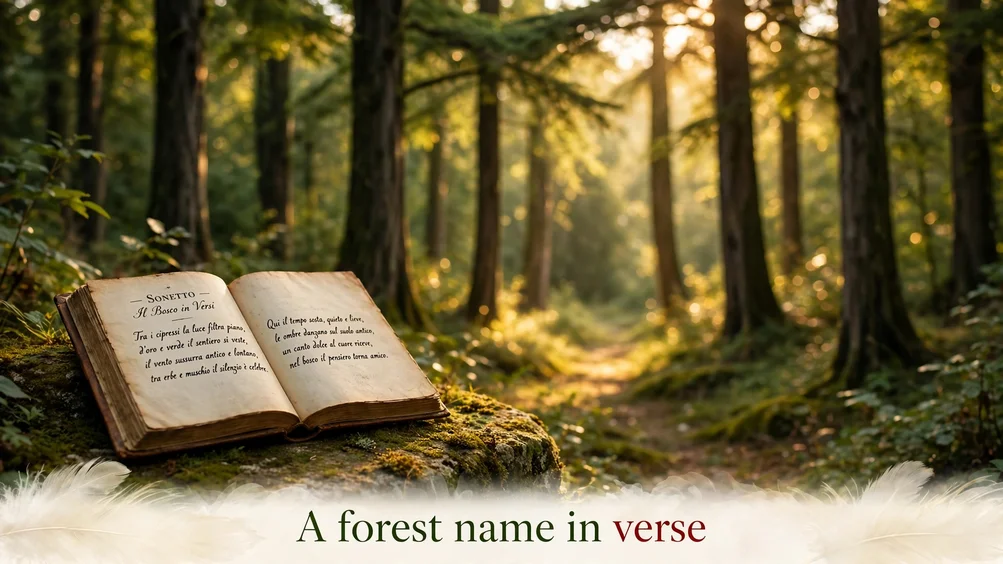
Silvia has lived in Italian poetry for centuries, longer than almost any other Italian girl name. Torquato Tasso gave the name to a nymph in 1573, Shakespeare borrowed it for a song, and Giacomo Leopardi made it the title of one of the best-known poems in the language.
Tasso’s nymph in Aminta, 1573
Torquato Tasso’s pastoral play Aminta, first performed in 1573, gives the name Silvia to a beautiful nymph, the shepherd Aminta’s beloved, who runs from love through the woods. The name fit the setting perfectly: a girl of the forest, in a play set among trees and streams. After Aminta, Silvia carried a literary shine in Italy that it has never lost.
Shakespeare’s song, “Who is Silvia?”
Shakespeare borrowed the Italian spelling for the heroine of The Two Gentlemen of Verona, first performed around 1594, and gave her the song “Who is Silvia? What is she, that all our swains commend her?” The play carried the name into English, and the Italian spelling stayed in use for centuries before Sylvia took over in the English-speaking world.
Leopardi’s “A Silvia”, 1828
Giacomo Leopardi wrote “A Silvia” in 1828, a lyric addressed to a young woman he had known in Recanati, usually identified with Teresa Fattorini, who died of tuberculosis in her teens. The poem mourns lost youth and unfulfilled hopes, and Italian schoolchildren still read it today. Few Italian names carry a poem this famous, and it is the main reason Silvia still sounds literary to Italian ears.
Silvia’s Bearers: A Queen, an Actress, a Scholar
The best-known Silvia today is Queen Silvia of Sweden, born in Germany in 1943 and queen since her marriage to King Carl XVI Gustaf in 1976. She is the longest-serving queen consort in Swedish history, and her name day, August 8, is an official flag day in Sweden.
Queen Silvia of Sweden
Silvia Renate Sommerlath was born in Heidelberg, Germany, in 1943, and she met the future king at the Munich Olympics in 1972, where she worked as a hostess and interpreter. They married in 1976, and she founded the World Childhood Foundation, which works against the abuse and exploitation of children. Her bearing gave the name a royal polish across Europe.
Silvia Colloca and Silvia Pinal
Silvia Colloca is the Italian actress, television presenter, and food writer known around the world for cookery programs that celebrate Italian food and family life. Silvia Pinal, born in 1931 and died in 2024, was one of the great stars of Mexican cinema, the lead of Luis Bunuel’s Viridiana in 1961. Both carried the name into living rooms far from Italy.
Silvia Federici, the scholar
Silvia Federici, born in 1942, is the Italian-born feminist scholar and activist who wrote Caliban and the Witch, a study of the European witch hunts and the origins of capitalism. Her work is read in universities around the world, and it gives the name a serious, thinking edge that balances the poetry and the glamour.
Silvia in Italy and America Today
Silvia was a mid-century favorite in Italy, popular from the 1960s through the 1990s, and it has eased down since as newer names took its place. In the United States it stays a quiet choice, ranked 1,240th in 2025 with 182 baby girls given the name.
Italy’s mid-century favorite
Silvia filled Italian classrooms for decades, and parents of that generation still think of it as a familiar, warm name, one Italian parents keep choosing. It has slipped as newer names came into fashion, but it keeps a devoted following among parents who want a literary name with deep Italian roots. It reads as classic in Italy, a name parents still choose on purpose.
The American numbers
In the United States, Silvia ranked 1,240th in 2025, with 182 baby girls given the name, according to Social Security Administration data. It peaked at 494th in 1974, its best rank, and 374 babies received the name in 1991, its biggest single year. At least 21,272 American girls have carried the name since 1884.
One popular name site lists Silvia at 766th in the United States, but that figure does not match the Social Security data, which puts it at 1,240th for 2025. The gap is worth noting: the lower rank is the honest one, and parents should trust the official count over a site’s rounded figure.
Short Forms and Cousins: Silvi, Silvio, and Silvana
Silvia’s family is small and close. Silvi is the natural Italian nickname, Silvio is the masculine form, Silvana is the longer woodland cousin, and the international spellings Sylvia, Sylvie, and Sylwia carry the same forest meaning in other languages today. Federica is another Italian name with a clear meaning: see what Federica means in Italian. Paola is another Italian name with a Latin root and a saint of its own: see what Paola means in Italian.
The family table
| Name | Form | Language | Meaning |
|---|---|---|---|
| Silvia | Feminine form | Italian, Spanish | Of the forest |
| Silvio | Masculine form | Italian | Of the forest |
| Silvius | Roman original | Latin | Of the forest |
| Silvana | Longer feminine form | Italian | Of the woods |
| Sylvia | English form | English, Swedish | Of the forest |
| Sylvie | French form | French | Of the forest |
| Sylwia | Polish form | Polish | Of the forest |
| Selva | Spanish form | Spanish | Forest, jungle |
Nicknames Italians actually use
In Italy, Silvi is the nickname that comes naturally, short and warm, and Sil is the brief modern option. Silvia is already short, so many families use the full name and skip nicknames entirely. Italian diminutive endings work too: Silvietta adds a gentle -etta, the way Italian families soften a name they love.
Among Italian girl names starting with S, Silvia is the literary one, the name with a poem, a saint, and a founding legend behind it. Its neighbors on the page lean on sound or fashion, while Silvia leans on history, which is why it still appears on Italian birth lists after centuries of use.
Silvia, Sylvia, and the spelling question
The two spellings split by language, not by meaning. Silvia is the Italian and Spanish form, Sylvia the English and Swedish one, and both come from the same Latin root. Parents in Italy should use Silvia, while an English-speaking family may pick Sylvia for easier spelling at home. The choice says where the name lives, not what it means.
Choosing Silvia: A Quiet Classic That Fits Any Surname
Choose Silvia if you want a classic name that stays quiet. Two syllables fit almost any surname, the forest meaning gives it a calm image, and the name works in Italian, Spanish, and English without changing its sound much. It suits parents who like history without noise.
The sound test with your surname
Say the full name aloud with your surname and listen for where the sounds meet. Silvia ends in an open A, so it flows into surnames that start with a consonant and can blur into surnames that start with a vowel. Try it with a middle name too, and say it quickly, as a teacher calls it in class. If the three names run together cleanly, the sound test passes.
Short surnames suit Silvia well, because two syllables leave room for a one-syllable last name without crowding it. Long Italian surnames work too, since the name’s light rhythm balances a heavier last name. The name is hard to mispronounce once heard, which helps in both Italian and English settings.
The spelling question
Ask whether the Y spelling will cause trouble where you live. In Italy, Silvia is the only spelling anyone expects, and Sylvia looks foreign on paper. In America, Sylvia is the familiar form, and Silvia may need spelling out. Pick the form that matches the country where your daughter will grow up, and the question mostly disappears.
The meaning test
Hold the meaning up against the name you will say every day. A forest is quiet, green, and old, and it grows slowly without asking for attention. If that image feels right for your daughter, the meaning test passes. Silvia asks for nothing more than to be said clearly and worn simply.
Our guide to Italian girl names with meanings puts Silvia beside other names with a clear meaning, so you can see how “of the forest” compares with the meanings behind Sofia, Aurora, and Beatrice before you decide which one fits your family best.
Frequently Asked Questions
How do you pronounce Silvia in Italian?
Italians say Silvia as SEEL-vyah, two syllables with the stress on the first. The SEEL rhymes with feel, and the vyah is a quick, soft yah with a V in front. English speakers often say SIL-vee-uh, with three syllables, but that is the English form, not the Italian one.
Is Silvia an Italian name?
Yes. Silvia comes from Latin and has been a common name in Italy since the Middle Ages. It is also used in Spain and Portugal, and the English form is Sylvia, but the Silvia spelling is the Italian one, and Italy holds close to half of the name's bearers worldwide.
What is Silvia's name day?
Silvia's name day in Italy is November 3, the feast of Saint Silvia, mother of Pope Gregory the Great. The Roman Martyrology keeps her on that date. In Sweden, the name day is August 8, kept as a flag day in honor of Queen Silvia.
What is the difference between Silvia and Sylvia?
The two spellings split by language, not by meaning. Silvia is the Italian and Spanish form, Sylvia is the English and Swedish form, and both come from the same Latin root, silva. Parents in Italy should use Silvia, while an English-speaking family may pick Sylvia for easier spelling at home.
How popular is Silvia in the United States?
Silvia ranked 1,240th in the United States in 2025, with 182 baby girls given the name. It peaked at 494th in 1974, and 374 babies received the name in 1991, its biggest year. At least 21,272 American girls have carried the name since 1884.
Conclusion
Silvia is a forest name with a long road behind it: a Latin word, a Roman legend, a sixth-century saint, a Renaissance nymph, and a poem Italian schoolchildren still read. It is quiet in America, familiar in Italy, and easy to say in both. If you like classic names with a clear meaning, Silvia is worth a place on your list, and our guide to what Serena means in Italian covers the next name in this series. Valentina is another name in this series with a strong Latin meaning: see what Valentina means in Italian.


