 Skip to content

What Does Valentina Mean in Italian
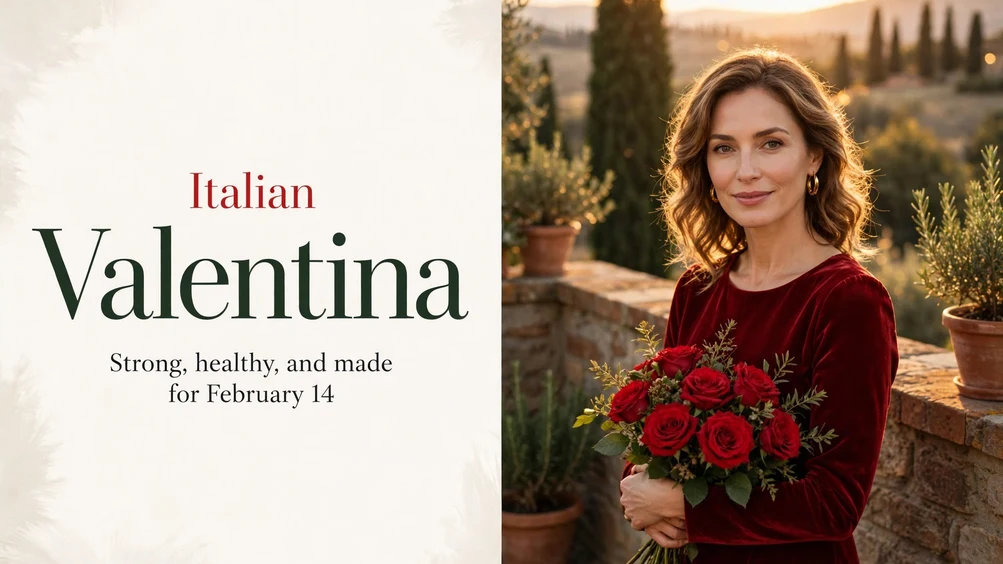
Valentina means strong, healthy, and vigorous in Italian. The name comes from the Latin word valens, and it is the feminine form of Valentinus, a Roman family name. Italian speakers say it vah-len-TEE-nah, and its name day falls on February 14, the feast of Saint Valentine. Among Italian girl names, Valentina stands out because its meaning points to strength while its associations point to romance.
The meaning and the association disagree. The word itself has nothing to do with love, roses, or February cards. The romance arrived later, carried by a saint’s feast day and a medieval poem. Parents who pick Valentina for its sound get the love story as well, and parents who pick it for its meaning get a much tougher name than they expected.
What Valentina Means: Strong, Healthy, and Vigorous
Valentina means strong, healthy, and vigorous. The meaning comes straight from the Latin verb valere, to be strong, through its present participle valens. Valentina is the feminine form of Valentinus, so the name carries that Roman sense of physical strength and good health into Italian, Spanish, Russian, and a dozen other languages.
The Latin root valens
Valens was an everyday Latin word. A Roman used it for a soldier, a wall, or a body that could still stand up to hard use. That plain sense survives in English words like valid and valiant, and it sits underneath Valentina too. The name promises stamina.
The same root gives us Valeria, from valere, and the English word valor. Valentina belongs to that whole family of strength words, which is why it pairs so naturally with names like Victoria. Where Victoria means victory, Valentina means the strength that wins it, a useful distinction when you are weighing the two.
Feminine of Valentinus, not of Valentine
The chain runs Valentinus to Valentina. Valentinus was a Roman family name built on valens, and Valentina is its feminine form, made by changing the ending. Valentino is the Italian masculine form, and Valentine is the shorter French and English form. Behind the Name lists Valentina as the feminine form of Valentinus, with usage across Italian, Russian, Spanish, and a dozen other languages.
That order matters, because some name sites flip it and call Valentina the feminine of Valentine. Valentine is the better-known word in English, so the mistake spreads easily. The Italian form never passed through Valentine at all. It came straight from the Latin family name, which is why it keeps its full four syllables in Italian.
What the meaning does not say about romance
Nothing in valens means love. The romantic feeling around Valentina is borrowed from Saint Valentine, whose feast day gave the name its February link, and from centuries of Valentine’s Day cards. If you want more names whose meanings run deeper than their sound, our guide to Italian girl names with meanings collects the strongest examples.
Some name sites get this wrong in the other direction. One popular page claims Valentina means bravery in battle, which has no basis in the Latin root. Valens meant strong and healthy, full stop. The battle reading is invented, and it shows why a meaning should always be checked against a name dictionary rather than a list site.
How Italians Say Valentina: vah-len-TEE-nah
In Italian, Valentina is pronounced vah-len-TEE-nah, with the stress on the third syllable and every vowel sounded cleanly. The final a stays open, the t is soft and dental, and no syllable gets swallowed. English speakers usually say val-en-TEE-nuh, which drops the final vowel sound and flattens the Italian rhythm.
The stress trap English speakers fall into
English speakers hear four syllables and often stress the second one, saying val-en-TEE-nah with a heavy middle. Italian keeps the stress on the third syllable, TEE, and lets the first two syllables stay light. Say it slowly as vah, len, TEE, nah, and the rhythm falls into place. The name rhymes with ballerina, which helps relatives learn it over the phone.
The t is the other detail worth copying. Italian t is dental, made with the tongue against the teeth, so it sounds softer than the hard English t. You do not need a perfect accent to say the name well. A soft t and an open final a are enough to make it sound Italian rather than anglicized.
Diminutives Italians actually use
In Italy, Valentina shortens most often to Vale, a warm two-syllable form that works for a child and an adult alike. Tina is the other everyday short form, and it has stood on its own as a full name for generations. Both keep the name’s sound without losing its shape.
Valya is the standard Russian short form, and you will hear it wherever the name is used in Russian-speaking families. Nina comes from the name’s ending and suits a toddler. Vee and Leni are modern English shortenings, and they work fine, but Vale is the one an Italian grandmother would actually use.
February 14: Valentina’s Name Day and the Saint Valentine Link
Valentina’s name day in Italy falls on February 14, the feast of Saint Valentine, the third-century Roman martyr whose name the family shares. Italian families celebrate the onomastico the way other countries mark a second birthday, with a call, a gift, or a dinner. For a Valentina, that means her name day always lands on the year’s most romantic date.
Who Saint Valentine was
Saint Valentine was a Roman priest and martyr of the third century, executed in Rome around the year 269. His feast was fixed on February 14, and the name Valentinus traveled with the cult of the saint across Europe. Italian, Spanish, and Portuguese speakers kept the feminine form in steady use, while Russia and Ukraine leaned on it heavily through the twentieth century.
The saint himself has nothing to do with romance in the early record. He was a martyr, and the feast honored his death, not his love life. The roses and cards came much later, which means the name’s oldest layer is about faith and endurance, and the romantic layer sits on top of it.
How a feast day became a name day
In Italy, the onomastico is the feast day of the saint a child is named after, and it is celebrated every year. Friends and family call or visit, and a small gift or a cake is normal. For most names the date is forgettable, one saint among many. For Valentina, the date is February 14, so the whole country is already celebrating when her name day arrives.
That timing cuts both ways. A Valentina never has to explain when her name day falls, and she never gets forgotten, because the date is printed on every calendar and shop window. The trade-off is that her personal celebration shares its day with a commercial holiday, and the flowers she receives may look like everybody else’s.
The romance arrived a thousand years late
The link between Saint Valentine and romantic love does not appear in the record until the fourteenth century, when Geoffrey Chaucer’s poem The Parliament of Fowls tied the feast to birds choosing their mates. That is roughly a thousand years after the saint’s death. The name Valentina is older than the romance attached to it by a full millennium.
This gap is the fact parents on the fence should weigh first. If the Valentine’s Day theme feels too sweet, remember that the name predates it by centuries and its meaning has nothing to do with it. If the theme delights you, the name carries it honestly, through a real saint and a real feast day.
Valentina’s Popularity: From Rare to the US Top 40
Valentina ranked 35th among American girls in 2025, its highest position ever, with 5,354 babies given the name that year. It first appeared in US records in 1897, spent most of the twentieth century outside the top 1,000, entered the top 100 in 2017, and has climbed almost every year since. Half of all American Valentinas were born after 2017.
The long flat century
For most of the twentieth century, Valentina was a rare name in the United States. As late as 1985, only about a hundred babies a year received it, and it sat in the low thousands of the rankings. It cleared the top 1,000 in 1993, then climbed steadily through the 2000s as long Romance-language names became fashionable in the US.
The rise tracks the same curve as Isabella and Sofia, which made long, vowel-heavy girls’ names mainstream a generation earlier. Valentina arrived later to the same trend, which is why it still feels fresh even inside the top 40. It has no revival hump to fall off, because it was never popular enough before to go out of fashion.
Where Valentina ranks strongest
Valentina is strongest in Florida, where it ranked 9th for girls in 2025, and in California, where it ranked 10th, with Texas close behind at 12th. The name is most popular in states with large Hispanic communities, which fits its Spanish and Italian usage. In Puerto Rico it ranked 2nd, the highest position it holds anywhere in the US records.
That geography matters for parents thinking about how the name will land. In Florida or California, Valentina is a familiar, everyday choice. In states where it ranks past 150th, it sounds more distinctive. Either way, the pronunciation is widely known now, so a Valentina rarely has to spell or explain her name.
What the climb means for parents
A name inside the top 40 and still climbing will put more than one Valentina in a large elementary school. That is the honest cost of choosing a name at its peak. The nickname you settle on may end up doing more work than the full name, which is another reason to pick a short form early and use it consistently.
The upside is that a rising name cannot sound dated, because nearly all of its use is recent. A Valentina born today joins a generation of Valentinas, not a throwback to a past fashion. Parents who want a name that feels current without feeling invented will find that balance here.

Famous Valentinas: Strength in Every Field
The best-known Valentina is Valentina Tereshkova, the Soviet cosmonaut who in 1963 became the first woman in space, flying solo aboard Vostok 6. The name’s other famous bearers match that same pattern of strength. Olympic fencer Valentina Vezzali won six gold medals, and mixed martial artist Valentina Shevchenko held the UFC flyweight title.
Valentina Tereshkova, the first woman in space
Tereshkova launched on June 16, 1963, and circled the Earth 48 times in about 71 hours, alone in her capsule. She remains the only woman to have flown a solo space mission, and the youngest woman to orbit the Earth. Her flight made Valentina a household name in the Soviet Union and far beyond it.
Tereshkova fits the meaning well. She came from a working-class family, worked in a textile mill, and trained as a parachutist before she was chosen for the space program. The name’s meaning and its most famous owner tell the same story, which is rare among popular names.
Valentina Vezzali, the fencer with six golds
Valentina Vezzali is an Italian foil fencer and politician, and one of the most decorated athletes in Olympic history. She won six Olympic gold medals and sixteen world titles, and she is widely regarded as the greatest women’s foil fencer ever. Her career ran from the mid-1990s into the 2010s, which gave the name a long run of Italian sporting glory.
Vezzali matters for this site because she is the Italian bearer, the one who shows the name at home rather than abroad. Tereshkova made Valentina famous worldwide, but Vezzali made it a name Italian parents could point to on their own television screens, year after year.
Valentina Cortese and the arts
Valentina Cortese was an Italian screen actress whose career ran from the 1940s into the 1990s, with an Academy Award nomination for Day for Night in 1974. She worked with Fellini, Antonioni, and Truffaut, which puts her at the center of European art cinema. Her name carried the same polish on a film poster that it carries in a classroom.
The arts give Valentina its third field, after space and sport. A name with famous bearers in science, athletics, and film is hard to pin to one stereotype, and that range is part of its appeal. Parents get strength and grace in the same package, without having to choose between them.
Valentina Around Europe: Variations and Nicknames
Valentina travels with few changes because Latin roots run through most of Europe. French speakers use Valentine, Ukrainians write Valentyna, Poles write Walentyna with a W that sounds like V, and Russians shorten it to Valya. The core sound stays the same everywhere, which is why the name sounds local in Milan, Buenos Aires, Moscow, and Miami. Another Italian name with a Latin root is Silvia, which means “of the forest”: see what Silvia means in Italian.
The spellings that change
The variations follow the spelling rules of each language, not a new meaning. Valentine is the French form, used for girls in France, while Valentin is the French masculine. Valentyna is the Ukrainian spelling, Walentyna the Polish one, and Valiantsina the Belarusian form. The Hungarian masculine is Balint, which shows the V to B shift Hungarian applies to Latin names.
Valentina is the best-known V name for girls in Italy, and it leads our list of Italian girl names starting with V. Parents choosing between the spellings should know that Valentina is the form used in Italy itself. If you are weighing other Italian names with strong meanings, see what Federica means in Italian. The other spellings mark the language they come from, so they suit families with that heritage and read as variants elsewhere. Paola is another Italian name with a Latin root, meaning small and humble: see what Paola means in Italian.
| Form | Language | Notes |
|---|---|---|
| Valentina | Italian, Spanish, Russian | The standard form in Italy |
| Valentine | French | Shorter form, used for girls in France |
| Valentyna | Ukrainian | Slavic spelling, common in Eastern Europe |
| Walentyna | Polish | W pronounced like V |
| Valiantsina | Belarusian | Usually shortened to Valya |
| Valentino | Italian | Masculine form |
The nicknames that stick
Four syllables give Valentina a full shelf of short forms. Val is the obvious clipped form, and the one most people will reach for without being asked. Tina is the vintage option, and it has worked as a full name on its own for decades. Vale is the Italian favorite, warm and short at once.
The less obvious nicknames are often the best ones. Leni comes from the middle of the name, va-LEN-tina, which is why almost nobody guesses it. Nina comes from the ending and suits a small child. Vina is soft and old-fashioned, the closest thing to a diminutive of the whole word. Pick one early, because the schoolyard will pick one for you if you do not.
Choosing Valentina: Does the Valentine’s Day Link Help or Hurt?
The Valentine’s Day link helps Valentina more than it hurts, as long as parents choose the name for its meaning first. The February 14 connection gives the name a built-in celebration, but it also ties the name to romance. If the strength meaning is what you love, the holiday link is a bonus, not the reason.
Where the link helps
The help is practical. A Valentina gets a name day the whole world already celebrates, a ready-made story for her birthday season, and a date nobody forgets. February babies suit the name best, since the birthday and the name day fall in the same season, and the red roses of the holiday match the name’s warmth.
The link also makes the name easy to explain. Grandparents, teachers, and strangers all know the reference, so nobody asks what kind of name it is. That familiarity is worth something, especially for a four-syllable name that might otherwise feel formal. The holiday does the introducing for you.
Where the link hurts
The hurt is the shadow the romance casts over the meaning. Every February brings jokes about sweethearts and cards, and some people will assume the parents picked the name for the holiday rather than for its strength. A Valentina who dislikes pink and hearts may spend her life correcting the first impression her name creates.
The other cost is the theme itself. A name tied to one day of the year can feel seasonal, and a girl born in August may find the February link irrelevant to her. Neither problem is fatal, but both are worth weighing before the birth certificate is signed, because the link cannot be switched off later.
The surname test
Say the full name aloud three times, fast and slow, before you decide. Valentina is long and ends on an unstressed a, so it pairs best with a short surname, and a long surname can make the whole name feel like a sentence. If your surname is also long and Italian, try a one-syllable middle name to give the ear somewhere to land.
For the middle name, avoid another name ending in a. Valentina Rose, Valentina June, and Valentina Claire all work because the short middle stops the rhythm instead of extending it. Then ask one last question: would you still love this name if February 14 did not exist? If the answer is yes, the name is yours.
Frequently Asked Questions
How do you pronounce Valentina in Italian?
In Italian, Valentina is pronounced vah-len-TEE-nah, with the stress on the third syllable and every vowel sounded cleanly. The final a stays open and the t is soft and dental. English speakers usually say val-en-TEE-nuh, which drops the final vowel sound.
Is Valentina a Valentine's Day name?
Valentina's name day falls on February 14, the feast of Saint Valentine, so the holiday link is real. But the name is roughly a thousand years older than the romance attached to it, and its meaning, strong and healthy, has nothing to do with love. The February 14 link is a bonus, not the reason to choose the name.
Is Valentina a popular name?
Valentina ranked 35th among American girls in 2025, its highest position ever, with 5,354 babies given the name that year. It entered the US top 100 in 2017 and has climbed almost every year since. It is strongest in Florida, where it ranked 9th, and in California, where it ranked 10th.
What are common nicknames for Valentina?
The most common nicknames are Val, Tina, and Vale, the Italian favorite. Valya is the standard Russian short form, Nina comes from the name's ending, and Leni comes from its middle. Pick a short form early, because a four-syllable name will collect one on its own.
What is the masculine form of Valentina?
The Italian masculine form is Valentino. Valentine is the shorter French and English form, and both keep the valens root intact. Valentina itself is almost entirely feminine in use; only 7 American boys received the name in 2025, against 5,354 girls.
Conclusion
Valentina means strong, healthy, and vigorous, and that meaning has held steady from Roman Latin to modern Italian. The romance people attach to it came a thousand years later, through a saint’s feast day and a medieval poem. Choose the name for the strength, enjoy the February celebration as a bonus, and let the meaning do the heavy work for the rest of her life.


