 Skip to content


Greco Surname Meaning
Greco means Greek. It is an Italian surname built on the Italian word greco, from the Latin Graecus, and it was given to a man whom his neighbors regarded as Greek, whether by birth, by speech, or by the church he attended. The name is most common in the far south, in Calabria, Apulia, and Sicily, the old Greek world of Magna Graecia.
Our Italian girl names A to Z guide treats surnames as part of the naming story, and Greco is one of the clearest cases of a single word carrying centuries of history. This guide follows the name from its Greek root to the southern towns where it is still thickest, then through its variants, its numbers, and the bearers who carried it onto the world stage.
The short answer is simple, but the name rewards a closer look. Greco can mark a Greek ancestor, a Greek-speaking village, or an Orthodox congregation, and the spelling alone cannot tell you which one applies to a particular family. The sections below separate what the name proves from what it only suggests.
What Does Greco Mean? The Greek in the Name
Greco means Greek. It is an ethnic surname, a label for a person from Greece or of Greek descent, formed from the Italian word greco and the Latin Graecus behind it. The Dictionary of American Family Names gives that reading as the principal explanation, with one secondary nickname sense recorded beside it.
From Latin Graecus to Italian Greco
The word behind the name traveled a short road. Greek Graikos, the name of a Greek tribe, became Latin Graecus, and Latin Graecus became the Italian adjective greco, still in everyday use for anything Greek. Treccani traces exactly that chain, and the surname keeps the ordinary word intact rather than translating a particular Greek family name.
That plainness is the point. In medieval Italy, a village needed a way to tell one Giovanni from another, and the Greek in the street, the Greek-speaking trader, or the family from across the sea each got the same practical label. Once the label entered the parish books, it stayed, and the children kept a word that described a neighbor, not a bloodline.
The Nickname Reading, and Why It Needs Care
The same dictionary records a second, less direct reading. In some cases Greco may have been a nickname for a person seen as crafty or guileful, because those were qualities once stereotyped as Greek. It is an occasional reading, not the main one, and it describes an old prejudice in the naming vocabulary rather than the people who carry the name today.
Two other uses of the word have nothing to do with the surname. Greco is also a northeast wind, the grecale, and a family of grape varieties and wines, including the Greco di Tufo. Treccani records both, but the surname dictionary is clear: the family name comes from the ethnic label, not from the weather or the vineyard.

Magna Graecia: The Greek Colonies Behind the Name
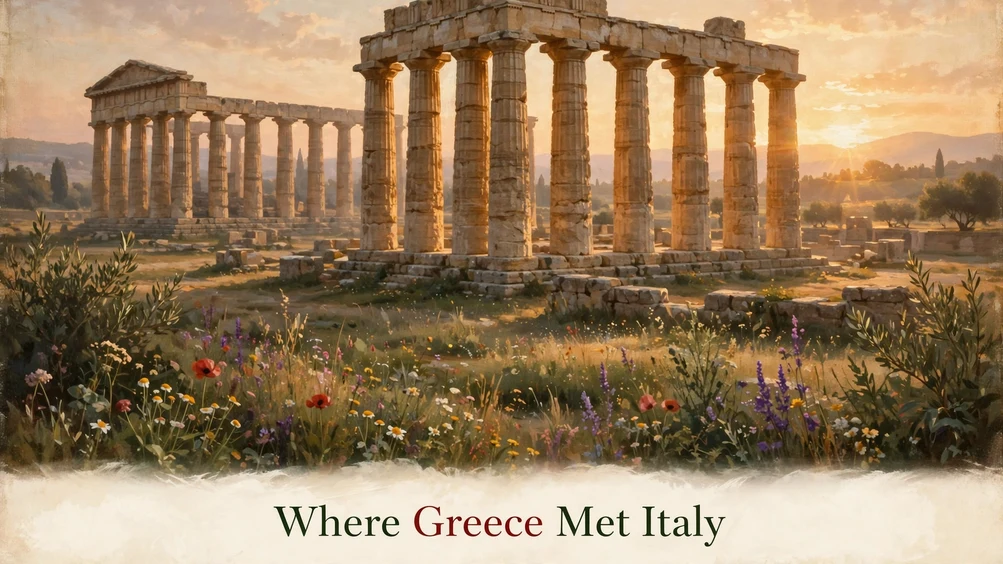
Greco is thickest exactly where Greek colonists settled. From the eighth century BCE, Greek cities lined the coasts of southern Italy and Sicily, a world the Romans called Magna Graecia, Greater Greece. The name Greco still maps that old coastline, because the Greek presence there lasted for centuries after the colonies themselves fell.
Neapolis, Rhegion, Syracuse, and Akragas
The colony names still sit on the modern map. Naples began as Neapolis, the new city, and Reggio Calabria was Rhegion. Syracuse, founded by Corinth, grew into one of the largest cities of the Greek world, and Agrigento on the southern Sicilian coast was Akragas, famous for its temples and its philosopher Empedocles.
Paestum, south of Naples, was Poseidonia, and its Greek temples still stand in remarkable condition today. When Rome absorbed this world, the Greek-speaking population did not vanish. It shrank into rural communities and smaller towns, but it kept its language and its customs for generations, long enough for the word greco to become a surname.
Griko, the Greek That Never Left
In two small pockets, the Greek language outlived the colonies by more than two thousand years. Griko, a form of Greek descended from the ancient settlers, survived in the Salento peninsula of southern Puglia and in the Bovesia area of Calabria, spoken as a living language into the twentieth century.
Griko is now critically endangered, with only a small number of elderly speakers left. Families named Greco in these districts may carry more than a label: they may carry one of the oldest unbroken cultural lines in Europe, a language that crossed from the Greek world to the Italian heel and never quite left.
Where Greco Lives: Calabria, Apulia, and Sicily
Greco is a southern name, and the numbers draw a clear map. Four regions sit above the national average: Calabria, where about 1 person in 155 carries the name, Apulia at 1 in 198, Sicily at 1 in 282, and Molise at 1 in 377. Every region that beats the average lies south of Rome.
The Four Regions Above the National Average
The national figure is about 1 bearer in 715 people. Against that background, the southern concentration stands out, and the table below puts the four leading regions side by side. The figures come from the 2014 distribution data, and the pattern they show has held in every count since.
| Region | Frequency | Share of Italian bearers |
|---|---|---|
| Calabria | 1 in 155 | 15% |
| Apulia | 1 in 198 | 25% |
| Sicily | 1 in 282 | 22% |
| Molise | 1 in 377 | Not reported |
Apulia, the Region Where Greco Leads
Apulia deserves a closer look. There Greco is not only common, it is the single most frequent surname in the region, concentrated almost entirely in the Salento, the heel peninsula where Griko is still spoken. The frequency table and the language map of the south draw the same line.
The pattern runs through the Byzantine centuries too. After Rome, the Byzantine Empire held the heel of the peninsula, and Greek rite and Greek speech stayed part of daily life in the south long after the north had turned fully Latin. A household called Greco in Calabria or the Salento was placed in a layer older than the Italian spoken around it.
How Common Is Greco? The Frequency Story
Greco is one of the ten most common surnames in Italy, and about 85,000 people carry it there. Worldwide, roughly 134,650 bearers were counted in the 2014 data, with about 63 percent still living in Italy. The United States holds the next largest share, with 16,346 bearers in the 2020 Census.
In Italy: About 85,000 Bearers
Two counts disagree slightly on the exact rank, and both are worth naming. Wikipedia, citing the Cognomix list of the 100 most common Italian surnames, places Greco tenth in the country. Forebears, working from the same 2014 data, counts 85,434 bearers at 1 in 716 and ranks it twelfth. Either way, it sits near the very top of the national list.
Greco is not the only southern surname that crowds the top of the list. Rossi still leads the country, and Esposito, the foundling name of Naples, sits close behind. What sets Greco apart is how tightly it clings to the south: a quarter of all Italian bearers live in Apulia, a fifth in Sicily, and about a seventh in Calabria.
In the United States: Rank 2,165 and Slipping
The 2020 Census counted 16,346 Americans named Greco, ranking the name 2,165th in the country at 5.47 bearers per 100,000 people. The count has slipped a little in each release: 17,013 bearers in 2000, then 17,150 in 2010, then 16,346 in 2020, a fall of about 5 percent across the last decade.
Name Census projects about 18,744 living bearers today by applying the Census rate to the current population, an estimate rather than a fresh count. The diaspora follows the old emigration routes: Argentina holds about 6 percent of the world’s bearers, Brazil about 4 percent, Canada about 2 percent, and France about 2 percent.
Greco, Grieco, and Lo Greco: Reading the Variants
Greco travels with a large family of spellings, and each one belongs to a place. Grieco is the recognized Italian variant, strongest around Bari. Lo Greco, La Greca, and Del Greco add an article or a preposition, while Greca, Greci, and Grego are related forms that need care before they are treated as the same name.
Grieco and the Bari Cluster
Grieco is the variant the Dictionary of American Family Names names directly, and it is the form to check first when a family line crosses from Greco into another spelling. It clusters around Bari and the towns of Apulia, where the vowel shifted from e to ie in the local speech. Forebears counts about 23,818 Grieco bearers worldwide, a large name in its own right.
The same vowel shift reaches further. Griego is Campanian, Lucanian, and Apulian, and the compressed forms Logreco and Logrieco belong to the Bari area, with Logrieco tied by the surname atlas to a single town, Bitonto. A spelling change in the records is normal for this family: parish clerks wrote what they heard, and the same household can appear under two spellings a generation apart.
The Article Forms: Lo Greco, La Greca, Del Greco
Some variants keep the article in front of the name. Lo Greco is found in Palermo, Agrigento, Foggia, and Bari, while La Greca belongs to the Agrigento country and Lagreca to the Bari and Salerno area. Del Greco, meaning of or belonging to the Greek, is mainly Tuscan and names the son, apprentice, or associate of a Greek.
These forms should be recorded exactly as they appear in the records, never stripped back to plain Greco without evidence. A documentary link, shared parents, a spouse, or a continuous residence, is more reliable than resemblance alone, and a family that wrote Lo Greco for a century may have no link at all to a Greco family in the next province.
Greca, Greci, and Grego: Related, Not Identical
Greca and Greci look like the feminine and the masculine plural of the ordinary Italian word, and Treccani gives exactly those forms. That likeness makes them useful spellings to notice, but it does not prove that separately recorded Greca or Greci families belong to the same line as a Greco family.
Grego needs the most care. It can be an Italian, Spanish, or Portuguese ethnic surname with the same Greek sense, but the dictionary also gives it separate Croatian and Slovenian explanations, including derivation from the personal name Gregorije in some Croatian cases. Similarity to Greco is not enough to merge every Grego record into an Italian Greco line.

Famous Grecos: A Chess Master, a Sculptor, and a Dancer
The Greco name has reached the top of chess, sculpture, and dance, and its bearers spread from a Calabrian village to the stages of New York. The best documented early bearer is Gioacchino Greco, the seventeenth-century chess player from Celico, while the best known modern bearer in Italy is Emilio Greco, the sculptor.
Gioacchino Greco, the Chess Player from Celico
Gioacchino Greco was born in Celico, in the province of Cosenza, near the end of the sixteenth century, and he is often called the first professional chess player. His 1619 chess treatise spread his games across Europe, and Treccani records his death in the West Indies in 1634. He puts the surname in established use in Calabria by the early 1600s.
He is not an earliest Greco claim, and he proves nothing about other Greco families. What his record does show is the name already fixed as a hereditary surname in a Calabrian town four hundred years ago, carried by a man whose skill took him from a mountain village to the courts of Europe.
Emilio Greco, the Sculptor
Emilio Greco (1913-1995) was an Italian sculptor whose large bronze figures stand in public squares and museums across Italy. His work kept the classical figure at its center, a fitting echo for a name that reaches back to the Greek colonies. He is the bearer most Italian readers will recognize first.
Two earlier Grecos worked in the same artistic world. Gaetano Greco (about 1657-1728) was a Baroque composer who taught Pergolesi, Durante, and Vinci, and Gennaro Greco (1663-1714) painted the vedute, the detailed city views, that collectors still prize. The name keeps turning up wherever southern Italy made art.
José Greco and the Name on Stage
José Greco (1918-2000) was born in Montorio nei Frentani, in Molise, and grew up in New York, where he became one of the great popularizers of Spanish flamenco dance in America. His name was genuinely Italian, yet his career carried it in a direction no one in his home village could have guessed.
The most famous Greco in art history is not a Greco at all. Doménikos Theotokópoulos, born on Crete in 1541, was called El Greco, the Greek, after he settled in Toledo, Spain, and the nickname became his identity. He shows how transparent the label was, but his case says nothing about the genealogy of Italian families named Greco.
How to Pronounce Greco
In Italian, Greco is pronounced GREH-koh, with the stress on the first syllable and a short, open e. The IPA spelling is [ˈɡrɛːko]. English speakers usually say GREK-oh, which keeps the stress in the right place but hardens the vowel, so the Italian version is worth practicing.
The Italian Sound: GREH-koh
The two syllables are simple once the rules are clear. Gre takes the open e of the Italian word for Greek, and co takes a hard k with a short o, never the soft ch sound English readers expect from an Italian word. The stress stays on the first syllable, GREH, and the second syllable falls away lightly.
The double spelling trap is the accent. Juliette Gréco, the French singer, spelled her name with an acute accent on the first e, and that mark is the giveaway: her name is French, not the Italian surname. An Italian Greco carries no accent at all, and the plain spelling is part of the name.
The Traps: Greco, Grego, and El Greco
Three lookalikes cause most of the confusion. Grego can be an Italian ethnic surname with the same meaning, but it can also be Croatian or Slovenian, so it is not automatically the same family. El Greco was a nickname for a Cretan painter, not a surname at all, and Gréco with an accent is French.
When you say the name aloud, keep the two syllables clean and the stress forward. GREH-koh, said once, is usually enough for an Italian listener to hear the name correctly, and writing it without an accent keeps the record straight for the next generation of researchers.
Would Greco Suit a Family with Greek Roots? A Cross-Border Test
Greco suits a family with Greek roots when the story behind it is real and the sound fits the household. The name is Italian in form and Greek in meaning, so it works best where both sides of the family can claim it honestly. The test below checks the sound first, then the meaning, before the name is chosen.
The Sound Test
Say the full name aloud three times, with the first name first. GREH-koh is short, open, and easy to say in both Italian and English, and it pairs well with first names that end in a vowel, especially the Italian girl names that end in a. A long or crowded first name can make the pair feel heavy, so try the combination with the middle name included.
Listen for the double k sound where the names meet. A first name ending in a hard c or k, such as Federica Greco, can blur at the join, while a first name ending in a vowel or an l, such as Elena Greco, flows cleanly. The test takes a minute, and it saves years of correcting the pronunciation.
The Meaning Test
Ask what the name will mean to the child who carries it. For a family with a Greek grandparent, a Greek-speaking village in its past, or a Calabrian town on the family tree, Greco is a plain statement of that history, not a decoration. If no Greek thread runs through the family at all, the name works as an Italian surname, but the story behind it deserves an honest telling.
Compare Greco with the names beside it before deciding. Our guide to Italian surnames and their meanings puts Greco in context with the other southern surnames, so a family can weigh the Greek root against the red of Rossi or the foundling story of Esposito. The right choice is the name whose story the family can tell without reaching.
Frequently Asked Questions
Is Greco Italian or Greek?
Greco is an Italian surname with a Greek meaning. It formed in Italy, it is most common in Calabria, Apulia, and Sicily, and it ranks among the ten most common surnames in the country. The Greek part is the meaning of the word, not the nationality of the name.
How common is the Greco surname?
About 85,000 people carry Greco in Italy, where it ranks around tenth in the country. Worldwide, roughly 134,650 bearers were counted in the 2014 data. In the United States, the 2020 Census counted 16,346 bearers, ranking the name 2,165th.
How do you pronounce Greco?
In Italian, Greco is pronounced GREH-koh, with the stress on the first syllable and a short open e. The IPA spelling is [ˈɡrɛːko]. English speakers usually say GREK-oh, which keeps the stress right but hardens the vowel.
Is Grieco the same family as Greco?
Grieco is a recognized Italian variant of Greco, strongest around Bari in Apulia, but sharing a spelling does not prove two families are related. Parish clerks wrote what they heard, so the same household can appear under both spellings, and a documentary link is needed before two lines are joined.
Is there a Greco family crest or coat of arms?
There is no single coat of arms that belongs to everyone named Greco. Heraldic arms were granted to individuals and pass down through specific documented lines, so a crest matched to the surname alone is decorative rather than genealogical.
Conclusion
Greco is a small word with a long memory. It began as a neighbor’s description, a Greek in a southern Italian street, and it grew into one of Italy’s most common surnames, carried from the temples of Paestum to the chess tables of Europe and the stages of New York. A family that carries it holds a piece of Magna Graecia in its own name, and that is a story worth keeping straight. Romano is another Italian surname that began as a neighbor’s description of where someone came from: see what Romano means in Italian.


