 Skip to content


Romano Surname Meaning
Romano means “the Roman,” a person from Rome or of Roman origin. The surname comes from the Latin word Romanus, and it reached Italian families in three ways: as the personal name of an ancestor called Romano, as a nickname for a man known as the Roman, and as a habitational name for someone who had come from the city. It is one of Italy’s most common surnames.
At ItalianGirlNames.com we treat every Italian surname as a small piece of family history, and Romano is one of the clearest examples on the list. This guide explains what the name means, where it formed, how common it is today, and how to say it the Italian way. The name still carries the Eternal City in plain sight.
What Does Romano Mean? The Roman in the Name
Romano means “the Roman,” from the Latin adjective Romanus, which describes a citizen or native of Rome. In Italian, romano still works as an ordinary word for anything Roman, and as a surname it kept that plain sense. The name never hides its meaning behind a trade or a nickname for looks; it simply says where a man belonged.
From Latin Romanus to the Italian Surname
The Latin word Romanus comes from Roma, the name of the city itself, and it passed into Italian with its meaning intact. Romanus was also a personal name in the ancient world, and the Dictionary of American Family Names records that several Christian martyrs and saints bore it. That double life matters, because a family could take the name from an ancestor or from a place.
Medieval records show the personal name in use long before surnames were fixed. The Dictionary of Medieval Names from European Sources records Latin Romanus as a personal name in Italian material from 1224 and 1229, with the genitive form Romani in 1348. Those dates prove the name was alive in Italy; they do not prove a surname existed that early, since most families only fixed surnames in the 13th and 14th centuries.
The Personal Name Route: Saints Called Romano
The most common route runs through the given name. A man named Romano would pass his name to his children, and over time the children’s children kept it as a family name. Several early saints carried the name, which kept it in baptismal use across Italy for centuries. That steady use explains why the surname appears in so many regions at once, rather than spreading from one village.
The Pilgrim Reading: A Man Who Walked to Rome
A third route runs through pilgrimage. In medieval Italy, a man who had walked to Rome could be called Romano by his neighbors, the way a man back from the Holy Land was called a palmer. The label marked a journey, not a birthplace, and it could stick for life. This reading does not replace the other two; it sits beside them as one more way the same word became a surname.

Why the Name Took Hold Away From Rome
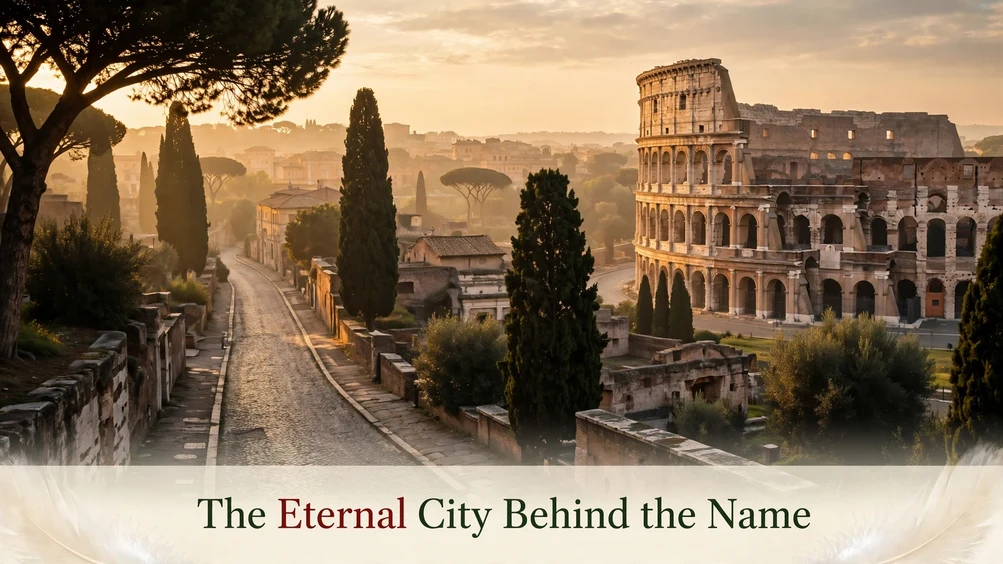
Nobody calls a man “the Roman” in Rome, where everyone is Roman. An origin name only works where the origin stands out, so Romano took hold in the south, where a man from central Italy was easy to spot. That simple logic explains why the surname is thickest in Campania, Sicily, and Calabria, and thinner in Lazio itself.
The Southern Heartland: Campania, Sicily, and Calabria
Forebears places about a third of Italy’s Romanos in Campania, with Sicily holding about 15 percent and Lombardy about 13 percent. In the south, Byzantine, Norman, Arab, and Lombard influences had all left their mark, so a man of Roman origin stood out among his neighbors.
In Naples, a newcomer from Rome was il Romano to his neighbors, and the label passed to his children when surnames became fixed in the 14th to 16th centuries, the period when most Italian family names hardened into their modern form. It sits beside Esposito in the same Neapolitan records, but the two names formed in opposite ways.
Lazio and the Central Belt
Romano also appears in Lazio and across central Italy, where it carries a different character. There it reads less as an ethnic marker and more as a plain statement of local origin, or as a surname taken from the given name Romano.
The given name stayed popular through the early Christian centuries, thanks to the saints who bore it. The central distribution is more scattered than the southern one, which fits a name that formed in several places at once instead of spreading outward from a single town.
Romano by the Numbers: Italy, Argentina, and the United States
Romano is one of Italy’s most common surnames. Forebears counts about 116,971 bearers in Italy, roughly one person in 523, which ranks the name seventh in the country. Worldwide, about 293,280 people carry it, with large communities in Argentina and the United States.
In Italy: Seventh in the Country
| Country | Bearers (2014) | Frequency | Rank |
|---|---|---|---|
| Italy | 116,971 | 1 in 523 | 7 |
| Argentina | 43,765 | 1 in 977 | 132 |
| United States | 39,211 | 1 in 9,244 | 1,111 |
| Philippines | 23,946 | 1 in 4,228 | 337 |
| Brazil | 21,565 | 1 in 9,927 | 578 |
The Italian figure is the one to trust most, since the other counts come from the same 2014 Forebears snapshot and older registers may differ. An earlier analysis based on 1994 data placed Romano eighth in Italy, so the exact rank has moved by one place over the decades while the name’s standing has stayed the same: firmly inside the national top ten.
Across the Ocean: Argentina and the United States
Outside Italy, Argentina holds the largest Romano community, with about 43,765 bearers, followed by the United States with about 39,211. The American figure reflects the great emigration of 1880 to 1924, when southern Italian families crossed the Atlantic in large numbers. Romano families settled heavily in New York, New Jersey, and New England, the same corridor that holds most Italian-American surnames from Campania and Sicily.
The name also travels as a first name. Forebears counts about 72,699 people worldwide who carry Romano as a given name, which can confuse anyone reading older Italian records. In a parish register, the same word may appear as a baptismal name in one entry and as a family name in the next, so researchers should check the record’s structure before assuming which role it plays.
Romano, Romani, and Romanò: The Variants That Matter
Romano has close relatives, and they are not all the same name. Romani is the plural form of the same family name, Romanò with a final accent can carry a separate Calabrian or Lombard history, and Romanelli and Romanello are diminutives. Knowing which form you hold keeps you from merging families that only look alike.
The -o Ending and the -i Ending
Many Italian surnames end in -i because medieval families were named after an ancestor in the plural: the house of Romano became Romani, and the plural stayed when the middle words fell away. Romani is best read as the same family in plural dress, not as a different line. Tuscan usage went further and put an article before a bare surname, so a Romano could appear in records as il Romano.
Romanò With the Accent: Calabria and Lombardy
The accent on Romanò is not decoration; it can point to a different history. In Calabria, the Dictionary of American Family Names explains Romanò as a term for someone from Nea Rhōmē, “New Rome,” the medieval Greek name for Constantinople.
In Lombardy, the same spelling can be a habitational name from Romanò or Villa Romanò in Inverigo, in the province of Como. When a record preserves the accent, keep it, because indexes that strip it can hide the clue.
Names That Look Related but Are Not
Roman, Roma, Romanos, and Romagnolo resemble Romano, but resemblance is not evidence of a shared line. Romagnolo names a man from Romagna, a different place entirely, and should never be folded into Romano. The medieval house of da Romano, the family of Ezzelino da Romano, is another trap: no line of descent is traced from that house to bearers of the surname, so the two should not be taken for one thing.
The Jewish Romano Line
The same dictionary records a separate Jewish use of the name, Italian and Sephardic, as a habitational name for someone from the city of Rome. This is one more reason not to assume that every Romano family shares one origin. Two families can carry the identical spelling while descending from different ancestors in different communities, so the earliest records for a line matter more than the spelling alone.


Famous Romanos: A Painter, a Prime Minister, and a Comedian
The best-known Romanos span art, politics, and comedy, and they show how far the name has traveled. Giulio Romano painted for Raphael and built the Palazzo Te in Mantua, Romano Prodi led Italy twice as prime minister, and Ray Romano made the name familiar to American audiences. Each one carried the surname, or the given name, into a different century.
Giulio Romano: Raphael’s Pupil From Rome
Giulio Romano was born Giulio Pippi in Rome around 1499, and his name says exactly where he came from. He trained as Raphael’s pupil and assistant, helped run the master’s workshop after Raphael died in 1520, and moved to Mantua in 1524 as court painter to Duke Federico II Gonzaga. His masterpiece there, the Palazzo Te with its illusionistic frescoes, still stands as one of the great buildings of the Italian Renaissance.
Romano Prodi: The Name as a First Name
Romano Prodi, born in Scandiano in 1939, carries Romano as a given name. He served twice as prime minister of Italy, from 1996 to 1998 and again from 2006 to 2008, and as president of the European Commission from 1999 to 2004, a career that shows the word’s double life in Italian naming.
Ray Romano and the Italian-American Stage
Ray Romano, born in 1957, is the American comedian and actor who starred as Ray Barone in the CBS sitcom Everybody Loves Raymond, which ran from 1996 to 2005, and voiced Manny the mammoth in the Ice Age films. His family story runs through the Italian-American communities of New York, where the surname had arrived with the southern emigration. For viewers, his name is the sound of an Italian-American household on screen.
More Romanos in Arts and Letters
The name also appears across Italian arts and letters. Lalla Romano (1906-2001) was an Italian novelist and poet, Antoniazzo Romano painted in Rome in the 15th century, and Fabrizio Romano, born in 1993, is the Italian sports journalist whose transfer news reaches millions of football fans. None of them shares a documented line with the others, which is exactly what a common surname looks like in practice.
Saying Romano the Italian Way: roh-MAH-noh
Romano is pronounced roh-MAH-noh in Italian, with the stress on the second syllable and a rolled R. The vowels stay short and clear: oh at the start, ah in the middle, oh at the end. English speakers often flatten the middle vowel, which turns the name into roh-MAY-noh, a sound no Italian speaker would use.
The Stress Falls on the Second Syllable
Italian stress usually lands where the spelling points, and Romano follows the pattern: ro-MA-no, with the middle syllable carrying the weight. The double consonant rule that shapes names like Rossi does not apply here, since Romano has single consonants throughout. Say each vowel cleanly, roll the R lightly, and the name comes out the way an Italian speaker would say it.
Would Romano Suit Your Family? A Roman Roots Test
Romano suits a family that wants a clear meaning and a link to Rome. It works as a surname, or as a first name for a boy when the family has Roman roots or a love of the city. Test it like any family name: say it aloud, pair it with the surname, and check that the meaning feels right.
The Sound Test
Say Romano with the family surname and listen for the rhythm. The three syllables and the open vowels pair well with short surnames and with longer Italian ones, and the stress on the middle syllable keeps it from running together. If the full name trips the tongue, try the given-name form Romana for a girl, which carries the same root in feminine form.
The Meaning Test
Ask whether the meaning earns its place in your family story. Romano says “the Roman” in plain language, so it fits a family with roots in Rome, a love of the city, or a Roman ancestor in the tree.
If meaning matters most in your choice, browse Italian girl names with meanings to compare Romano’s plain sense against names chosen for what they mean. A meaning that matches the family’s own story will age better than one chosen only for its sound.
Frequently Asked Questions
Is Romano Italian or Spanish?
Romano is principally an Italian surname, though the same spelling also appears in Spanish and Portuguese naming. The Italian lines are the best documented, and the name ranks seventh among surnames in Italy.
How common is the Romano surname?
About 293,280 people worldwide carry Romano, according to Forebears' 2014 data. Italy holds about 116,971 of them, roughly one person in 523, and Argentina and the United States hold the next largest communities.
How do you pronounce Romano?
In Italian it is roh-MAH-noh, with the stress on the second syllable and a rolled R. Say each vowel cleanly: oh, ah, oh. English speakers often flatten the middle vowel into roh-MAY-noh, which no Italian speaker would use.
Is Romani the same family as Romano?
Not necessarily. Romani is the plural form of the same name, so it often marks the same family in plural dress, but two families can share the spelling while descending from different ancestors. Check the earliest records for a line before assuming a connection.
Is there a Romano family crest or coat of arms?
No single coat of arms belongs to everyone named Romano. Heraldic arms were granted to individuals and descend through specific documented lines, so a crest sold with the surname alone is decorative rather than genealogical.
Conclusion
Romano is a surname that says exactly what it means. From Latin Romanus to the streets of Naples, from the seventh most common name in Italy to the stages of American television, it has carried the name of Rome for centuries without changing its shape.
If your family carries Romano, the next step is the commune: find the town your line came from, and the records will tell you which of the name’s several roads your ancestors walked. To place Romano among its neighbors, our guide to Italian surnames and their meanings lays out how origin names sit beside trade names and nicknames. Ricci is another Italian surname that began as a neighbor’s description: see what Ricci means in Italian.


