 Skip to content


Bianchi Surname Meaning
Bianchi means “the white ones.” It is the plural of bianco, the Italian word for white, and it began as a nickname for a fair-haired or pale man, given in a village where one noticed trait told neighbours apart. The plural ending is the clue: the name attaches to the whole household, not to one man. Today Bianchi ranks sixth among Italian surnames, with about 133,380 bearers in Italy and a strong Lombard heartland.
You can find Bianchi in our Italian girl names collection, sitting at the pale end of the spectrum opposite Rossi, the red-haired name. The two names are among the best-known Italian surnames, and their pairing tells you how medieval villages sorted people: by the colour of their hair.
What Does Bianchi Mean? The White Ones in the Family Plural
Bianchi means “the white ones,” the plural of bianco, Italian for white. It began as a nickname for a man with fair or white hair, or a pale complexion, and the plural form turned that one man’s nickname into his household’s surname. The name says nothing about rank or land, only about how one ancestor looked.
From Bianco to Bianchi: One Fair-Haired Man Becomes a Household
The grammar does the explaining. Italian surnames often took the plural of a nickname because the name belonged to the family, not the man. A fair-haired Giovanni became Giovanni il Bianco in his village, and the people around him soon spoke of his household as i Bianchi, the white ones. When the name hardened into a hereditary surname, the plural stayed.
The same logic built Rossi from rosso, red, and Neri from nero, black. Colour was the fastest shorthand a village had, and it worked because everyone in the parish knew exactly which fair-haired man the name meant. The system needed no office or land grant, only neighbours who could see. Esposito, the foundling name, is the one famous exception to the nickname rule.
What “White” Pointed At: Hair, Skin, or Clothing
The nickname most often pointed at hair: fair hair in youth, or hair gone white with age. It could also mark a pale complexion, and some dictionaries allow light-coloured clothing as a third reading. The Dictionary of American Family Names keeps it simple, calling Bianchi the light-complexioned or white-haired man.
The safest reading is the first one. Hair colour is the reading every serious source agrees on, while clothing is a guess that no record confirms. A family researching its own Bianchi should start with the hair, then look for the commune, since the name alone cannot say which fair-haired ancestor started the line.
The Florentine Bianchi: A Political Faction, Not a Family
The name also turns up in Florentine history as the Bianchi, the White Guelphs, one of the two factions that split Florence in the early 1300s. The faction took its name from the colour, not from a family, and most people called Bianchi today descend from the village nickname rather than from that political camp. The overlap is a coincidence of colour, not a bloodline.

Why Bianchi Belongs to the North
Bianchi is a northern surname, densest in Lombardy around Milan, Como, and Bergamo, with strong ground in Piedmont and Liguria. Fair hair and pale complexions appeared more often in the north, so the nickname had more work to do there. South of the Po Valley, the same nickname took the singular form Bianco instead.
Lombardy, Piedmont, and Liguria: The Northern Heartland
Forebears puts 44 percent of Italy’s Bianchis in Lombardy, with Tuscany at 14 percent and Lazio at 11 percent. The name spread through the Lombard city-states early, carried by artisan households, farming families, and the minor merchants of Milan and its surrounding communes. Northern Italy fixed hereditary surnames sooner than the south, driven by civic administration and church record-keeping.
By the 14th and 15th centuries, many northern families had stable hereditary surnames, and Bianchi appears in Milanese and Lombard records throughout that period. The name is so common in Lombardy that the province alone tells a researcher almost nothing: the specific commune, the town or village, is the detail that narrows a search.
Bianco in the South: The Singular Twin
South of roughly the Po Valley, the plural Bianchi gives way to the singular Bianco. Southern dialects leaned toward singular forms where northern dialects used plurals, so the same nickname produced two surnames split by geography. Bianco appears through Calabria, Sicily, and parts of Campania, while a Bianchi family found there usually points to northern origin or internal migration.
The north-south split is the same pattern Rossi shows with Russo, its southern singular twin. Together the two pairs map the old dialect boundary across the peninsula, and they remind a researcher that the ending of a surname can say as much about place as the root says about hair.
Sixth in Italy: Bianchi’s Reach Across the Americas
About 200,155 people worldwide carry the surname Bianchi, which makes it the 2,793rd most common surname on earth. Italy holds about 133,380 of them, where Bianchi ranks sixth nationally at one bearer in every 459 people. Argentina and Brazil hold the next largest groups, each above 16,000.
In Italy: Lombardy Holds Nearly Half
| Country | Bearers | Rank |
|---|---|---|
| Italy | 133,380 | 6 |
| Argentina | 16,189 | 343 |
| Brazil | 16,148 | 718 |
| United States | 12,308 | 3,654 |
| France | 6,643 | 956 |
| Switzerland | 3,723 | 231 |
The Italian figure is the one that matters most: one Italian in 459 is a Bianchi, and nearly half of them live in Lombardy. San Marino holds the highest density of all, one bearer in every 221 people, though the count there is only about 150. The name also appears as a first name, carried by about 2,195 people worldwide.
Argentina, Brazil, and the United States
Outside Italy, Argentina leads with 16,189 bearers, followed closely by Brazil at 16,148. The United States holds about 12,308, where the name ranks 3,654th. France follows with 6,643, a legacy of Lombard and Piedmontese families who crossed the Alps, and Switzerland holds 3,723.
The American story runs through the northern emigration stream. Lombard and Piedmontese emigrants left earlier than the great southern wave, often in the 1870s and 1880s, and they settled in California, the northeast, and Illinois as well as New York. Their ports of departure were usually Genoa, and their ship manifests often name the commune, which is the detail a family researcher needs first.
Bianchi, Bianco, and Bianchini: The Fair-Haired Family Tree
Bianco is the singular twin of Bianchi, and Bianchini and Bianchetti are diminutive forms that grew from the same root. Lo Bianco keeps the article that older records used. These spellings mark the same nickname in different places and periods, but they do not prove that two families sharing them are kin.
The -i Ending and the -o Ending
The -i ending is the family plural, the form that says “the white ones” as a household. The -o ending is the singular, the form that named one man. In the north the plural won, and in the south the singular won, so the ending on a surname is a rough map of where the family came from.
Bianchini, Bianchetti, and Bianconi: Diminutives and Patronymics
Bianchini and Bianchetti are diminutive forms, the “little white one” shapes that Italian dialects build with -ini and -etti endings. Bianconi is a patronymic shape, roughly “son of Bianco” or “of the Bianco line.” These forms cluster in the same northern regions as Bianchi, and each one began as a separate nickname on a separate man.
Lo Bianco and the Article Forms
Lo Bianco keeps the article lo, “the,” in front of the name, the way older records often wrote it. The article forms survive in the south and in emigrant records, where a clerk wrote what he heard. They are the same name in older dress, not a separate surname.
Same Spelling, Different Family: The No-Merge Warning
The warning matters because Bianchi is so common. Two families called Bianchi in the same province are usually unrelated, each descending from a different fair-haired man in a different village. A shared spelling proves a shared nickname, not a shared bloodline, and a family tree should never merge two Bianchi lines without a paper trail through the commune records.
Famous Bianchis: A Bicycle, a Bond Girl, and a Racing Dynasty
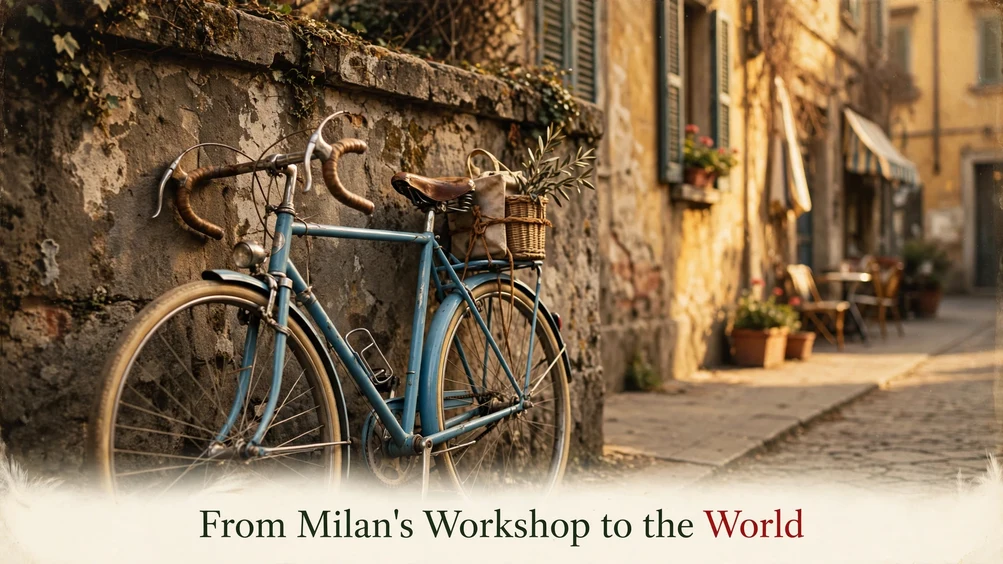
The best-known Bianchi is Edoardo Bianchi, who founded the Bianchi bicycle company in Milan in 1885. Daniela Bianchi carried the name onto cinema screens as a Bond girl in 1963, and Jules Bianchi carried it into Formula One, following his great-uncle Lucien. The name also appears in mathematics, music, and the church.
Edoardo Bianchi: The Bicycle Maker of Milan
Edoardo Bianchi was born in Milan in 1865 and founded his bicycle workshop there in 1885, making Bianchi the oldest bicycle maker still in existence. His machines raced the early Tours de France, and the company’s celeste paint, a pale sky blue-green, became one of cycling’s most recognised colours. It is a neat accident that a name meaning white became famous for a shade of blue.
The company still builds bicycles today, more than 140 years after Edoardo opened his shop. For a family named Bianchi, the bicycle is the one bearer that needs no explanation: the name is stamped on the frame, and the frame has carried it around the world.
Daniela Bianchi: Tatiana Romanova on Screen
Daniela Bianchi, born in Bologna in 1942, played Tatiana Romanova opposite Sean Connery in From Russia with Love in 1963, one of the most acclaimed entries in the James Bond series. Her role put the surname in front of cinema audiences worldwide, and it remains the name’s best-known screen appearance. Regina Bianchi, an actress of the Neapolitan stage, carried the same name a generation earlier.
Jules and Lucien Bianchi: The Racing Uncle and Nephew
Lucien Bianchi, born in Italy in 1934, raced for Belgium and died in a testing accident in 1969. His great-nephew Jules Bianchi, born in 1989, reached Formula One with Marussia and died in 2015 from injuries in the 2014 Japanese Grand Prix. The two men are one of only two blood relationships the sources document across dozens of bearers.
Gino Bianco, an Italian racing driver born in 1916, raced under the singular form and is not part of the same family line. The racing connection is a coincidence of the name’s spread, not a family trade, and it shows how far a northern nickname travelled once its bearers left Lombardy.
More Bianchis in Science, Music, and the Church
Luigi Bianchi, a mathematician born in 1856, gave his name to the Bianchi classification of three-dimensional Lie algebras, a tool still used in geometry and physics. Leonardo Bianchi, a neuropathologist born in 1848, led the psychiatric hospital in Naples. Gerardo Bianchi, born around 1223, was a churchman and the earliest bearer the sources record.
The name stayed close to music as well: Eliodoro Bianchi, born in 1773, was an operatic tenor, and Luigi Alberto Bianchi, born in 1945, was a violinist and violist. Myriam Alejandra Bianchi, known on stage as Gilda, sang in Argentina until her death in 1996. Each of these Bianchis earned the name on their own; none of them shares a line with the others.
BYAHN-kee: The Sound of Bianchi
Bianchi is pronounced BYAHN-kee in Italian, with the stress on the first syllable and the “ch” sounded as a hard “k.” The spelling tempts English speakers to say “bee-AN-chee,” with a soft “ch” as in cheese, but Italian “ch” before “i” always sounds like “k.” Say the first syllable like “bya” in “yard,” then “kee.”
The Stress Falls on the First Syllable
The International Phonetic Alphabet writes the name [ˈbjaŋki], with the stress mark before the first syllable. The “ia” glides into one sound, close to “ya,” and the final “i” stays short. An English speaker who stresses the middle syllable, bee-AHN-kee, is putting the weight in the wrong place.
The “Ch” Trap English Speakers Fall Into
Italian “ch” before “e” or “i” always sounds like the “k” in “key.” The same rule shapes Chiara, pronounced kee-AH-rah, and the surname Bianchi follows it exactly. Once the “ch” is read as “k,” the name falls into place, and the only remaining choice is the stress, which belongs on the first syllable.
Would Bianchi Suit Your Family? A Fair-Hair Test
Bianchi suits a family that likes a short surname with a plain meaning and a northern Italian root. It works best when the first name is longer, since the two-syllable surname can sound clipped beside a short first name. Test it against your family story: if the name’s Lombard heartland or its fair-hair meaning feels right, it earns its place.
The Sound Test
Say the full name aloud with the surname last: Bianca Bianchi, for instance, repeats the root twice and sounds heavy, while a longer first name like Alessandra Bianchi lets the surname land cleanly. The “kee” ending is bright and quick, so it pairs well with first names that end in a softer sound. Try it in the playground test too: a two-syllable surname survives shouting without losing its shape.
The Meaning Test
The meaning test is the simpler one. Bianchi means “the white ones,” a fair-hair nickname with no rank or title behind it, so it suits a family that likes plain, honest names. If your family story runs through Lombardy or Piedmont, the geography test passes too. And if you are weighing Bianchi as a surname for a daughter’s first name, Bianca is the feminine form, one of the Italian girl names with meanings on this site.
Frequently Asked Questions
Is Bianchi Italian or Spanish?
Bianchi is Italian. The name grew from the Italian word bianco in northern Italy, chiefly Lombardy. Similar spellings can surface in Spanish records, but the surname's documented home is Italy.
Is Bianco the same family as Bianchi?
Not automatically. Bianco is the singular form of the same nickname, and Bianchi is the plural, but each form was coined separately on different men in different villages. Two families sharing the spelling are usually unrelated unless commune records connect them.
How common is the Bianchi surname?
About 200,155 people worldwide carry it, and about 133,380 live in Italy, where it ranks sixth. Argentina holds about 16,189 and Brazil about 16,148, while the United States holds about 12,308.
How do you pronounce Bianchi?
BYAHN-kee, with the stress on the first syllable and the "ch" sounded as a hard "k," as in "key." The common English mistake is "bee-AN-chee," which puts the stress in the wrong place and softens the "ch."
Is there a Bianchi family crest or coat of arms?
There is no single coat of arms for everyone named Bianchi. Arms were granted to individuals and descend through specific documented lines, so a crest sold with the surname alone is decorative rather than genealogical.
Conclusion
Bianchi is a plain name with a long reach: a fair-hair nickname from a Lombard village, now the sixth most common surname in Italy and a familiar name in Argentina, Brazil, and the United States. Its plural ending is the detail to remember, since it marks a household rather than one man.
If Bianchi has caught your eye, the Italian surnames and their meanings guide gathers the whole colour family in one place, from Rossi to Esposito. Start with the commune, say the name BYAHN-kee, and the rest of the story follows from there. Gallo is another Italian surname that began as a neighbor’s description: see what Gallo means in Italian.


