 Skip to content

How to Pronounce Beatrice in Italian
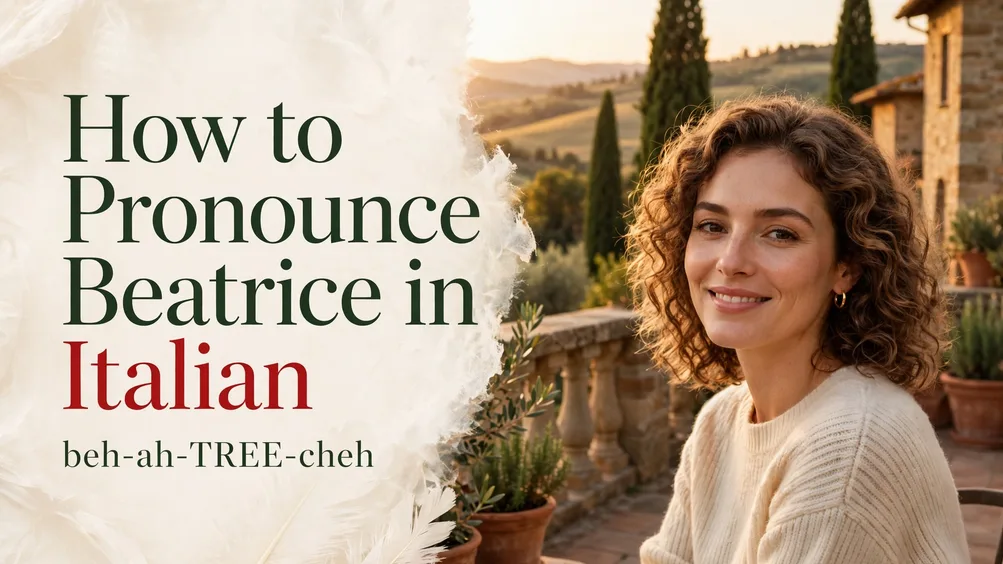
In Italian, Beatrice is pronounced beh-ah-TREE-cheh, with the stress on the third syllable and a soft che sound at the end. English speakers usually say BEE-uh-triss, so the Italian version sounds quite different, and this guide from our Italian girl names collection walks you through each syllable until the Italian form feels natural.
The Italian Pronunciation, Syllable by Syllable
Beatrice has four syllables in Italian: be, a, tri, and ce. Say them as beh, ah, TREE, and cheh, giving the third syllable the strongest push. The whole name runs about one second when spoken at a normal pace, and the vowels stay short and clear, with no drawled sounds anywhere in the word.
Sound by sound
| Syllable | Sound | Say it like |
|---|---|---|
| be | beh | the “be” in “bed”, short and open |
| a | ah | the “a” in “father” |
| tri | TREE | the word “tree”, stressed |
| ce | cheh | the “che” in “check” |
Each vowel in Italian keeps one sound, so nothing in Beatrice slides or changes as you say it. The first two syllables move quickly, the third carries the weight, and the last one closes the name with a soft cheh. Keep your mouth relaxed and let the syllables run together in one smooth line, without a pause between tri and ce.
The “ce” that sounds like “che”
The ending trips up most English speakers, because Italian letters follow their own rules. In Italian, c before e or i sounds like the ch in check, so the final ce in Beatrice sounds like cheh, never like see or triss. The same rule shapes names like Lucia, where ci sounds like chee, and it explains why the English ending feels so far from the Italian one.
The contrast shows up clearly in how to pronounce Chiara, where ch before i keeps a hard k sound, so the name starts with kee, while Beatrice ends with a soft che. The rule is simple to keep: c plus e or i is soft, and ch plus e or i stays hard. Say the two names back to back and the difference is easy to hear.
Where the stress falls
Italian stress falls on the third syllable, TREE, and that single shift changes the whole shape of the name. English puts the weight on BEE at the start, which flattens the rest of the name into a quick mumble. In Italian the first two syllables stay light and quick, the third rings out, and the last one lands softly, like a closing note.
A simple test keeps the stress in place: tap your hand on TREE and say the name three times, louder on that syllable each time. If BEE starts taking the weight again, slow down and stretch TREE until it feels like the peak of the name. The rhythm should feel like a small hill, rising to the third syllable and falling gently after it.
Italian vs English: Where Most People Slip
English and Italian share the same spelling, but the two pronunciations part ways on stress, vowels, and the ending. English says BEE-uh-triss with the weight up front and a flat s at the end, while Italian says beh-ah-TREE-cheh with the weight near the end and a soft che. Knowing the three differences keeps the English habit from creeping back in.
The three mistakes to avoid
| Mistake | What happens | Fix |
|---|---|---|
| Stress on BEE | The name sounds English and flat | Move the weight to TREE |
| “ce” as “triss” | The ending loses its Italian sound | Say cheh, like “check” |
| Rushing the vowels | beh-ah blurs into “bay” | Keep each vowel short and open |
The stress mistake is the most common, and it comes straight from reading the name with English eyes. BEE feels like the natural place to push, because English names often stress the first syllable. Italian works differently here, so the push belongs on TREE. Once the stress moves, the vowels and the ending usually fall into place on their own.
The two-syllable shortcut
Some English speakers shorten the name to BEE-triss, dropping the middle vowel entirely. The shortcut sounds brisk and modern, and plenty of families use it as their everyday form. Italian keeps all four syllables, though, so the shortcut works as a nickname form. Use it if the family prefers it, and keep the four-syllable form for the Italian pronunciation.
Practice It Until It Sticks
Five minutes of slow, out-loud practice locks in the Italian sound better than reading the respelling ten times. Say the syllables one at a time, then join them, then use the name in a full sentence. The drill below takes about five minutes, and it works best when you say the name aloud instead of hearing it in your head.
A five-minute drill
- Say each syllable alone, slowly: beh, ah, TREE, cheh.
- Join them at half speed: beh-ah-TREE-cheh.
- Say it at normal speed three times in a row.
- Put it in a sentence: “Beatrice arrived early this morning.”
- Record yourself and listen for the stress on TREE.
The same slow-build method works for other Italian names with a tricky middle, and how to pronounce Giulia uses it for the soft gl sound in the middle of that name. If you can say Giulia smoothly, Beatrice will feel easier, because both names ask you to slow down in the middle and let one syllable carry the weight. Practice the two names back to back for a quick workout.
Say it with your surname
A name only works when it sounds right with the surname that follows it, so test the full combination out loud. Beh-ah-TREE-cheh flows well after short surnames, and it holds its shape after longer ones too, because the stress on TREE gives the first name its own rhythm. Say the pair three times, fast and slow, and listen for any place where the sounds clash or run together.
What Beatrice Means and Where It Comes From
Beatrice comes from the Latin Beatrix, built on beatus, meaning blessed or happy, and it carries the sense of she who brings joy. For the full story of the meaning, the two name days, and the variants, see what Beatrice means in Italian. The name reached Italy through the Latin form, and it spread across Europe on the strength of Dante’s Beatrice Portinari, the Florentine woman who became his guide through Paradise.
From Viatrix to Beatrix to Beatrice
The name started as Viatrix, from the Latin word for traveler, and it was reshaped into Beatrix under the pull of beatus, blessed. That change gave the name its joyful meaning, and the Italian form Beatrice kept the sound of the Latin original. Behind the Name lists Beatrice as the Italian form of Beatrix, and it notes Dante’s muse as the name’s most famous bearer.
Shakespeare gave the name a second life in Much Ado About Nothing, where his Beatrice is sharp, funny, and quick with a reply. The play kept the name in English ears for centuries, and the Italian pronunciation stayed close to the Latin root the whole time. Today the name feels both literary and warm, a classic that still sounds fresh on a child.
The name day: January 19
In Italy, a name day matters almost as much as a birthday, and Beatrice celebrates hers on January 19, the feast of Saint Beatrice d’Este. The saint, a thirteenth-century Benedictine nun from Ferrara, gave up a planned marriage to enter a convent she founded herself. Families in Italy still mark the day with a small greeting or a call to every Beatrice they know.
Nicknames, Variants, and Spellings
Bea and Bice are the two nicknames that matter most, with Bice as the traditional Italian short form and Bea as the everyday choice in English. The name also travels well across languages as Beatriz, Beatrix, and Beata, and each form keeps the same joyful meaning while changing the sound to fit its own language.
Nicknames that keep the Italian sound
Bice, said BEE-cheh, is the old Italian diminutive, and it keeps the soft che sound that makes the full name so musical. Bea works in both languages, and Bee suits a small child or a close friend. Tris and Trixie lean English, and they drop the Italian ending entirely, so they sound like different names when spoken aloud. Pick the nickname that matches the pronunciation the family uses.
Spellings that change the sound
Beatriz, the Spanish and Portuguese form, ends with a z sound and stresses the final syllable, so it sounds quite different from the Italian form. Beatrix, the Latin form, ends with an x and reads as BAY-ah-trix in English. The spelling Beatriss and the doubled-t variants show up in old records, and they are best left there, since they add confusion without changing the meaning.
Famous Beatrices Who Carry the Name
The name has belonged to poets, saints, artists, and athletes, and the most famous bearer is still Dante’s Beatrice Portinari, the Florentine woman he made his guide through Paradise. Modern bearers range from a British princess to an Italian Olympic fencer, and each one keeps the name in the public ear.
- Beatrice Portinari (1266-1290), Dante’s muse and guide through Paradise in the Divine Comedy.
- Princess Beatrice of York, granddaughter of Queen Elizabeth II.
- Beatrice Borromeo, Italian journalist and member of the Borromeo family.
- Beatrice Vio, known as Bebe Vio, Italian wheelchair fencer and Paralympic champion.
- Beatrice Rana, Italian concert pianist.
- Beatrice Wood (1893-1998), American artist and studio potter.
- Bea Arthur (1922-2009), American actress and comedian.
- Beatrice Chebet (born 2000), Kenyan long-distance runner and Olympic champion.
Frequently Asked Questions
Is the "ce" in Beatrice pronounced "che"?
Yes. In Italian, c before e or i sounds like the ch in check, so the ce at the end of Beatrice sounds like cheh. The rule also explains the ci in Lucia, which sounds like chee, and the ce in other Italian names.
How many syllables does Beatrice have in Italian?
Four: be, a, tri, and ce. English often compresses the name to three syllables, BEE-uh-triss, or even two, BEE-triss, but Italian keeps all four. Each syllable gets its own vowel sound, and none of them is swallowed.
How is Beatrice pronounced in English?
In English, Beatrice is usually pronounced BEE-uh-triss, with the stress on the first syllable and a flat s at the end. Some speakers shorten it to BEE-triss. Both forms are common, and families choose the one they prefer.
What does Beatrice mean?
Beatrice comes from the Latin Beatrix, built on beatus, meaning blessed or happy, and it carries the sense of she who brings joy. The name started as Viatrix, meaning traveler, before it was reshaped under the influence of beatus.
What is Beatrice's name day?
Beatrice celebrates her name day on January 19, the feast of Saint Beatrice d'Este, a thirteenth-century Benedictine nun from Ferrara. In Italy, name days are marked with a greeting or a small gift, much like a second birthday.
Conclusion
Beh-ah-TREE-cheh is the Italian way to say Beatrice, and the whole name turns on two small moves: stress on TREE and a soft che at the end. Once those two land, the name sounds the way Dante heard it, warm and musical. If you are still browsing names, our Italian girl names starting with B page holds the full set of B names to compare.


