 Skip to content

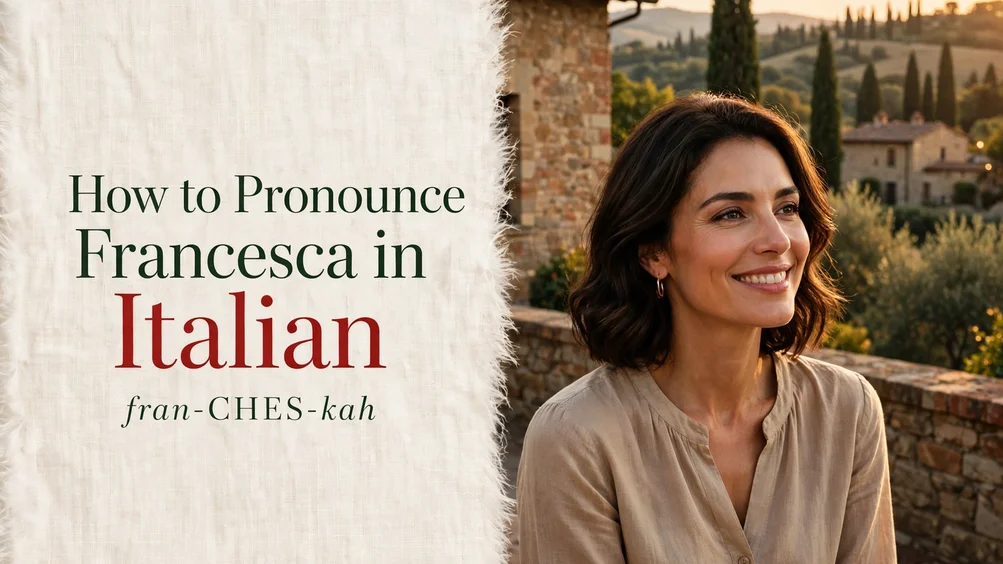
In Italian, Francesca is pronounced fran-CHES-kah, with the stress on the second syllable, CHES. The IPA spelling is [franˈtʃeska], and the name has three syllables: fran, CHES, kah. Among Italian names for girls, Francesca is one of the most loved classics, and its sound is simpler than its spelling suggests.
English speakers usually say fran-CHEH-skuh, and that version works fine in English conversation. But the Italian form keeps the stress on CHES, gives the middle syllable a clear ch sound, and ends with an open ah instead of a soft uh. This guide breaks the name down sound by sound, flags the three mistakes people make most, and gives you a short drill to practice.
The Italian Pronunciation, Syllable by Syllable
Francesca has three syllables in Italian: fran, CHES, kah. Stress falls on the second syllable, CHES, and every vowel is pronounced clearly, with no swallowed sounds. The IPA spelling is [franˈtʃeska], and the table below maps each syllable to its sound, so you can build the name one piece at a time.
Sound by sound
| Syllable | Sound | How to say it |
|---|---|---|
| fran | a as in father, short | Light and quick, never stressed |
| CHES | ches as in chess | The stressed syllable, say it loudest |
| kah | a as in father, open | Clear ah, never a flat uh |
Say the three pieces slowly, fran-CHES-kah, then speed up until they flow into one word. Keep the stress on CHES the whole time. If the stress drifts to the first syllable, you are back in English territory, so slow down and start again from the stressed syllable.
The “ces” trap: say “ches”, not “ses” or “kez”
The middle syllable is where most people go wrong. In Italian, ce before e sounds like ch in church, so ces comes out as ches, the same sound as the start of chess. That ch sound is the whole trick: say chess on its own, then drop it into the middle of the name.
Chiara hides a similar trap, a soft sound inside plain spelling, and our guide to how to pronounce Chiara breaks it down the same way, syllable by syllable. Both names reward the same habit: trust the Italian sound rules instead of the English reading.
The first syllable stays light
The first syllable, fran, is short and unstressed, so give it no extra weight. Say it with a quick, open a, like the a in father, then move straight to the stressed CHES. English speakers often lean on the first syllable instead, which pulls the whole name off balance. Keep fran light and let CHES carry the name.

Italian vs English: Where Most People Slip
The English version, fran-CHEH-skuh, is fine in English, but it differs from the Italian form in three places: the stress can drift, the middle syllable can turn into a z, and the final vowel flattens into uh. Italian keeps the stress on CHES, the ch sound crisp, and the final ah open. The table below compares the two versions.
The three mistakes to avoid
| Mistake | What happens | Fix |
|---|---|---|
| FRAN-ches-kah | Stress lands on the first syllable | Shift the weight to CHES |
| fran-CHEZ-kah | The Italian ch turns into an English z | Keep the ch of chess |
| fran-CHES-kuh | The final vowel flattens into a schwa | Finish with an open ah, kah |
The z version deserves a special warning. One pronunciation guide suggests fran-CHEZ-kah as a casual form, but that z belongs to English, not Italian. In Italian, the s in ces never voices into a z, so CHEZ is the one version to drop outright. The other two mistakes are softer, but this one changes the sound of the name itself.
The final A: kah, never kuh
Italian vowels stay open, so the last syllable of Francesca is kah, with the a of father. English habit pulls it toward kuh, a quick schwa that swallows the vowel. That one change makes the name sound English even when the stress is right. Finish the name the way it starts, with a clear vowel, and the whole word lifts.
Practice It Until It Sticks
Five minutes of slow, deliberate practice will fix the Italian pronunciation of Francesca in your ear. Say each syllable on its own, then join them with the stress on CHES, then use the name in a sentence. The drill below takes you through those steps in order.
A five-minute drill
- Say chess three times, slowly, and feel the ch at the front.
- Add the first syllable: fran-chess, fran-chess, fran-chess.
- Add the ending: fran-CHES-kah, with the stress on CHES.
- Say the full name five times at normal speed, keeping the stress in place.
- Use it in a sentence: “Francesca is coming over for dinner tonight.”
Repeat the drill three times, with a short pause between rounds, and listen for the ch in CHES each time. If the z creeps back in, go back to saying chess on its own, then drop it back into the name. Giulia follows the same Italian sound rules, and our guide to how to pronounce Giulia gives you another name to practice with.
Say it with your surname
A name only works when it flows with the surname beside it, so test Francesca against your family name before you settle on it. Say the full name aloud at normal speed, then a little faster, and listen for any clash where the kah meets the next word. If the pair runs smoothly, the pronunciation will hold in everyday use.
What Francesca Means and Where It Comes From
Francesca is the Italian feminine form of Francesco, from the Latin Franciscus, and it means from France or free one. Behind the Name lists it as the Italian and Catalan feminine form of Franciscus, and the name spread through Italy in the 13th century, in part through devotion to Saint Francis of Assisi. Our guide to what Francesca means in Italian covers the Frenchwoman meaning, Saint Frances of Rome, and the famous bearers in full.
From Franciscus to Francesca
The root is the Latin Franciscus, a name for a Frank, the Germanic people whose name also carried the sense of free. The feminine Italian form grew from Francesco, and Francesca became the standard form for girls in Italy. It later traveled into French as Francoise, into Spanish as Francisca, and into German as Franziska, while the Italian spelling stayed put.
The name day: March 9
Francesca shares its name day with Saint Frances of Rome, celebrated on March 9. In Italy, the onomastico is a second birthday of sorts, and families often mark it with a call or a small gift. If you are choosing the name, March 9 gives you a ready-made day to celebrate it each year.

Nicknames, Variants, and Spellings
The most used nicknames for Francesca are Fran, Frankie, and Cesca, with Chessie as a playful option that keeps the ches sound. International variants include Francisca, Franziska, and Francoise, and each one shifts the pronunciation. The table below sorts the short forms from the spellings that change the sound.
Nicknames that keep the Italian sound
Fran and Frankie are the everyday short forms, and Cesca is the Italian-flavored one, taken from the stressed middle of the name. Chessie leans on the ches sound and suits a child, while Frankie works at any age. All four keep the name easy to say, and none of them hides where it comes from.
Spellings that change the sound
Francisca, the Spanish and Portuguese form, softens the middle into a th or s sound depending on the region. Franziska, the German form, keeps a harder z and a different rhythm. Francoise, the French form, drops the k sound entirely. Each variant is a real name in its own language, so use the spelling that matches the pronunciation you want.
| Name | Type | Sound note |
|---|---|---|
| Fran | Nickname | Keeps the first syllable |
| Frankie | Nickname | Friendly, works at any age |
| Cesca | Nickname | Keeps the stressed ches |
| Chessie | Nickname | Playful, keeps the ches sound |
| Francisca | Variant | Spanish and Portuguese, softer middle |
| Franziska | Variant | German, harder z, different rhythm |
| Francoise | Variant | French, no k sound |
Famous Francescas Who Carry the Name
Francesca has been carried by a Baroque composer, a Dante heroine, a Grand Slam tennis champion, and a long list of actresses and writers. The name turns up in music, literature, film, and sport, which is part of why it still feels current. Here are the bearers most readers will recognize.
- Francesca Caccini, Italian composer and singer of the early Baroque era.
- Francesca da Rimini, the 13th-century noblewoman in Dante’s Inferno.
- Francesca Schiavone, Italian tennis player and French Open champion.
- Francesca Annis, English actress.
- Francesca Battistelli, American Christian singer and songwriter.
- Francesca Capaldi, American actress.
- Francesca Hayward, English ballet dancer.
- Francesca Martinez, British comedian and actress.
Frequently Asked Questions
Is the stress on the first or second syllable?
The stress falls on the second syllable, CHES: fran-CHES-kah. Stressing the first syllable, FRAN-ches-kah, is the most common English mistake, and it makes the name sound flat.
How do you say the "ces" in Francesca?
Say "ches", like the start of the word chess. In Italian, ce before e sounds like ch in church. It is not a soft s, not a z, and not a hard k.
What is the difference between the Italian and English pronunciation?
English usually says fran-CHEH-skuh, with the final vowel flattened into uh. Italian says fran-CHES-kah, with the stress firmly on CHES, a crisp ch in the middle, and an open ah at the end.
What does Francesca mean?
Francesca means from France or free one. It is the Italian feminine form of Francesco, from the Latin Franciscus. A full meaning explainer will cover the name in more depth when it publishes.
What are common nicknames for Francesca?
The most common nicknames are Fran, Frankie, and Cesca, with Chessie as a playful option that keeps the ches sound. Cesca is the most Italian-flavored short form, taken from the stressed middle of the name.
Conclusion
Say it fran-CHES-kah, with the stress on CHES, the ch of chess in the middle, and an open ah at the end. Once the three syllables click, the name is easy to hold onto. If you are still browsing, our Italian girl names starting with F round up the whole F group, so you can compare Francesca with its neighbors side by side.


