 Skip to content

What Does Francesca Mean in Italian
Francesca means “Frenchwoman” in Italian. If you like a name with a clear meaning and a long history, our guide to what Sofia means in Italian covers a name that means wisdom. It is the feminine form of Francesco, from the Latin name Franciscus, which meant “Frenchman”, a man of the Franks. The “free” meaning you see on most name sites came later, as the word frank picked up the sense of free in the Romance languages, so “woman from France” is the literal meaning and “free one” is the association that grew around it.
On ItalianGirlNames.com, Francesca ranks among the most searched Italian names, and the question behind the searches is usually the same: does it mean French, or does it mean free? This guide separates the literal meaning from the later association, then follows the name from a medieval byname to a saint’s feast day.
Frenchwoman, Not Free Woman: What Francesca Really Means
Francesca literally means “Frenchwoman”, the feminine form of the Latin Franciscus, which meant “Frenchman”, a man of the Franks. The gloss “free one” is real but secondary: it grew out of the word frank, which took on the sense of free in medieval Romance languages, long after the name itself was in use.
The two glosses, side by side
Put the two readings next to each other. “Frenchwoman” is the literal meaning: Francesca is the feminine form of Francesco, built from Franciscus, “the Frenchman”. “Free one” is the looser reading, the one most baby-name sites lead with. Both come from the same tribal root, but only the first is what the name meant when it was given.
Why “free” shows up on every name site
The Franks were a Germanic people, and their tribal name gave medieval Latin the word francus, which came to mean both “a Frank” and, by extension, “free”, since free Franks answered to no lord. That second sense traveled into French and Italian, and name sites picked it up. The chain is genuine, yet the name itself meant “Frenchwoman” long before “free” entered the picture.
What the name meant in medieval Italy
In medieval Italy, Francesco was first a byname, a nickname for a man with French ties, before it became a given name. Francesca followed the same path as its feminine form: a woman called Francesca was, in the plain sense of the name, a Frenchwoman, or a woman of the Frankish world.
The “free spirit” reading is a modern gloss, not the medieval sense. Parents who love the name for the freedom it suggests should know which part is history and which part is poetry, and this article keeps the two apart.
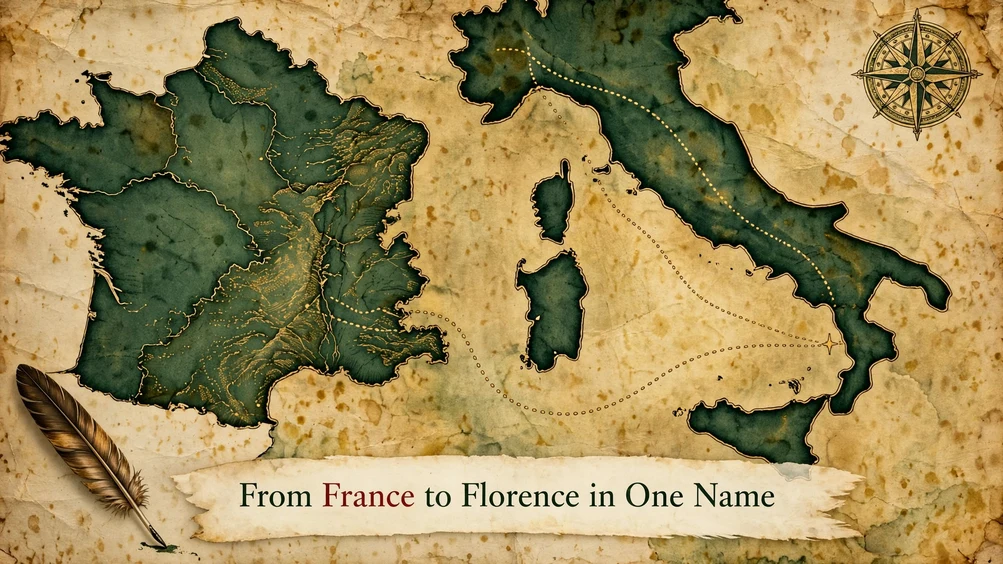
From Franciscus to Francesca: How the Name Traveled
Francesca began as the Latin Franciscus, a byname for a man of the Franks, and reached Italy through the fame of Saint Francis of Assisi, whose nickname Francesco spread the name across Europe. The feminine form followed the same road, changing its ending from -o to -a, and by the late Middle Ages Francesca was an established Italian name.
A byname for a man from France
Franciscus started as a description. In medieval Italy, a man called Francesco was a man with French connections, perhaps a trader with business in France. The Latin root is Francia, France, with the suffix -iscus, meaning “ish” or “of”, so Franciscus meant “the French one” before it meant anything else.
Saint Francis and the name’s great spread
The name’s turning point was Giovanni di Pietro di Bernardone, born in Assisi around 1181, whose father nicknamed him Francesco, the Frenchman, after his French business ties. Behind the Name traces Francesca as the Italian feminine form of Franciscus, and the saint’s fame carried that root across Europe. After Francis founded the Franciscan order, Francesco and Francesca spread with his followers, and the name took root in Italy.
The -a ending that made it feminine
Italian makes feminine forms by changing the masculine -o to -a, and Francesca is a textbook case: Francesco plus the -a ending. The same pattern gives Giuseppina from Giuseppe and Antonella from Antonio. The change is small, but it turned a byname for a Frenchman into one of Italy’s classic girls’ names, and the form has stayed unchanged for centuries.
The CHES Sound: Saying Francesca the Italian Way
In Italian, Francesca is pronounced fran-CHES-kah, with three syllables and the stress on the middle one. The middle sound is CHES, with a hard CH as in “chair”, because the Italian letters “sce” sound like “sheh”. English speakers often soften it to fran-SES-kah, dropping the CH entirely.
Three syllables, stress on CHES
Francesca breaks into three syllables: Fran, CHES, ca. The stress falls on the middle syllable, CHES, and the final -a is short and open, as in most Italian girls’ names. Say it slowly, Fran-CHES-kah, and the rhythm falls into place: the first syllable is quick, the middle one carries the weight, and the last one floats.
The “sce” trap English speakers fall into
The trap sits in the middle of the name, in the letters “sce”. In English, “sce” reads as “sess”, so English speakers say fran-SES-kah without thinking. In Italian, “sc” before “e” or “i” sounds like “sh”, and the “c” adds a hard edge, giving “ches”. A common online rendering, “fran-CHEZ-kah”, makes the opposite mistake, swapping the crisp CHES for a soft Z.
The full sound-by-sound breakdown
For the full breakdown, with the Italian IPA and practice tips, see how to pronounce Francesca on this site. It walks through the FRAN opening, the CHES middle, and the soft -kah ending, and it covers the mistakes English speakers make most. A minute of practice is enough to say the name the way an Italian family would.
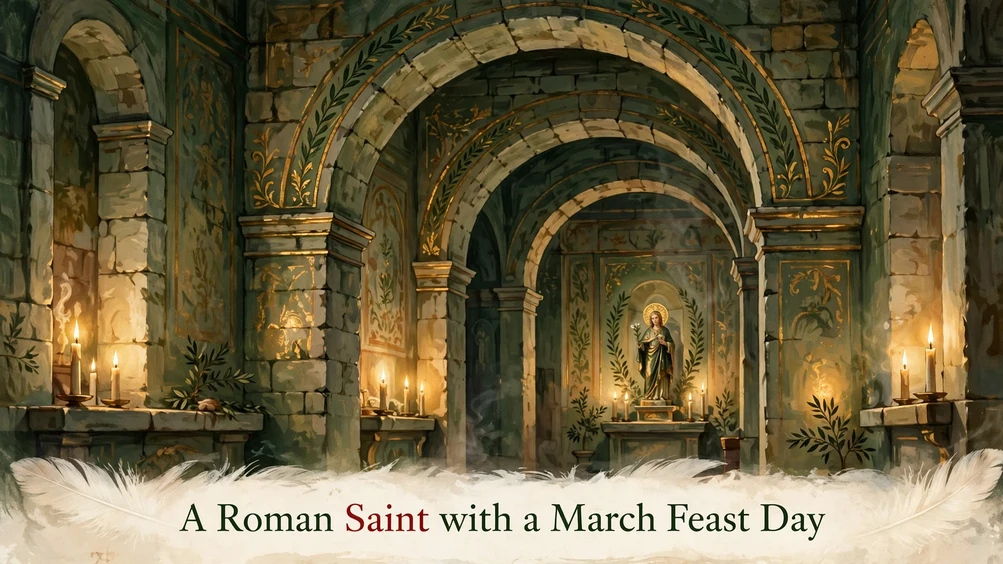
Saint Frances of Rome: The Name Day on March 9
Francesca’s name day is March 9, the feast of Saint Frances of Rome, whose birth name was Francesca Bussa de’ Leoni. She was a Roman noblewoman, wife, and mother who founded a community of oblates and was canonized in 1608. Italian families with a Francesca celebrate her onomastico on March 9.
Francesca Bussa de’ Leoni, 1384 to 1440
Frances of Rome was born Francesca Bussa de’ Leoni in Rome in 1384, and married at thirteen to Lorenzo Ponziano. She lived as a wife and mother of three, gave her wealth to the poor of Rome, and founded the Oblates of Tor de’ Specchi in 1425. She died on March 9, 1440, and the Church fixed her feast on the day of her death.
Patroness of Rome, widows, and motorists
Saint Frances is honored as a patroness of Rome itself, and as the patron saint of widows and Benedictine oblates. Drivers claim her too: legend says an angel walked beside her at night, lighting her way with a lamp. On her feast day, cars still line up outside her Roman basilica for a blessing.
How Italian families mark March 9
In Italy, an onomastico is a small celebration rather than a second birthday: a phone call, a cake, or a family meal. For Francesca, March 9 falls in early spring, so the day suits an outdoor lunch. Parents who want a saint with a clear feast behind the name can use March 9 with confidence.
Francesca in Dante and Beyond: Famous Bearers
Francesca’s most famous bearer is Francesca da Rimini, the real 13th-century noblewoman Dante placed in the fifth canto of the Inferno, and the name has stayed in the arts ever since. A Baroque composer, a French Open champion, and a string of actresses have carried it, so the name reads as literary and modern at once.
Francesca da Rimini, the real woman behind the Inferno
Francesca da Polenta was the daughter of Guido da Polenta, lord of Ravenna, and married into the Malatesta family of Rimini in the late 1200s. Dante gave her story to the fifth canto of the Inferno, where she tells of her love for Paolo Malatesta, and the poem made her name famous. She was a real person first, and her name was already in use before Dante wrote about her.
Francesca Caccini, the Baroque composer
Francesca Caccini, born in Florence in 1587, was a composer, singer, and lutenist at the Medici court, a leading musician of the early Baroque. Her opera La liberazione di Ruggiero, staged in 1625, is the earliest surviving opera by a woman. She gives the name a musical line that runs from the Renaissance courts to the present day.
Modern Francescas, from the court to the screen
On the court, Francesca Schiavone won the French Open in 2010, the first Italian woman to win a Grand Slam singles title. On screen, Francesca Annis has played Lady Macbeth and the lead in Cranford, and Francesca Eastwood, daughter of Clint Eastwood and Frances Fisher, carries the name into a third generation.
Francesca Battistelli sings it, Francesca Hayward dances it with the Royal Ballet, and Francesca Simon writes it into the Horrid Henry books.
Nicknames and Variants Across Europe
Francesca shortens easily, and the nicknames split into two camps: the Italian ones, Cesca and Franca, which keep the name’s sound, and the English ones, Fran and Frankie, which cut it short. Across Europe the name changes spelling: Frances, Françoise, Francisca, and Franziska all come from the same Latin root.
Nicknames that keep the Italian sound
Cesca is the nickname Italian families reach for first: it keeps the music of the full name and cuts it to two syllables. Franca is the short form that stands on its own as a name. Fran and Frankie are the English answers, warm and plain, while Chessie is the playful one.
Variants by language
| Form | Language | Notes |
|---|---|---|
| Francesca | Italian, Catalan | The feminine form of Francesco, three syllables |
| Frances | English | The usual English feminine form of Francis |
| Françoise | French | The French feminine form |
| Francisca | Spanish, Portuguese | The Iberian feminine form |
| Franziska | German | The German feminine form |
| Franciszka | Polish | The Polish feminine form |
| Franciska | Hungarian | The Hungarian feminine form |
| Franca | Italian | A short form that stands on its own |
Would Francesca Suit Your Family?
Francesca suits a family that wants a long, romantic name with a meaning and a saint’s day to celebrate. It works in Italian, Spanish, French, and English without changing, it shortens to Cesca or Frankie, and its popularity is rising without making it common. The tests below help you check it against your surname.
The sound test with your surname
Say Francesca aloud with your surname and listen for where the sounds meet. The name ends in a soft -a and starts with a firm FR-, so it flows best with a surname that starts with a consonant. Try it with a middle name too: three syllables plus a long surname can feel heavy, while Rose or Grace gives it room to breathe.
The popularity question
Francesca ranked 307th for girls in the United States in 2025, its best rank ever, with 984 births, the most in a single year. That puts it in a sweet spot: familiar everywhere, but far from the top of the charts.
If you like Francesca’s length but want a name with a different story, our guide to what does Ginevra mean in Italian is the next one to read. For more names with meanings, browse our Italian girl names with meanings.
Frequently Asked Questions
Is Francesca the same name as Frances?
Yes. Francesca and Frances come from the same Latin root, Franciscus, and they are the same name in different languages. Frances is the usual English feminine form of Francis, while Francesca is the Italian feminine form of Francesco.
What is the difference between Francesca and Françoise?
Françoise is the French feminine form and Francesca is the Italian one, both from the Latin Franciscus. They share the same meaning, "Frenchwoman", and the same root, but they took different paths through French and Italian, so they sound different and belong to different naming traditions.
How do you pronounce Francesca in Italian?
In Italian, Francesca is pronounced fran-CHES-kah, with three syllables and the stress on the middle one. The middle sound is CHES, with a hard CH as in "chair", because the Italian letters "sce" sound like "sheh". English speakers often say fran-SES-kah, which drops the CH entirely.
When is Francesca's name day?
Francesca's name day is March 9, the feast of Saint Frances of Rome, whose birth name was Francesca Bussa de' Leoni. She was born in Rome in 1384, founded the Oblates of Tor de' Specchi, died on March 9, 1440, and was canonized in 1608. Italian families celebrate the onomastico on March 9.
Is Francesca a popular name?
Francesca ranked 307th for girls in the United States in 2025, its best rank ever, with 984 births, the most in a single year. It is familiar everywhere and rising, but far from the top of the charts, so a girl named Francesca will rarely share her name in class.
Conclusion
Francesca means “Frenchwoman”, the feminine form of Francesco, from the Latin Franciscus, “the Frenchman”. The “free” reading is a later gift from the same root, and the name carries a saint’s feast on March 9 and a sound that works in four languages. If you want a name with history behind it and music in it, Francesca earns its place on your list.
Find more names in our Italian girl names starting with F collection.


