 Skip to content


What Does Greta Mean in Italian
Greta means “pearl” in Italian use. The name is a German short form of Margareta, which comes from the Greek word margarites, meaning pearl, and Italian families use it as the short, modern form of Margherita. Italians say it GREH-tah, and its name day falls on July 20, through Saint Margaret of Antioch.
Parents browsing Italian girl names meet Greta near the top of Italy’s charts, where it now ranks seventeenth, and the name carries a double history: a German short form with a Greek pearl inside, and an Italian life of its own. This guide covers the meaning, the Garbo glamour, the pronunciation, and the name day.
A Pearl in Two Syllables: What Greta Means
Greta means “pearl”. The name is a German short form of Margareta, which comes from the Greek margarites, meaning pearl, and it reached Italy as the short form of Margherita, the Italian version of the same name. Two syllables carry the whole history: Greek pearl, German shortening, Italian use.
From Greek margarites to German Margareta
The story starts in Greek, with the word margarites, meaning pearl. Latin took it as Margarita, and the Germanic languages shaped it into Margareta, the long form that German and Scandinavian families used for centuries. Greta grew out of Margareta as a pet form, the front of the long name kept and the rest dropped, until it stood on its own.
Behind the Name lists Greta simply as a short form of Margareta, and that plain entry is the most honest one on the page. It gives the chain without dressing it up, and it names Greta Garbo as the famous bearer who carried the short form around the world.
Why Greta is German, not originally Italian
Greta was born German, and honesty about that matters. The short form grew in German-speaking homes, where Margareta was a daily name and Greta was its quick, warm version. Italy adopted it later, and Italian families now use it freely, but the name did not start on Italian soil. Calling it an old Italian name, as some name sites do, gets the direction of travel wrong.
That borrowed history is part of the charm. Italy has a long habit of taking names from its neighbors and making them its own, and Greta now sits seventeenth in the Italian charts, ahead of many names with deeper Italian roots. A name does not need to be born in Italy to belong there, and Greta proves it every year.
The pearl that is also a daisy
The same root gives Greta a second image. In Italian, the word margherita means daisy, the white flower, so the long form Margherita carries both meanings at once: pearl from the Greek root, daisy from the Italian word. Greta keeps the pearl and leaves the flower to its longer sister, but parents who know the link get two symbols for one name.
French does the same trick with Marguerite, which is also the French word for daisy. That is why the name feels both precious and fresh, a jewel and a field flower in the same breath. A pearl is rare and quiet; a daisy is common and open. Greta holds both, and that double image is part of why parents keep choosing it.
Garbo’s Name: How Greta Became Glamorous
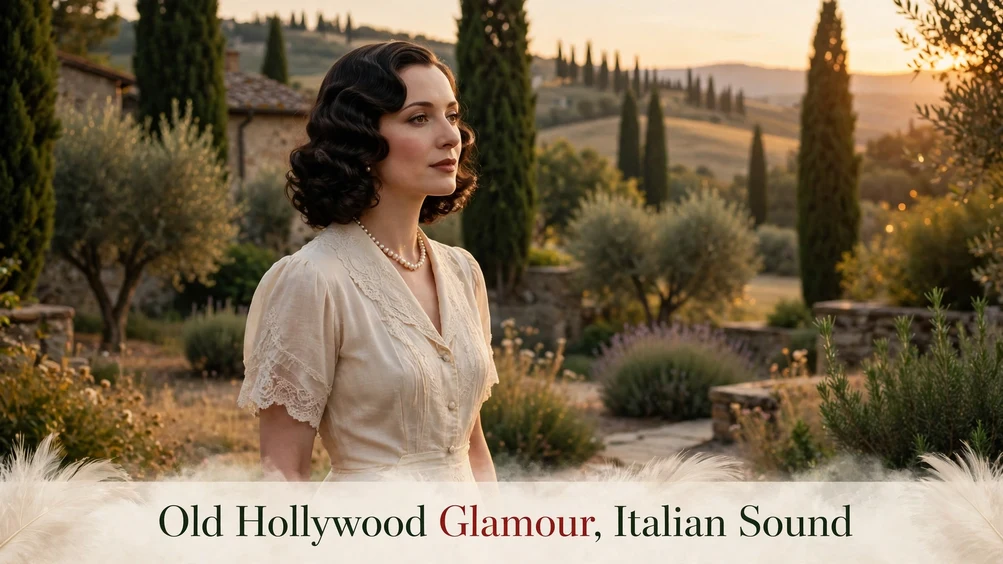
Greta Garbo made the name famous, and no other bearer comes close. Born Greta Lovisa Gustafsson in Stockholm in 1905, she became the most glamorous film star of the 1930s, and her short, sharp name became part of her image. When parents say Greta today, Garbo is still the first association for most of them.
Greta Lovisa Gustafsson of Stockholm
Garbo was born Greta Lovisa Gustafsson in Stockholm on September 18, 1905, and she kept her first name when Hollywood renamed the rest of her. She rose through silent films in Sweden and Germany, then crossed to America, where her face became one of the most photographed in the world. The name Greta, short and northern, suited the screen image perfectly.
“I want to be alone” and the 1930s peak
Garbo moved into talking pictures with Anna Christie in 1930, earned an Oscar nomination for it, and followed with Grand Hotel in 1932 and Camille in 1936. Her line from Grand Hotel, “I want to be alone”, became one of the most quoted lines in film, though she later said her character wanted freedom, not solitude. The name Greta peaked in America in 1932, at the height of her fame.
She retired from the screen in 1941, at only thirty-six, and spent the next fifty years guarding her privacy in New York. The American Film Institute still ranks her among the ten greatest screen legends, and her name never left the public ear. Parents who pick Greta today are borrowing a little of that cool, private glamour.
Gerwig, Scacchi, and Thunberg today
Three modern Gretas keep the name in the news. Greta Gerwig, born in 1983, moved from acting to directing Lady Bird and Little Women, then directed Barbie in 2023, one of the biggest films of the decade. Greta Scacchi, born in 1960, is the Italian-Australian actress of White Mischief and The Player. Greta Thunberg, born in 2003, is the Swedish climate activist whose school strike spread around the world.
The Thunberg link cuts both ways, and parents should weigh it honestly. Some love the name more because of her courage, and some worry the name now points at one famous person before it points at their daughter. The name itself is older than any of its bearers, and it will outlast the news cycle, but the association is real today.
How Italians Say It: GREH-tah
Italians say Greta as GREH-tah, two syllables with the stress on the first. The GREH rhymes with the word grey without the Y sound at the end, and the TAH is open and light, like the TAH in tapas. Say it in two quick beats, lean on the first, and an Italian listener hears the name correctly.
Two syllables, stress on the first
Break the name into GREH and TAH, and give the first syllable the weight. The Italian E is short and open, like the E in bed, and the final A is a clear ah, never swallowed. Both vowels stay bright, which is what gives Greta its crisp sound. Shorten it to one beat, or stretch the second syllable, and the Italian shape disappears.
The English GRAY-tuh trap
English speakers often say GRAY-tuh, with a long A in the first syllable, and that is the English form of the name. Italians still understand it, but it sounds different in Italian mouths, softer and quicker. The trap is the letter E: English reads it as a long A, while Italian reads it short. Keep the E short, and the name sounds Italian at once.
Greta, Grete, and Gretel on paper
The spelling changes with the language, while the sound stays close. German and Scandinavian families also write Grete, and Gretel is the smaller German pet form, the one from the Hansel and Gretel story. Gretchen is another German pet form of Margarete, a sister form rather than a child of Greta. English speakers sometimes write Gretta with two Ts, but the Italian spelling keeps one.
Seventeenth in Italy: Greta’s Quiet Climb
Greta ranked seventeenth among girls born in Italy in 2025, with 1,413 newborn girls given the name. It has held a place in the Italian top twenty recently, so it is a familiar name in Italy, not a rare one, though it sounds uncommon to English ears. In the United States it ranked 908th in 2025, far down the charts.
ISTAT 2025: 1,413 baby Gretas
ISTAT, the Italian statistics institute, released its 2025 baby-name rankings on October 21, 2026, and Greta came in seventeenth for girls, with 1,413 newborn girls given the name. The year before, 1,828 Italian girls were named Greta, so the count fell even as the rank held near the top twenty. Both figures come from ISTAT’s own birth records, quoted in Behind the Name’s user comments.
Greta in the United States
Across the Atlantic the picture flips. Greta ranked 908th for American girls in 2025, with 291 births, and it has drifted down from a 2015 peak of 575th. The name peaked in America long ago, in 1932, at the height of Garbo’s fame, when it reached the 310s. It left the top 1000 for a stretch, returned in 1999, and has stayed a quiet choice since.
A top-twenty name that still feels rare
Greta is one of those names that is common in one country and rare in another. In Italy it sits beside the most given names of the year, while in America it sits outside the top 900. Among Italian girl names starting with G, it is the one most likely to be heard on a playground in Milan and least likely in Minneapolis.
July 20: Greta’s Name Day by Way of Margaret
Greta’s name day in Italy is July 20, borrowed from Saint Margaret of Antioch, whose feast the Roman Martyrology keeps on that date. Greta has no saint of its own, so Italian families mark the day through Margaret, the long form behind it. Sweden agrees: Behind the Name lists July 20 as Greta’s Swedish name day too.
Saint Margaret of Antioch, the dragon and the pearl
Saint Margaret of Antioch, called Marina in the East, was a young Christian woman martyred around 304, during the persecution under the emperor Diocletian. Her legend says a dragon swallowed her and she escaped it with the cross she carried, which is why she is the patron of women in childbirth. She is one of the Fourteen Holy Helpers, and her name is honored in churches from Rome to Montefiascone.
Why July 20, and why Sweden agrees
Margaret’s feast was kept on July 20 for centuries, and it still stands in the Roman Martyrology on that date, even though the feast left the General Roman Calendar in 1969. The Eastern churches honor her as Marina on July 17, a separate date for the same saint, and her shrine at Montefiascone still draws pilgrims near her day.
Behind the Name gives Greta’s name days as July 20 in Sweden, March 13 in Norway, January 12 in Poland, and July 13 in Estonia. The Swedish date matches the Italian one, which is no accident: both come from Margaret’s July 20 feast. A family in Stockholm and a family in Milan can mark the same day for the same reason.
How Italian families mark it
An onomastico in Italy is a small celebration, closer to a birthday than a holiday. Family and friends call or visit, and a cake often appears, with the name as the reason to gather. For a Greta, July 20 is the day to mark, with a nod to Saint Margaret behind it. No competitor page gives this date for Greta, so parents searching for it have guessed until now.
Short Forms and Cousins: Gretel, Grete, and Rita
Greta’s closest cousins are Grete, Gretel, Gretchen, and Rita, all short forms of the same Margaret family. Grete is the Scandinavian twin of Greta, Gretel is the smaller German pet form, Gretchen is a German pet form of Margarete, and Rita is the short form used in Italy and Spain. Margherita, Marguerite, and Margarita are the long forms behind them.
The family table
| Name | Form | Language | Meaning |
|---|---|---|---|
| Greta | Short form | German, Italian | Pearl |
| Margareta | Long form | German, Scandinavian | Pearl |
| Margherita | Long form | Italian | Pearl, daisy |
| Marguerite | Long form | French | Pearl, daisy |
| Margarita | Long form | Latin, Spanish | Pearl |
| Grete | Short form | German, Scandinavian | Pearl |
| Gretel | Pet form | German | Pearl |
| Gretchen | Pet form | German | Pearl |
| Rita | Short form | Italian, Spanish | Pearl |
| Margot | Short form | French | Pearl |
Nicknames Italians actually use
In Italy, Greta is already short, so families rarely shorten it further. Italian parents sometimes add a diminutive ending, -ina or -etta, to a short name, and Greta takes those endings easily. The name stands alone as it is, two syllables and no nickname needed, which is part of its appeal. Parents who want a longer formal name can register Margherita and call her Greta from the first day.
Marguerite and the daisy cousins abroad
Outside Italy the same root wears many spellings. French writes Marguerite, and the short form Margot has become a name in its own right, helped by the actress Margot Robbie. Spanish and Portuguese write Margarita, and English keeps Margaret with its army of nicknames: Meg, Maggie, Peggy, and Maisie. Every one of them means pearl, and every one of them traces back to the same Greek word.
Choosing Greta: A Short Form with a Pearl Inside
Choose Greta if you want a short name with a long history. It fits a family that likes Italian sound without a long Italian name, and it pairs well with most surnames because two syllables leave room for a longer last name. Weigh the fame question: Garbo and Thunberg are strong associations, and parents should be glad to carry them.
The sound test with your surname
Say the full name aloud with your surname and listen for where the sounds meet. Greta ends in an open A, so it flows into surnames that start with a consonant and can blur into surnames that start with a vowel. Try it with a middle name too, and say it quickly, as a teacher calls it in class. If the three names run together cleanly, the sound test passes.
The fame question
Ask whether the famous Gretas feel like a gift or a shadow. Garbo gives the name glamour and privacy, Gerwig gives it warmth and wit, and Thunberg gives it courage and a cause. A child named Greta will hear all three names, and most people will smile at the first two. If those associations feel welcome, the name is yours.
Our guide to Italian girl names with meanings puts Greta beside other names with a clear meaning, so you can see how pearl compares with the meanings behind Sofia, Aurora, and Beatrice before you decide. A meaning you love is easier to carry than one you only like.
The meaning test
Hold the meaning up against the name you will say every day. Pearl is a quiet meaning: it speaks of something small, rare, and formed slowly, and it suits a name that is short and plain on the surface. If that image feels right for your daughter, the meaning test passes. Greta asks for nothing more than to be said clearly and worn simply.
Frequently Asked Questions
How do you pronounce Greta in Italian?
Italians say Greta as GREH-tah, two syllables with the stress on the first. The E is short, like the E in bed, and the final A is an open ah. English speakers often say GRAY-tuh, which is the English form.
Is Greta an Italian name?
Greta is German in origin, a short form of Margareta, but Italian families use it freely and it ranked seventeenth among girls born in Italy in 2025. It is a German name with a strong Italian life, not an originally Italian one.
When is Greta's name day in Italy?
Greta's name day in Italy is July 20, borrowed from Saint Margaret of Antioch, whose feast the Roman Martyrology keeps on that date. Behind the Name also lists July 20 as Greta's name day in Sweden.
How popular is Greta in Italy?
Greta ranked seventeenth among girls born in Italy in 2025, with 1,413 newborn girls given the name. In the United States it ranked 908th in 2025, with 291 births.
Who are the most famous people named Greta?
Greta Garbo (1905-1990), the Swedish film star of Grand Hotel and Camille; Greta Gerwig (born 1983), director of Lady Bird, Little Women, and Barbie; and Greta Thunberg (born 2003), the Swedish climate activist. Greta Scacchi (born 1960) is the Italian-Australian actress of White Mischief.
Conclusion
Greta is a small name with a long road: a Greek pearl, a German short form, an Italian favorite, and a Hollywood legend. It is seventeenth in Italy, quiet in America, and easy to say in both. If you like short names with a clear meaning, Greta is worth a place on your list, and our guide to what Noemi means in Italian covers the next name in this series.


