 Skip to content


What Does Matilde Mean in Italian
Matilde means “mighty in battle” in Italian. It is the Italian form of the Germanic name Matilda, built from maht, meaning might or strength, and hild, meaning battle. Italians say it mah-TEEL-deh, and its name day falls on March 14, the feast of Saint Matilda.
Parents browsing ItalianGirlNames.com meet Matilde near the top of Italian lists, and the name earns its place. A medieval countess carried it into history, it ranks seventh in Italy today, and its sound is soft even though its meaning is fierce. This guide covers the meaning, the pronunciation, the countess, and the name day.
Mighty in Battle: The Meaning Behind Matilde
Matilde means “mighty in battle.” The Germanic roots are maht, might or strength, and hild, battle, so the name describes a person who is strong in war. Italian families kept the meaning intact when the name crossed from Germanic lands into Italy, and it still reads as a promise of courage today.
The two Germanic roots
The first root, maht, meant might or strength in Old High German, and it survives in modern German Macht, power. The second root, hild, meant battle, and it appears in other old names such as Brunhild and Hilda. Put together, the two roots form a single image: strength that shows itself in battle.
From Mahthildis to Matilde
The name entered history as the Germanic Mahthildis, then passed through Latin as Matilda and Old French as Mathilde. Italian dropped the H and kept the softer ending, giving Matilde its present shape. Behind the Name lists Matilde as the Spanish, Portuguese, and Italian form of Matilda, which is how the same name appears in three Romance languages at once.
What “mighty” actually promises
A name that means mighty in battle sets a tone, and parents should weigh that tone. It suits a family that values courage and independence, and it can feel too forceful for parents who want a gentler meaning. The sound softens the message, since the ending lands on a light E, so the name carries its strength without shouting it.
How Italians Say It: mah-TEEL-deh
Italians say Matilde as mah-TEEL-deh, three syllables with the stress on the middle one. The first syllable is a short mah, the middle syllable is a clear TEEL, and the final E is open, like the E in the word the. Say all three syllables evenly and lean on the middle one, and an Italian listener hears the name correctly.
Three syllables, stress on TEEL
Break the name into Ma, til, and de, and give the middle syllable the weight. The Italian IPA is /maˈtilde/, and the mark before til shows where the voice rises. The final E stays open and unhurried, which gives the name its gentle landing. Shorten any syllable and the name loses the rhythm that makes it sound Italian.
The traps English speakers fall into
Nameberry lists the pronunciation as muh-TIL-duh, and MomJunction gives muh-tild with a German audio clip, and neither one teaches the Italian sound. The English versions rush the name into two beats and swallow the final E. The fix is simple: three syllables, stress on TEEL, and an open final E that stays audible.
Matilde, Matilda, and Mathilde on paper
The three spellings sound close, but they point to different traditions. Matilde is the form used in Italy, Spain, and Portugal, Matilda is the English and Latin form, and Mathilde is the French and German form. An Italian birth record will read Matilde, and parents who want the Italian form should spell it with the E and expect the occasional question from English speakers.
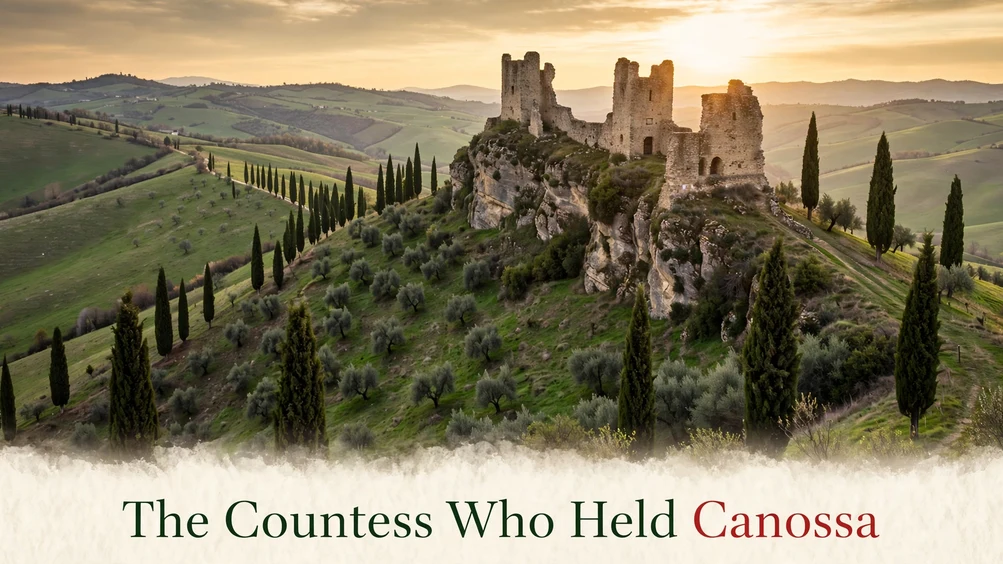
The Great Countess: Matilde di Canossa
Matilde di Canossa, also called Matilda of Tuscany, was the most powerful woman in medieval Italy. She ruled Tuscany from 1055 to 1115, mediated the meeting between Pope Gregory VII and Emperor Henry IV at her castle of Canossa in 1077, and at times led her troops. Her name is the reason Matilde still feels like a ruler’s name today.
Ruler of Tuscany, 1046 to 1115
Matilde was born around 1046, the daughter of Boniface of Canossa and Beatrice of Lorraine, and she inherited lands that covered much of present-day Lombardy, Emilia-Romagna, and Tuscany. She ruled jointly with her mother after her father’s death, then alone from 1076. Her castle at Canossa, in the Apennines southwest of Reggio Emilia, became the center of her domains.
The Walk to Canossa in January 1077
In January 1077, the excommunicated Emperor Henry IV crossed the Alps in bitter winter and waited barefoot in the snow outside Canossa for three days, seeking absolution from Pope Gregory VII. Matilde hosted the pope in her castle and acted as intermediary between the two men, and Gregory received the emperor back into the church.
The scene became known as the Walk to Canossa, and it is one of the most famous episodes of the Middle Ages. Matilde’s name is tied to it in Italian history books, and the castle ruins still draw visitors to the Apennine ridge where it happened.
Why her name still carries weight
Matilde backed the pope with her own armies after 1080, sent part of the Canossa treasure to Rome to fund his cause, and was named Vice-Queen of Italy in 1111. She died on July 24, 1115, and her tomb in St. Peter’s Basilica in Rome, carved by Bernini, shows her holding the keys of St. Peter and a sword. No other Italian girl name carries a single bearer this large.
One Name Day: March 14, Saint Matilda
Matilde’s name day is March 14, the feast of Saint Matilda. Matilda was the wife of Henry I the Fowler, king of Germany, and she died on March 14, 968, at the monastery of Quedlinburg, where she was buried beside her husband. Italian families with a Matilde mark the day as her onomastico, the Italian name-day celebration.
The queen who became a saint
Saint Matilda was born around 895, the daughter of Count Dietrich of Westphalia, and she married Henry the Fowler in 909. She was known for her charity and for founding churches and convents, and she was venerated as a saint immediately after her death. Her feast has been kept on March 14 ever since, the anniversary of her death.
How Italian families mark the onomastico
In Italy, the onomastico is a small family celebration, often a phone call, a cake, or a visit from grandparents, and it falls on the saint’s feast day rather than the birthday. A Matilde born in any month still celebrates on March 14. Parents who like the tradition should know the date before choosing the name, since it becomes a second small birthday.
Matilde in Italy Today: Seventh in the Country, First in Tuscany
Matilde ranked seventh among girl names in Italy for babies born in 2025, according to ISTAT, the Italian statistics institute. It is a top-ten name in Italy and Portugal, and it is the most given girl name in Tuscany. In the United States it is rare, with only 27 girls named Matilde in 2025.
Seventh in Italy for 2025
ISTAT released its 2025 birth-name rankings on October 21, 2026, and Matilde placed seventh for girls, behind Sofia, Aurora, Ginevra, Vittoria, Beatrice, and Giulia. Nameberry also lists Matilde in the top ten for Italy and Portugal. The name has held a strong position for years, which makes it a classic rather than a trend.
First in Tuscany
The ISTAT release also breaks the rankings down by region, and Matilde is the most given girl name in Tuscany. That is no accident: the region is the home of Matilde di Canossa, and her castle and lands shaped its history. Parents in Tuscany who choose Matilde are naming a daughter after the region’s own great countess.
Matilde in the United States
Across the Atlantic, Matilde is a rare choice. The Social Security Administration recorded 27 American girls named Matilde in 2025, ranking the name 4,948th, and its best year was 1883, when it peaked at 639th. The English form Matilda is far more common in the United States, so an American Matilde should expect her name to be read as Matilda at first glance.
Nicknames and Cousins Across Europe
Italians shorten Matilde to Tilde or Mati, and English speakers use Mattie, Tillie, or Tilly. The name has close cousins in nearly every European language, from Mathilde in French to Matylda in Czech and Maud in English. The variant table below shows the main forms, so parents can see which spelling fits their family.
Nicknames Italians actually use
Tilde is the natural Italian short form, made from the second half of the name, and Mati is the quick everyday form. MomJunction also lists Maty, Tidde, and Mity, though those are less common in Italy itself. Parents who want a nickname should pick one early, since family and friends will settle on a short form whether the parents choose one or not.
The variant table
| Form | Language | Note |
|---|---|---|
| Matilde | Italian, Spanish, Portuguese | The form this article covers |
| Matilda | English, Latin | The English form, far more common in the US |
| Mathilde | French, German | The form used in France and Germany |
| Matylda | Czech, Polish | Slavic spelling of the same name |
| Mafalda | Italian | A separate Italian form of the same Germanic root |
| Maud | English | The old vernacular short form, revived in the 1800s |
| Tilda | English, Scandinavian | Short form used as a name in its own right |
The Mafalda question
Behind the Name lists Mafalda as an Italian form of the same Germanic name, alongside Matilde. The two names share the root, but they are not the same name, and Mafalda has its own history in Italy and Portugal. Parents who like the sound of Matilde but want something rarer sometimes consider Mafalda, though it reads as a different name to most Italians.
Famous Matildes, from the Newsroom to the Stage
The best-known Matilde in Italy is Matilde Serao, the journalist and novelist who founded newspapers in Naples. Other bearers include the mathematician Matilde Marcolli and the Olympic ice dancer Matilde Ciccia. Rossini’s opera Matilde di Shabran also carries the name, though its Matilde is a character, not a real person.
Matilde Serao, journalist and novelist
Matilde Serao (1856-1927) was born in Greece to an Italian father and a Greek mother, grew up in Naples, and became one of Italy’s first women journalists. She founded the newspaper Il Mattino with her husband Edoardo Scarfoglio and wrote novels about Neapolitan life. Her career made the name familiar to readers across Italy, and she remains the most cited Italian bearer of the name.
Matilde Marcolli and Matilde Ciccia
In science, Matilde Marcolli is an Italian mathematical physicist who works on the border between mathematics and physics. In sport, Matilde Ciccia is an Italian Olympic ice dancer. The two show the name’s range in modern Italy, from the university to the rink, and both carry the full Matilde spelling in their professional lives.
The opera trap: Matilde di Shabran
Two competitor pages list Matilde di Shabran as a person, one calling her a composer and another an opera singer. She is neither. Matilde di Shabran is the title character of Gioachino Rossini’s opera, which premiered in Rome on February 24, 1821. Readers who meet the name in a cast list should know they are looking at a role, not a singer.
Choosing Matilde: A Warrior Meaning in a Gentle Sound
Choose Matilde if you want a name with a strong meaning and a soft sound, and if you are comfortable with a name that is common in Italy and rare in the United States. Say it with your surname, check the March 14 name day, and weigh the warrior meaning against the gentle three-syllable sound before you decide.
The sound test with your surname
Say the full name out loud several times, with the surname after it, and listen for the rhythm. Matilde’s three syllables pair well with short surnames, and the open final E flows into a surname that starts with a consonant. Long surnames can make the full name feel heavy, so try the nickname Tilde with the surname too, since that is the form family will use every day.
The meaning test
A meaning is the part of a name a child carries longest, and “mighty in battle” is a bold one to give a daughter. Some parents love the courage it promises, and others prefer a quieter meaning. Our guide to Italian girl names with meanings sets Matilde beside other names, so you can compare its warrior meaning with softer ones before you commit.
The rarity question
In Italy, Matilde is a top-ten name, so an Italian Matilde will share her name with classmates. In the United States, it is rare, so an American Matilde will explain her name often and rarely meet another. Neither position is wrong. Pick the name for the sound and the meaning first, and let the popularity in your own country settle the rest.
Frequently Asked Questions
How do you pronounce Matilde in Italian?
Italians say Matilde as mah-TEEL-deh, three syllables with the stress on the middle one. The first syllable is a short mah, the middle syllable is a clear TEEL, and the final E is open.
When is Matilde's name day in Italy?
Matilde's name day is March 14, the feast of Saint Matilda. Matilda was the wife of Henry I the Fowler, king of Germany, and she died on March 14, 968, at the monastery of Quedlinburg.
Is Matilde popular in Italy?
Yes. ISTAT, the Italian statistics institute, ranked Matilde seventh among girl names for babies born in 2025, and it is the most given girl name in Tuscany. In the United States it is rare, with only 27 girls named Matilde in 2025.
What is the difference between Matilde and Matilda?
They share one meaning, mighty in battle, and the difference is only spelling and tradition. Matilde is the form used in Italy, Spain, and Portugal, while Matilda is the English and Latin form and Mathilde is the French and German form.
Who was Matilde di Canossa?
Matilde di Canossa, also called Matilda of Tuscany, ruled Tuscany from 1055 to 1115 and was the most powerful woman in medieval Italy. In January 1077 she hosted Pope Gregory VII at her castle of Canossa, where Emperor Henry IV waited barefoot in the snow for absolution.
Conclusion
Matilde means “mighty in battle,” and it earns that meaning twice over: once in its Germanic roots, and once in the countess of Canossa who carried it into history. It is said mah-TEEL-deh, it celebrates on March 14, and it ranks seventh in Italy and first in Tuscany. For more names in the same letter, see our Italian girl names starting with M. The next name in the series, Greta, means “pearl”: see what Greta means in Italian.


